Supplements for Hot Flashes: What to Compare
Plant-supplement studies offer mixed signals, so a broad menopause claim isn’t proof that a specific product eases hot flashes.
No supplement can be called a dependable “best” choice for hot flashes based on these findings. A red clover trial found no clinically important overall benefit, while a review of many plant products found pooled improvements but noted uneven study quality. If symptoms disrupt sleep or daily life, compare a specific product’s evidence with hormone and nonhormonal treatment options. 1245
Compare the ingredient, not the promise
When hot flashes are affecting your sleep or day, “menopause support” on a bottle doesn’t tell you whether that product has helped with hot flashes in a well-designed study. The more useful questions are whether the ingredient was tested, what changed compared with a placebo, and how closely the studied product matches the one you’re considering.
A 2024 review pooled trials of many plant-derived supplements in perimenopausal and postmenopausal women. It found statistically significant improvements in several menopause questionnaire scores, including hot-flash frequency. But the review combined varied products, and it rated about one-quarter of the studies as low quality. That broad result suggests possible benefit across the group; it doesn’t identify a reliable product or tell you which one is likely to help you. 2
What the results say about familiar ingredients
Red clover: A randomized trial followed 252 recently postmenopausal women with frequent hot flashes for 12 weeks. Average daily hot flashes decreased by about five in each group: 5.1 with one red clover supplement, 5.4 with the other, and 5.0 with placebo. One supplement reduced hot flashes more quickly than placebo, but neither had a clinically important overall effect. The placebo comparison matters: improvement in a supplement group alone doesn’t show that the supplement caused it. 1
Soy-derived supplements: Soy products were among the varied plant supplements in the 2024 review. Its pooled result can’t establish that a particular soy extract or bottle works, because the review combined different products and studies. 2
Black cohosh: Older reviews reached different conclusions. A 2005 review described it as effective for menopausal symptoms, while later reviews characterized evidence for herbal supplements as mixed or inconclusive. Those broad reviews don’t settle whether a particular black cohosh product reduces hot flashes. 345
The red clover trial and the broader plant-supplement review also don’t establish whether supplement outcomes differ for women using hormone therapy. Don’t assume a reported result applies unchanged if you’re taking it. 12
Put supplements beside other care options
Supplements aren’t the only option to discuss. Clinical reviews describe hormone therapy as an effective treatment for hot flashes and also discuss nonhormonal prescription medicines, including certain antidepressants, gabapentin, and clonidine. These options aren’t interchangeable, and whether one fits depends on your health and preferences. The supplement findings don’t directly compare a specific product with these treatments. 45
If you’re considering a supplement, bring its exact label or ingredient list to a clinician or pharmacist. Ask whether hot-flash results exist for that ingredient and formulation, what is known about its safety alongside your current treatments, and what remains uncertain about longer-term use. Reviews describe limitations in supplement safety evidence; a general claim about an ingredient can’t answer those questions for every product. 235
If hot flashes repeatedly interrupt sleep or make daily activities harder, you don’t have to choose between putting up with them and buying a supplement. Ask what hormonal and nonhormonal options fit your circumstances, then weigh any supplement against those options rather than against doing nothing. 45
How to read supplement claims
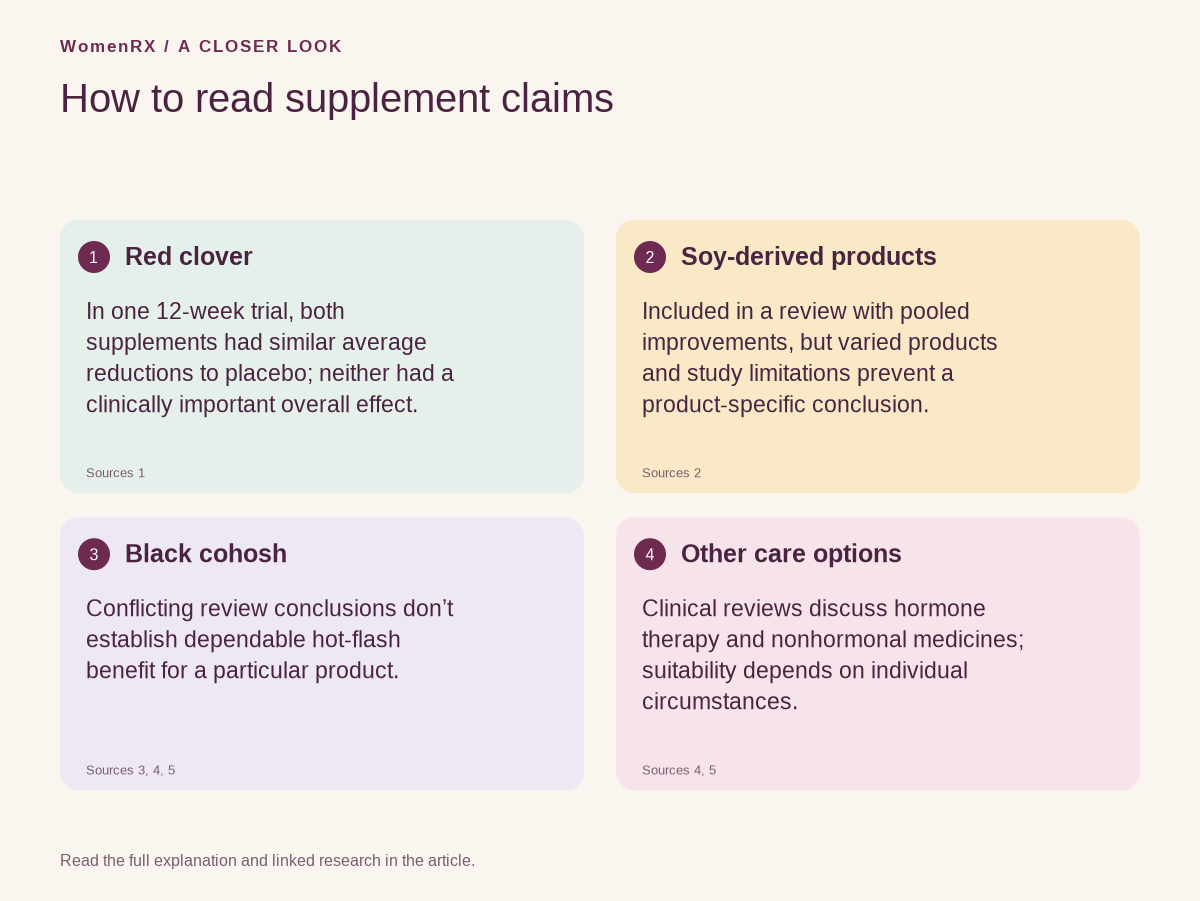
Red clover: In one 12-week trial, both supplements had similar average reductions to placebo; neither had a clinically important overall effect.1
Soy-derived products: Included in a review with pooled improvements, but varied products and study limitations prevent a product-specific conclusion.2
Black cohosh: Conflicting review conclusions don’t establish dependable hot-flash benefit for a particular product.345
Other care options: Clinical reviews discuss hormone therapy and nonhormonal medicines; suitability depends on individual circumstances.45
Read the figure as text
An ingredient-specific trial, a pooled review, and a treatment option answer different questions. None provides a ranking of supplement products.- Red clover: In one 12-week trial, both supplements had similar average reductions to placebo; neither had a clinically important overall effect.1
- Soy-derived products: Included in a review with pooled improvements, but varied products and study limitations prevent a product-specific conclusion.2
- Black cohosh: Conflicting review conclusions don’t establish dependable hot-flash benefit for a particular product.345
- Other care options: Clinical reviews discuss hormone therapy and nonhormonal medicines; suitability depends on individual circumstances.45
More questions, answered
If hot flashes improve while I take a supplement, does that prove it worked?
Not by itself. In the red clover trial, hot flashes decreased in all three groups, including placebo. Comparing the change with placebo helps show whether an ingredient adds a benefit beyond improvement that also happens without it. 1
Sources you can check
- Phytoestrogen supplements for the treatment of hot flashes: the Isoflavone Clover Extract (ICE) Study: a randomized controlled trial.Tice JA, Ettinger B, Ensrud K, Wallace R, Blackwell T, Cummings SR. · JAMA · 2003Return to first citation
- Efficacy of plant-derived dietary supplements in improving overall menopausal symptoms in women: An updated systematic review and meta-analysis.Oh MR, Park JH, Park SK, Park SH. · Phytotherapy research : PTR · 2024Return to first citation
- Botanical and dietary supplements for menopausal symptoms: what works, what does not.Geller SE, Studee L. · Journal of women's health (2002) · 2005Return to first citation
- Treatment strategies for hot flushes.Shen W, Stearns V. · Expert opinion on pharmacotherapy · 2009Return to first citation
- Advances in the treatment of menopausal symptoms.Pinkerton JV, Stovall DW, Kightlinger RS. · Women's health (London, England) · 2009Return to first citation