Do You Need a Greens Powder? Start With the Gap
A greens powder makes more sense as a response to a specific dietary concern than as a shortcut to better nutrition.
You probably don’t need a greens powder just because you sometimes miss a serving of vegetables. Start by naming the nutrient or food gap you’re trying to address, since supplements don’t replace a varied diet.1 If you still want a powder, check what each serving actually provides, look for independently verified quality, and pay particular attention to vitamin K if you take warfarin.21
Name the gap before shopping
“Eat more greens” and “get enough of a particular nutrient” are different goals. If your concern is that vegetables rarely make it onto your plate, a powder doesn’t answer the whole question. Nutritional needs are generally best met through food, while supplements can be useful when a specific need is hard to meet that way.1
If your concern is more precise, make the comparison more precise too. For example, if you’re wondering whether your diet provides enough vitamin K, compare foods you regularly eat with the powder’s stated vitamin K content. Leafy vegetables are a major food source, but vitamin K also comes from other foods, including some oils.1 A long ingredient list alone won’t tell you how much vitamin K, or any other nutrient, a serving contributes.
That distinction helps you choose between three reasonable next moves: change what’s practical about your meals, look for a supplement that clearly supplies the nutrient you’re concerned about, or skip the purchase if you can’t identify a need it would meet. A greens powder doesn’t need to be a default purchase.1
Read the numbers, not just the greens
On a product you’re considering, find the serving size and any stated amounts of vitamins and minerals. Then look at the ingredient list. A familiar ingredient name doesn’t establish that the finished powder supplies a meaningful amount of a nutrient.
Check for added vitamins and minerals separately from the plant ingredients. That matters if you already take another supplement: you want to know what both products contribute, rather than assume the powder contains only dried vegetables. For any nutrient that prompted your search, a product with a clearly stated amount is easier to assess than one that relies on broad claims about its blend.
Quality is a separate question from nutrition. An independent organization may verify aspects of a supplement’s quality or ingredients, but that verification does not establish that the product is safe or effective for you. Labeled ingredients or amounts can also differ from what a supplement contains.2 If contaminant testing is a priority, ask what was tested in the finished product, whether testing applies to the batch you would buy, and whether the company will share the results. Don’t read a general quality claim as an answer to those questions.
One medication check is especially concrete
Vitamin K helps the body make proteins involved in blood clotting. Warfarin works against vitamin K’s action, so people taking warfarin need to keep their vitamin K intake consistent across food and supplements. Suddenly adding or removing a powder that supplies vitamin K could change that consistency.1 If you take warfarin, find out whether the product provides vitamin K and discuss the proposed change with the clinician managing your anticoagulation before making it. The goal isn’t to avoid vegetables; it’s to avoid an unplanned change in intake.1
Other herbs require ingredient-by-ingredient attention rather than a blanket claim that all greens powders interact with medicines. For example, LactMed reports that fenugreek, an herb used in some supplement mixtures, can interact with warfarin. That finding is about fenugreek, not every greens powder.4
Review every ingredient during pregnancy or breastfeeding
Pregnancy can change micronutrient needs, but that’s a reason to identify what needs to be supplied, not a reason to buy a greens powder. Supplements cannot replace adequate nutrition during pregnancy, and a review of pregnancy supplementation emphasizes planning intake around particular nutrients rather than assuming a multi-ingredient product meets every need.3
If you’re pregnant or breastfeeding, check the entire ingredient list, including added herbs, before considering a powder alongside supplements you already use. Safety information for an individual herb doesn’t automatically establish the safety of a mixture. LactMed notes limited safety information for fenugreek in nursing mothers and infants and advises avoiding dong quai during breastfeeding; those cautions matter if a product contains those ingredients, not because every greens powder does.42
A useful final test is simple: can you say what this product would add to your diet, in an amount the label makes clear? If not, the attractive list of plants isn’t yet a reason to make it a daily habit.
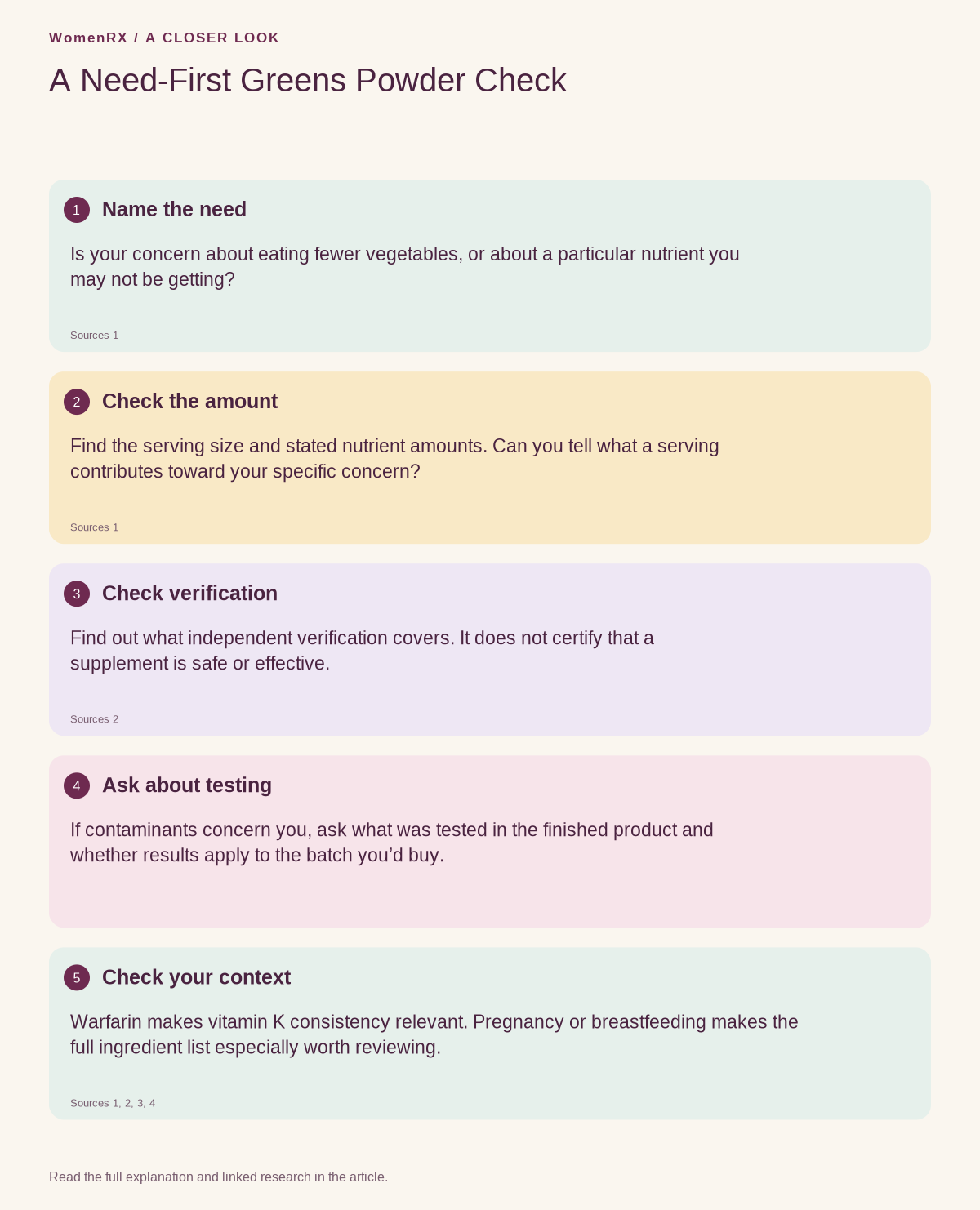
A Need-First Greens Powder Check
Name the need: Is your concern about eating fewer vegetables, or about a particular nutrient you may not be getting?1
Check the amount: Find the serving size and stated nutrient amounts. Can you tell what a serving contributes toward your specific concern?1
Check verification: Find out what independent verification covers. It does not certify that a supplement is safe or effective.2
Ask about testing: If contaminants concern you, ask what was tested in the finished product and whether results apply to the batch you’d buy.
Check your context: Warfarin makes vitamin K consistency relevant. Pregnancy or breastfeeding makes the full ingredient list especially worth reviewing.1234
Read the figure as text
Follow these questions in order; a product is easier to judge when you know what you expect it to provide.- Name the need: Is your concern about eating fewer vegetables, or about a particular nutrient you may not be getting?1
- Check the amount: Find the serving size and stated nutrient amounts. Can you tell what a serving contributes toward your specific concern?1
- Check verification: Find out what independent verification covers. It does not certify that a supplement is safe or effective.2
- Ask about testing: If contaminants concern you, ask what was tested in the finished product and whether results apply to the batch you’d buy.
- Check your context: Warfarin makes vitamin K consistency relevant. Pregnancy or breastfeeding makes the full ingredient list especially worth reviewing.1234
More questions, answered
Does third-party verification mean a greens powder works?
No. Independent verification may address a product’s quality or ingredients, but it does not certify safety or effectiveness.2 Check what a particular verification covers instead of treating its seal as proof of a health benefit.
Sources you can check
- Vitamin K - Health Professional Fact SheetAccessed 2026-09-25Return to first citation
- Dong Quai2006Return to first citation
- Optimisation of Micronutrient Supplementation During Pregnancy: Interactions Between Bioactive Compounds, Their Impact on Health, and Regulatory Considerations.Makó RA, Sipos P. · Biomolecules · 2026Return to first citation
- Fenugreek2006Return to first citation