Greens Powder: Does It Fill a Real Nutrition Gap?
A greens powder is only useful for a specific shortfall if its label shows a meaningful amount of the nutrient you need.
Sometimes, but a long list of grasses, algae, and botanicals doesn’t tell you how much of a particular nutrient a serving provides. Start with the serving size, then look for named nutrients and their amounts. Compare those with your food, prenatal or multivitamin, and actual needs. A small study of one greens product measured short-term blood markers, not whether greens powders correct deficiencies or replace vegetables. 5
Start with the gap, not the ingredient list
A greens powder may contain many plant ingredients and still be a poor way to address a particular nutrition shortfall. The useful question isn’t how many ingredients are pictured on the tub. It’s whether a serving provides a known amount of the nutrient you’re trying to get more of, and whether you need it.
One study tested a particular commercial product in 10 healthy people for four weeks and measured antioxidant-related blood markers. It did not establish that greens powders correct nutrient deficiencies, improve health outcomes, or stand in for vegetables. That result also can’t tell you what another product contains or does. 5
A label-reading check that starts with the serving
1. Check the serving size. Note how much powder counts as one serving, and compare nutrient amounts on that basis. If you usually use less than the listed serving, you’re getting less than the stated amounts. Don’t compare tubs by scoop size or ingredient count alone.
2. Find named nutrients and their amounts. Look for individual nutrients with an amount per serving, rather than assuming that a list of greens means the powder is rich in vitamins or minerals. Check whether vitamins or minerals have been added to the powder, and count their stated amounts too. A daily value can help compare the amount with other products, but it doesn’t tell you whether that nutrient is the one you need. 1 2
3. Separate measured nutrients from blends. If a label groups ingredients into a blend without giving each ingredient’s amount, you can’t calculate how much of a particular nutrient comes from each one. Treat a blend’s impressive-sounding ingredient list as a list, not as proof of a useful nutrient dose.
4. Check for overlap. Add the product’s named nutrients to what you already get from a multivitamin, prenatal supplement, or other products. More products can mean duplication rather than a better match for your needs. Nutritional needs are generally best met through food and fortified foods, with supplements used when a specific need can’t be met that way. 2
5. Ask a separate quality question. Nutrient amounts and product quality are different questions. An ingredient list doesn’t establish that a product has been independently tested for contaminants or that a particular batch passed testing. If you’re considering a product, ask the manufacturer whether independent testing is available for the specific product and batch, and what it covers. A testing claim alone isn’t a guarantee of purity.
“Greens” doesn’t tell you which nutrient you’re getting
Plant ingredients aren’t interchangeable. For example, leafy greens are a food source of vitamin K, but the amount of vitamin K in a powder can’t be inferred from the words “greens” or “superfoods.” You need a stated nutrient amount to compare it with your other sources. If you take warfarin, sudden changes in vitamin K intake from food or supplements can affect the medication’s action, so consistency matters. 2
Iodine is another example of why an ingredient list can mislead. Most fruits and vegetables are poor iodine sources, and the amount in seaweed varies widely. A product that lists kelp or another seaweed without a stated iodine amount doesn’t tell you how much iodine you’ll get. Some, but not all, prenatal supplements contain iodine, so check the actual label rather than assuming. 1
Pregnancy or breastfeeding calls for a closer comparison
During pregnancy, iodine recommendations increase, and some U.S. pregnant women may have inadequate intake. During breastfeeding, the recommended intake is also higher than for adults who aren’t pregnant or lactating. Those are reasons to check the specific nutrient amounts in a greens powder alongside your prenatal or other supplements, not reasons to assume that a greens blend covers the need. 1
If you’re pregnant, trying to conceive, or breastfeeding, put the powder’s full label next to your prenatal and other supplement labels. Check for repeated nutrients, particularly iodine, and flag amounts that look high rather than assuming a bigger number is better. Some iodine supplements contain amounts above the tolerable upper intake level, though that finding doesn’t tell us the iodine content of any particular greens powder. Also check whether a blend includes botanicals. If the product includes a blend whose individual ingredient amounts aren’t given, bring the full label to your prenatal care team for individualized advice. Preconception guidance supports discussing supplement use and notes that more research is needed on supplement efficacy and safety. 1 4
Check whether the powder supplies the missing nutrient
Write down the shortfall you’re trying to address, such as a nutrient your clinician has identified or one you’re unsure you’re getting enough of. Then check whether the powder names that nutrient and gives an amount per serving. If it doesn’t, you can’t use its ingredient list to confirm that it addresses the gap. If it does, compare the amount with your other supplements and food sources, and consider whether a more direct food or supplement option fits the need better.
If you can’t identify a specific shortfall, a greens powder may simply add another product to your routine. It shouldn’t be treated as a vegetable replacement or as proof that you’re meeting your nutrition needs. A varied eating pattern remains the foundation; supplements can fill a defined gap when food alone isn’t enough. 2 3
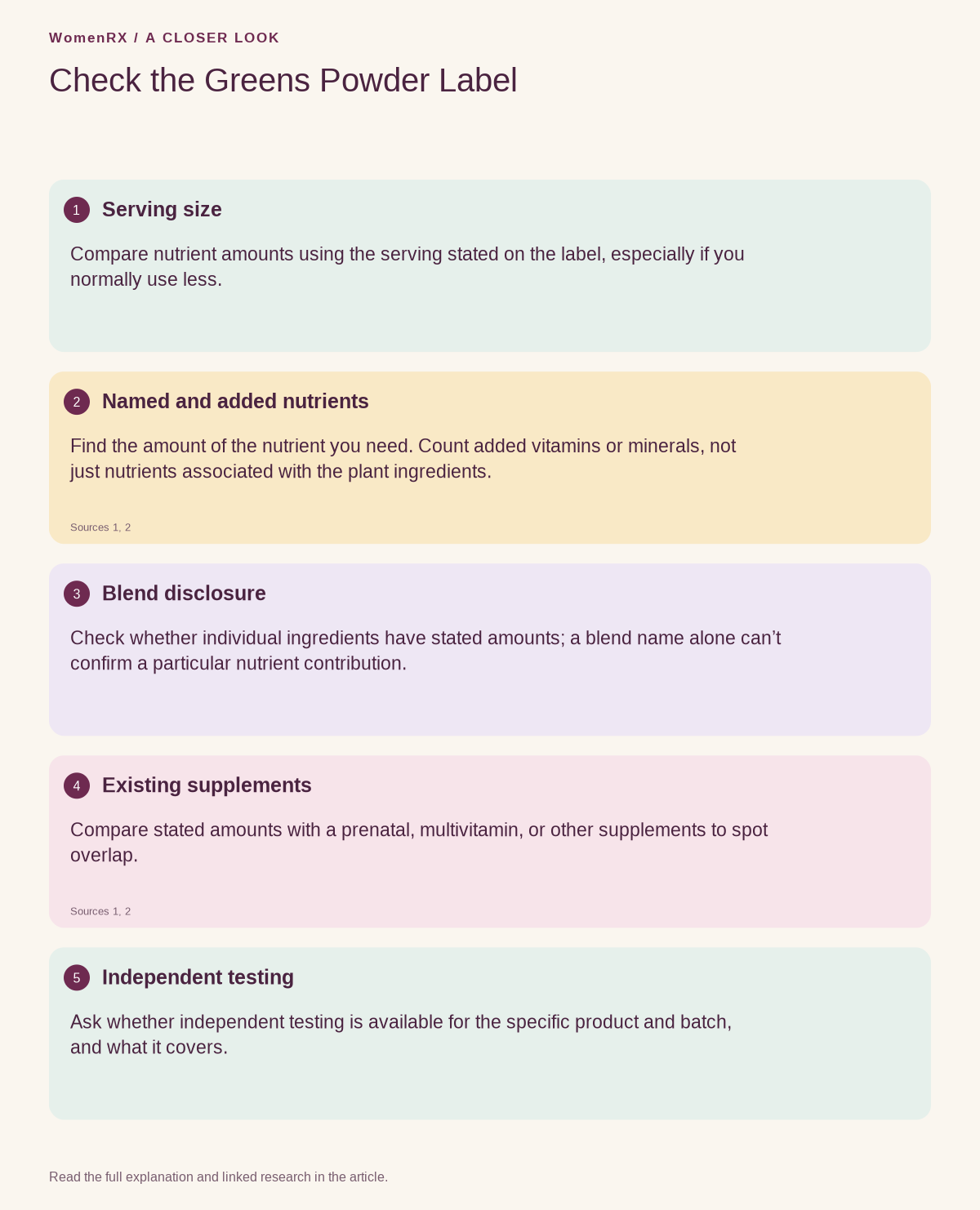
Check the Greens Powder Label
Serving size: Compare nutrient amounts using the serving stated on the label, especially if you normally use less.
Named and added nutrients: Find the amount of the nutrient you need. Count added vitamins or minerals, not just nutrients associated with the plant ingredients.12
Blend disclosure: Check whether individual ingredients have stated amounts; a blend name alone can’t confirm a particular nutrient contribution.
Existing supplements: Compare stated amounts with a prenatal, multivitamin, or other supplements to spot overlap.12
Independent testing: Ask whether independent testing is available for the specific product and batch, and what it covers.
Read the figure as text
Use these checks to see whether a serving addresses a specific nutrient need or mainly adds an ingredient list.- Serving size: Compare nutrient amounts using the serving stated on the label, especially if you normally use less.
- Named and added nutrients: Find the amount of the nutrient you need. Count added vitamins or minerals, not just nutrients associated with the plant ingredients.12
- Blend disclosure: Check whether individual ingredients have stated amounts; a blend name alone can’t confirm a particular nutrient contribution.
- Existing supplements: Compare stated amounts with a prenatal, multivitamin, or other supplements to spot overlap.12
- Independent testing: Ask whether independent testing is available for the specific product and batch, and what it covers.
More questions, answered
Can a greens powder replace vegetables?
Don’t assume it can. A list of plant ingredients doesn’t show that a powder provides the nutrients or amounts you get from vegetables, and the small study of one product did not test whether it could replace them. 5
Does a greens powder provide iodine?
Not necessarily. Most fruits and vegetables are poor iodine sources, and seaweed iodine content varies widely. Look for a stated iodine amount rather than relying on a kelp or seaweed ingredient name. 1
Sources you can check
- Iodine - Health Professional Fact SheetAccessed 2026-09-25Return to first citation
- Vitamin K - Health Professional Fact SheetAccessed 2026-09-25Return to first citation
- Nutrition: MedlinePlusAccessed 2026-09-25Return to first citation
- The clinical content of preconception care: nutrition and dietary supplements.Gardiner PM, Nelson L, Shellhaas CS, Dunlop AL, Long R, Andrist S, Jack BW. · American journal of obstetrics and gynecology · 2008Return to first citation
- In vitro and in vivo antioxidant properties of the plant-based supplement greens+™.Rao V, Balachandran B, Shen H, Logan A, Rao L. · International journal of molecular sciences · 2011Return to first citation