Greens Powders: How to Check Ingredients, Evidence, and Product Quality
No benefit timeline can be inferred from a greens powder’s ingredient list. Its label can help you check declared nutrient amounts, but cannot show whether or when it will address your dietary gap.
Ingredient amounts cannot establish when a greens powder will produce a benefit. To judge a particular powder, start with the dietary gap you’re trying to address, then check ingredient amounts per serving and overlap with other supplements. A label or quality seal cannot establish a health benefit or when one might occur. If you’re pregnant or planning pregnancy, review the full ingredient list with your prenatal care team. 1 If you take medicine, share the label with your pharmacist or prescriber. 3 Include breastfeeding in a product-specific review too.
How long does a greens powder take to work?
Ingredient amounts cannot establish when a greens powder will produce a benefit. A serving may supply listed nutrients, but an ingredient amount does not show whether or when the finished powder will correct your dietary gap or produce a noticeable change. What matters is the specific product, the gap you want to address and the outcome you expect.
Begin with the gap, not the greens
Before comparing tubs, name the specific gap you’re trying to address. Is there a nutrient you’ve been told you’re low in, or are you hoping the powder will make up for a broader eating pattern? Those are different questions. A product listing several plant ingredients doesn’t tell you whether it provides a useful amount of a nutrient you need.
A dietary supplement can contain vitamins, minerals, herbs, botanicals, or other ingredients. That broad category doesn’t establish that a particular combination has been shown to produce a particular health outcome. 3 Evidence for one supplement or use cannot be assumed to apply to another. An athlete-focused review found that evidence differed across the supplements and uses it assessed. 2
If you can’t name the gap, pause before buying. A label audit is more useful when you know what you’re looking for.
Read the serving before the ingredient list
Find the serving size first. Then check how many servings are in the container and how much of each listed ingredient comes in one serving. If the label gives a percent Daily Value, read it alongside the amount and serving size, not as a promise that the product is right for you. This helps you compare what’s printed on the label with the gap you’re trying to address.
Next, compare that list with any multivitamin, prenatal vitamin, single-nutrient supplement, or fortified product you already use. The goal is to spot overlap, not to add up numbers blindly: your needs depend on your circumstances, and a long ingredient list doesn’t tell you what you personally need.
A “proprietary blend” can make that comparison harder if it gives a combined amount without showing how much of each ingredient is included. If you can’t tell the amount of the ingredient you’re considering, you can’t meaningfully compare it with another product or judge whether it addresses your stated gap.
Separate the ingredient facts from the health promise
A label can tell you what a company says is in a product and what claims it makes. Those are not the same as evidence that the finished blend prevents or treats a condition. A health claim on a supplement label is not proof of a clinical benefit. For example, most fish-oil products with health claims in a US label study used structure/function claims, despite a lack of trial data showing cardiovascular benefit for supplement-range doses. That finding concerns fish oil, not greens powders. 4
For a greens powder, ask: Is there human research on this finished blend for the outcome being advertised, or only information about individual ingredients? Does the study population and outcome match the promise? Evidence for one ingredient, or for a different formulation, doesn’t automatically establish the same result for the powder in your hand. Quality risks reported for multi-ingredient supplements in an athlete-focused review are not a risk estimate for greens powders. 2
Check what a quality seal can and can’t tell you
Look for a named, independent certification program and verify the product or batch in that program’s current records when available. Don’t rely on a seal image alone. In the athlete-focused supplement setting, third-party certification can reduce but not eliminate contamination risk. Batch coverage can be limited, logos can be misused, and supply chains can change. Check the coverage of the powder you’re considering; those athlete-focused findings do not establish its risk level. 2
Quality checks and clinical evidence answer different questions. Testing or certification may offer information about product quality within its stated scope; it does not, by itself, establish that the powder delivers an advertised health outcome. Dietary supplements in the United States also don’t require FDA approval before marketing or proof of efficacy and safety before they’re sold. 3
Make life stage and medicines part of the audit
If you’re pregnant or trying to become pregnant, don’t assume a general greens powder can replace a prenatal vitamin. Pregnancy guidance cautions that herbs and supplements may harm a developing fetus, and notes that regular vitamins may contain too much or too little of what’s needed in pregnancy. Bring the complete ingredient list to prenatal care rather than judging the product by its “greens” name. 1
If you’re breastfeeding, include that in the review too. The ingredients matter, and a product designed for general use isn’t automatically suitable for every life stage. Pregnancy guidance does not establish breastfeeding safety for a greens powder. Neither a pregnancy label nor a general quality seal establishes it either.
If you take prescription medicines, show a pharmacist or prescriber the full label, including amounts and blend details. Supplement use alongside prescription medicines can raise interaction concerns. Whether a particular greens powder poses one depends on its ingredients and your medicines; no specific greens-powder interaction is identified here. 3 Don’t stop or change a prescribed medicine to make room for a supplement.
A simple decision rule
A powder is easier to assess when you can identify the gap it’s meant to address, see the amount of each relevant ingredient, account for overlap, find verifiable quality documentation, and distinguish product-specific evidence from marketing language. If one of those pieces is missing, you may not have enough information to decide that this product is a useful fit. You can choose not to buy it, or take the label to someone who can help assess the specific need and ingredients.
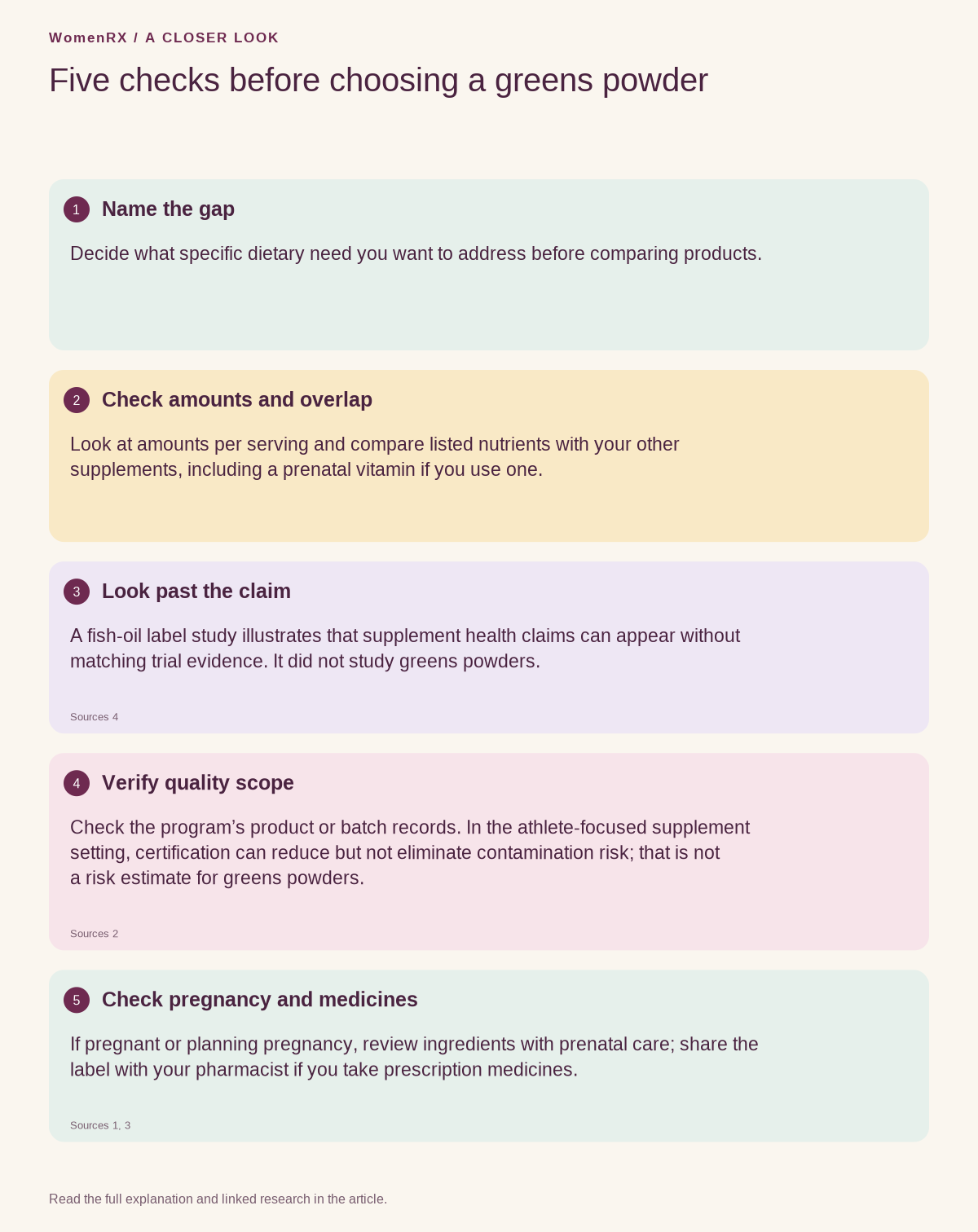
Five checks before choosing a greens powder
Name the gap: Decide what specific dietary need you want to address before comparing products.
Check amounts and overlap: Look at amounts per serving and compare listed nutrients with your other supplements, including a prenatal vitamin if you use one.
Look past the claim: A fish-oil label study illustrates that supplement health claims can appear without matching trial evidence. It did not study greens powders.4
Verify quality scope: Check the program’s product or batch records. In the athlete-focused supplement setting, certification can reduce but not eliminate contamination risk; that is not a risk estimate for greens powders.2
Check pregnancy and medicines: If pregnant or planning pregnancy, review ingredients with prenatal care; share the label with your pharmacist if you take prescription medicines.13
Read the figure as text
A greens powder’s listed ingredients cannot establish when it will produce a benefit. Use these checks to separate nutrient amounts from product quality and evidence of a health benefit.- Name the gap: Decide what specific dietary need you want to address before comparing products.
- Check amounts and overlap: Look at amounts per serving and compare listed nutrients with your other supplements, including a prenatal vitamin if you use one.
- Look past the claim: A fish-oil label study illustrates that supplement health claims can appear without matching trial evidence. It did not study greens powders.4
- Verify quality scope: Check the program’s product or batch records. In the athlete-focused supplement setting, certification can reduce but not eliminate contamination risk; that is not a risk estimate for greens powders.2
- Check pregnancy and medicines: If pregnant or planning pregnancy, review ingredients with prenatal care; share the label with your pharmacist if you take prescription medicines.13
More questions, answered
Does a third-party seal mean the powder works?
No. A seal doesn’t establish that a greens powder produces a particular health outcome. An athlete-focused supplement review describes certification as a way to reduce, not eliminate, contamination risk in that setting. Check what the certification covers, then look separately for evidence on the finished product and the benefit being advertised. 2
Can a greens powder replace a prenatal vitamin?
Don’t assume it can. Pregnancy guidance says regular vitamins may contain too much or too little of what’s needed during pregnancy, and that herbs and supplements may harm a developing fetus. Review the full ingredient list with your prenatal care team. 1
Sources you can check
- Pregnancy and Medicines | MedlinePlusAccessed 2026-09-25Return to first citation
- Reducing the Risk of Unintentional Doping From Supplements: A Practical Guide for Athletes and Support Teams.Mancin L, Close GL, Jeukendrup A, Freschi M, Pugh J, Sala M, Baioccato V, Vecchiato M, D'Antona G, Palermi S. · Translational sports medicine · 2026Return to first citation
- Knowledge Gaps and Educational Interventions in Dietary Supplement Regulations Among Resident Physicians.Azar L, Neola M, Tran J, Budd S. · Cureus · 2025Return to first citation
- Health Claims and Doses of Fish Oil Supplements in the US.Assadourian JN, Peterson ED, McDonald SA, Gupta A, Navar AM. · JAMA cardiology · 2023Return to first citation