Greens Powders: What’s in the Scoop?
A greens powder can contain vegetables, added vitamins, herbs, and probiotics, but its name won’t tell you how much of each you’re getting.
Compare greens powders by the labeled serving, not the number of ingredients on the front. One formula lists measured vitamins alongside blends whose individual ingredient amounts aren’t shown; another lists greens and fruit ingredients while claiming its scoop equals two produce servings. Those are different kinds of information, and neither establishes that a powder can replace vegetables in your diet. 34
Start with the serving, not the ingredient count
“Greens powder” describes a product style, not a fixed recipe. For example, Huel Daily Greens lists an 8.5-gram serving with added vitamins and minerals, plant ingredients, and a probiotic. Field of Greens lists ingredients including kale, broccoli, berries, spirulina, and matcha. Its product page also describes several blends, but the ingredient list alone doesn’t tell you the amount of each plant in a scoop. 34
To compare two products, find the serving size on each label first. Then look at what that serving actually reports. Huel lists 1 gram of fiber and less than 1 gram of protein per serving, along with individual amounts for many added nutrients. Its “Organic Antioxidant Greens Blend” has a stated total weight of 1,049 milligrams, but that figure does not tell you how much of each ingredient is in the blend. A long ingredient list may be interesting; it isn’t the same as a measured contribution from every ingredient. 3
Separate measured nutrition from produce claims
A label can give you useful, narrow answers: how much fiber is declared per serving, whether a vitamin has an amount listed, or whether an ingredient you avoid appears in the formula. It cannot, by itself, show that the powder has the same nutritional value or effect as eating vegetables. Huel describes its powder as a supplement rather than a meal and says its formula puts less emphasis on protein, fat, carbohydrates, and fiber. Field of Greens markets a scoop as “two full servings” of fruits and vegetables, but its product page does not establish that equivalence through a side-by-side nutrient comparison with produce. 34
That distinction matters on an ordinary busy day. If you’re choosing between adding a powder to breakfast and eating vegetables later, you don’t need to treat the scoop as a debt paid or a vegetable serving accounted for. You can judge it by the nutrients its own label declares while keeping produce as a separate part of what you eat.
The same rule applies to benefit claims. Field of Greens describes a 30-day trial and changes in cellular markers. A seller’s description of those results does not demonstrate that greens powders as a category prevent deficiencies, improve how you feel, or replace fruits and vegetables. 4
Check added nutrients against your own situation
Some powders are closer to a multivitamin with plant ingredients than to dried vegetables alone. Huel’s listed serving includes added vitamin A, vitamin D, folate, iron, and vitamin K, each with its own amount. Before adding a powder, compare those amounts with any other supplements you already use rather than assuming more ingredients fill a gap you have. 3
Life stage changes the question, but it doesn’t create a universal need for greens powder. If you’re pregnant or planning pregnancy, don’t use a general wellness claim or a percent Daily Value as proof that a formula meets your specific nutrient needs. Check the listed nutrients and amounts in the context of your existing food and supplements. Huel, for example, lists vitamin A as retinol acetate and folate as l-methylfolate calcium; those are details to notice, not proof that this product is appropriate for every life stage. 3
Ingredients can also matter because of medicines. Vitamin K is a specific concern with warfarin: changes in vitamin K intake can affect anticoagulation. Huel lists 126 micrograms of vitamin K per serving, so someone taking warfarin should check that figure before making the powder a regular addition. 13 Don’t assume every green-colored ingredient has the same interaction. If a formula contains green tea extract, that’s a different label detail to investigate: NCCIH reports interactions between green tea products and some medicines, including reduced blood levels of atorvastatin with green tea extract and an interaction with raloxifene. A listing for matcha alone does not establish that it has the same effects as a studied extract. 24
Make the label earn its place in your routine
A useful final question is: What am I buying this to add? If the answer is a particular nutrient, look for its amount per serving and compare it with what you already take. If the answer is vegetables, an ingredient list or a produce-equivalence slogan doesn’t give you enough information to count the scoop as a replacement. And if the appeal is a broad promise such as better energy, keep that promise separate from the measurable facts on the label. 34
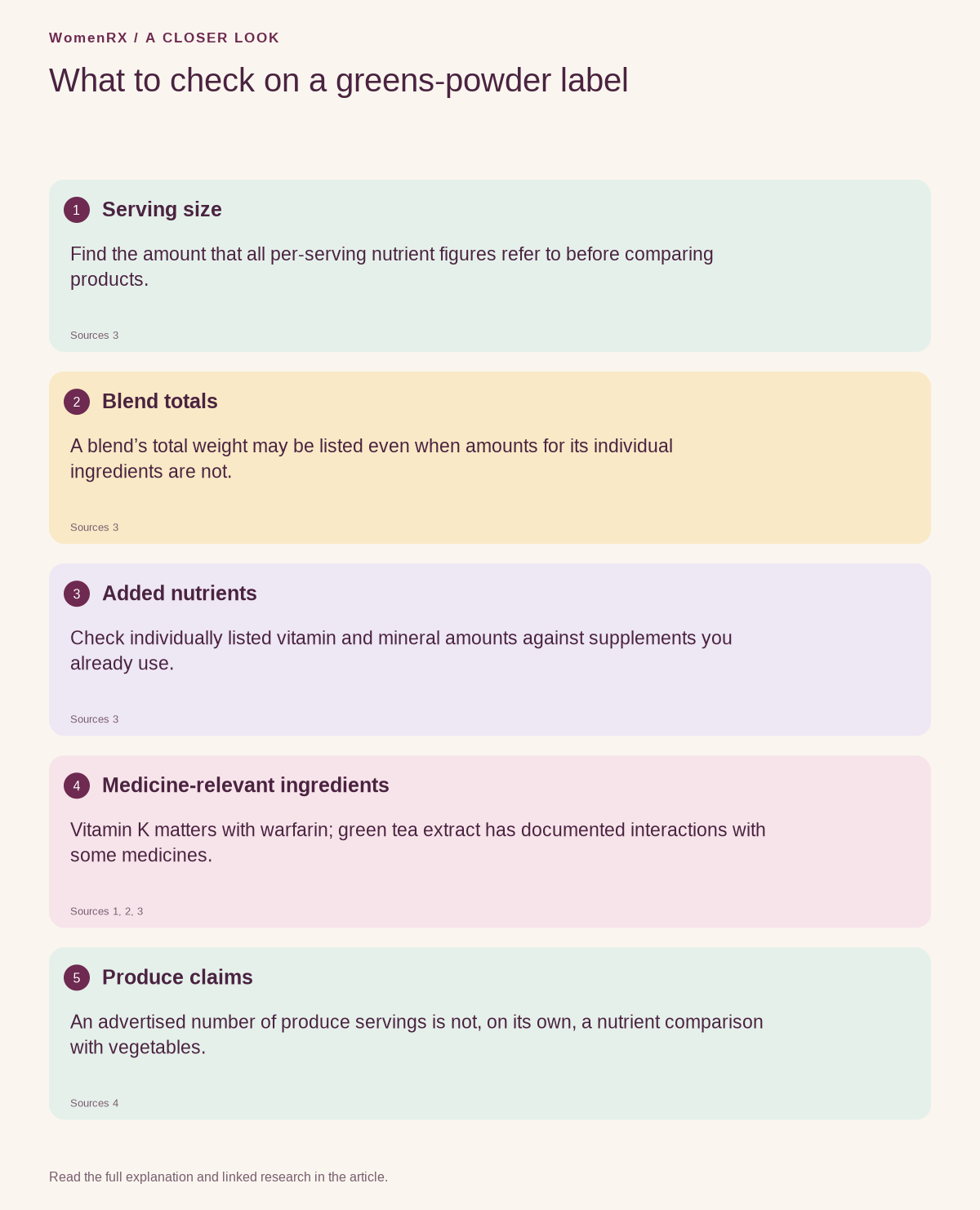
What to check on a greens-powder label
Serving size: Find the amount that all per-serving nutrient figures refer to before comparing products.3
Blend totals: A blend’s total weight may be listed even when amounts for its individual ingredients are not.3
Added nutrients: Check individually listed vitamin and mineral amounts against supplements you already use.3
Medicine-relevant ingredients: Vitamin K matters with warfarin; green tea extract has documented interactions with some medicines.123
Produce claims: An advertised number of produce servings is not, on its own, a nutrient comparison with vegetables.4
Read the figure as text
Read each line for a different answer; an ingredient name, a nutrient amount, and a benefit claim are not interchangeable.- Serving size: Find the amount that all per-serving nutrient figures refer to before comparing products.3
- Blend totals: A blend’s total weight may be listed even when amounts for its individual ingredients are not.3
- Added nutrients: Check individually listed vitamin and mineral amounts against supplements you already use.3
- Medicine-relevant ingredients: Vitamin K matters with warfarin; green tea extract has documented interactions with some medicines.123
- Produce claims: An advertised number of produce servings is not, on its own, a nutrient comparison with vegetables.4
More questions, answered
Does a longer greens-powder ingredient list mean more nutrition?
Not necessarily. A list tells you what’s included, while the serving information tells you which nutrient amounts are declared. A stated total for a blend does not reveal the amount of each ingredient within it. 3
Does a Nutrition Facts label prove a powder replaces vegetables?
No. Field of Greens points to its Nutrition Facts label while also making a produce-serving claim. The label type alone does not establish that a scoop is nutritionally equivalent to the fruits and vegetables it names. 4
Sources you can check
- [A Systematic Review of the Acceptable Intake Level of Vitamin K among Warfarin Users].Sato Y, Murata M, Chiba T, Umegaki K. · Shokuhin eiseigaku zasshi. Journal of the Food Hygienic Society of Japan · 2015Return to first citation
- Green Tea: Usefulness and Safety | NCCIHAccessed 2026-09-25Return to first citation
- The Huel Daily Greens Formula Explained | Huel USAccessed 2026-09-26Return to first citation
- Field of Greens | Best Greens Powder: Clinically Proven, Doctor FormulatedAccessed 2026-09-26Return to first citation