Greens Powders: How to Judge a Serving
The useful number isn’t scoops per day. It’s what one scoop of your particular powder contains.
There’s no single daily serving that fits every greens powder. Start with the serving shown on the product’s label, then check the amounts of nutrients you’d actually want to add. One product lists substantial amounts of several vitamins but only 1 gram of fiber per scoop, so its nutrient panel tells you more than its vegetable imagery does.7 If you take warfarin, check vitamin K before making it a daily habit.2 In pregnancy, check vitamin overlap and botanical ingredients; while breastfeeding, pay particular attention to caffeine. 96
Start with the scoop, then read past it
A scoop tells you how much powder the maker considers a serving. It doesn’t tell you whether that serving fills a gap in your diet. For example, Huel Daily Greens lists an 8.5-gram scoop containing 1 gram of fiber, less than 1 gram of protein, and separately listed amounts of vitamins A, C, D, and K. Those numbers give you something concrete to compare with the rest of what you eat or take. They don’t show that the powder improves health or replaces vegetables.7
Another manufacturer tells customers to mix one scoop of its greens powder daily, while advertising it as the equivalent of two servings of fruits and vegetables. Treat that vegetable-equivalence statement as a marketing claim, not a way to calculate what your body is getting. Look for disclosed nutrient amounts instead.8
Check what’s measured and what’s bundled
Read the amounts per serving, not just the list of plants on the front. A powder with added vitamins may contribute measurable amounts of those vitamins. If you also take a multivitamin, put the labels side by side so you can see which nutrients appear in both.
Then look for blends. Huel’s formula page, for instance, gives a total weight for an “Organic Antioxidant Greens Blend” and another for a “Plant-Based Protein & Superfood Blend.” A blend total tells you the combined weight, not how much of each listed plant is in your scoop. That limits what you can conclude about any one ingredient.7 If the ingredient you care about has no individual amount, don’t guess it from its position in a long list.
Ingredients can matter more than the word “greens”
If you take warfarin, check whether the powder supplies vitamin K. People taking warfarin need a consistent vitamin K intake from foods and supplements because sudden changes can alter the medicine’s effect. That’s a reason to review a new daily powder with the clinician or pharmacist managing your warfarin, rather than quietly adding or stopping it.2
Also scan for green tea or green tea extract. Green tea contains caffeine, and NCCIH reports interactions between green tea products and certain medicines, including nadolol, atorvastatin, and raloxifene. Reports of liver injury have primarily involved green tea extracts in tablets or capsules. These findings don’t establish the effect of an unspecified amount in a greens powder; they do make the ingredient worth checking if you take one of those medicines or have concerns about concentrated extracts.6
During pregnancy, the type and amount of added vitamins matter. Excess preformed vitamin A can cause birth defects; beta-carotene is a different form and does not carry that same pregnancy risk. Compare the powder with your prenatal before adding them together. Many botanical ingredients also lack adequate pregnancy safety research, and a mixture of extracts is harder to assess than a single defined ingredient. That is why the full label deserves a review with your pregnancy care team. 9
While breastfeeding, check caffeine separately. Green tea contains caffeine, which can pass into breast milk; high intake may leave an infant fussy or sleeping poorly. A powder's total scoop weight does not tell you its caffeine content. 6
Ask what a testing claim actually covers
A label may say “third-party tested.” That’s a useful prompt for a follow-up question: Tested for which contaminants, if any, by whom, and for which product? Supplement-quality testing can address ingredient identity, composition, and contaminants. It cannot establish that a greens powder delivers its advertised health benefits. A review of supplement adulteration describes third-party testing and certification or verification programs as ways to help manage quality risks, alongside manufacturers’ own quality controls.5
The practical decision is smaller than the advertising suggests. If a powder lists a nutrient you want and an amount you can check, you can assess that contribution alongside your food and other supplements. If its selling point depends on an undisclosed blend, an unverified vegetable-equivalence claim, or a health promise without product-specific evidence, you don’t have enough information to count that promise as a benefit.78
What one scoop tells you
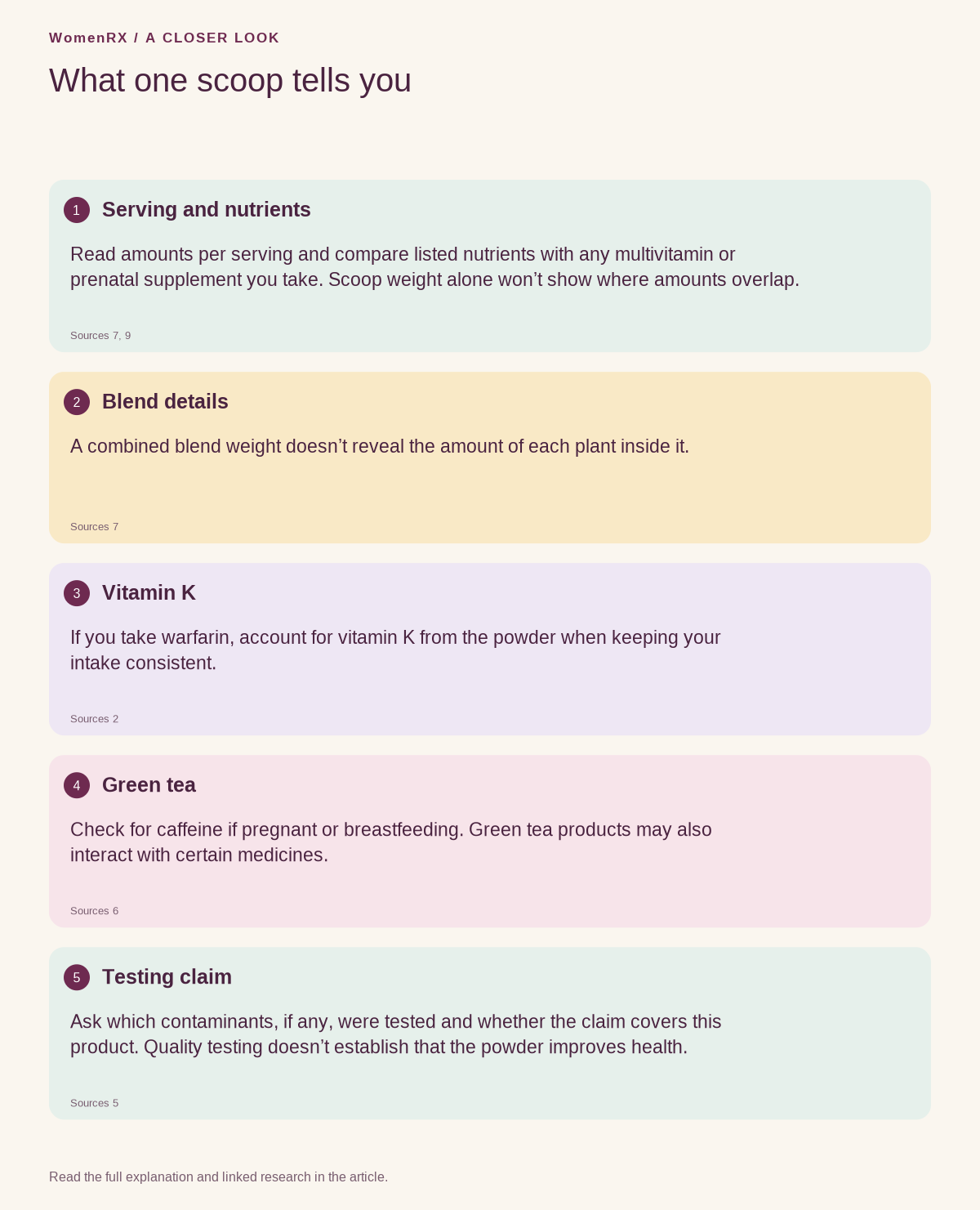
Serving and nutrients: Read amounts per serving and compare listed nutrients with any multivitamin or prenatal supplement you take. Scoop weight alone won’t show where amounts overlap.79
Blend details: A combined blend weight doesn’t reveal the amount of each plant inside it.7
Vitamin K: If you take warfarin, account for vitamin K from the powder when keeping your intake consistent.2
Green tea: Check for caffeine if pregnant or breastfeeding. Green tea products may also interact with certain medicines.6
Testing claim: Ask which contaminants, if any, were tested and whether the claim covers this product. Quality testing doesn’t establish that the powder improves health.5
Read the figure as text
Use these checks to separate disclosed amounts from claims that need more information.- Serving and nutrients: Read amounts per serving and compare listed nutrients with any multivitamin or prenatal supplement you take. Scoop weight alone won’t show where amounts overlap.79
- Blend details: A combined blend weight doesn’t reveal the amount of each plant inside it.7
- Vitamin K: If you take warfarin, account for vitamin K from the powder when keeping your intake consistent.2
- Green tea: Check for caffeine if pregnant or breastfeeding. Green tea products may also interact with certain medicines.6
- Testing claim: Ask which contaminants, if any, were tested and whether the claim covers this product. Quality testing doesn’t establish that the powder improves health.5
Does a bigger scoop mean a better greens powder?
Not necessarily. Scoop weight describes the amount of powder, not the amount of each nutrient or plant ingredient. Compare the disclosed per-serving amounts and note where a blend lists only a combined weight.7
Does third-party testing prove a powder works?
No. Testing and verification can help assess product quality, such as identity, composition, or contaminants. Ask which contaminants, if any, were tested and whether the claim applies to this product. Testing doesn’t demonstrate a clinical benefit.5
Sources you can check
- Vitamin K - Health Professional Fact SheetAccessed 2026-09-25Return to first citation
- Dietary Supplement Adulteration: Laboratory Approaches to Risk Mitigation.Ma C, Monagas M, Bronstein L, Cadwallader A, Goldman V. · Journal of natural products · 2025Return to first citation
- Green Tea: Usefulness and Safety | NCCIHAccessed 2026-09-25Return to first citation
- The Huel Daily Greens Formula Explained | Huel USAccessed 2026-09-26Return to first citation
- Field of Greens | Best Greens Powder: Clinically Proven, Doctor FormulatedAccessed 2026-09-26Return to first citation
- NIH: Dietary Supplements and Life Stages, PregnancyAccessed 2026-09-26Return to first citation