Taurine Supplements: How to Judge the Dose and Evidence
There isn’t one established daily taurine dose for every goal; the useful comparison is between your product and the intervention studied.
A taurine label’s dose is meaningful only in context: what outcome was studied, for how long, and whether taurine was the only active ingredient. One small trial in men with obesity used 3 g daily for 12 weeks, but it did not test cardiovascular outcomes or establish a dose for women. A review’s broader dose range is not a universal target, and neither source settles pregnancy, breastfeeding, or medication safety questions. 12
Start with the goal, not the number
A supplement dose isn’t a general health recommendation just because it appears in a study. Before comparing labels, pin down the outcome you care about: for example, a specific blood marker, exercise performance, or another measured result. Then check whether the study actually measured that outcome, in a population like yours, over a relevant period.
For cardiovascular health in particular, a trial in men with obesity does not answer whether taurine prevents heart disease or improves cardiovascular outcomes. It measured body composition and two signaling molecules, asprosin and spexin. Those are not the same as heart attacks, blood pressure, or other clinical cardiovascular outcomes. 1
Match the product to the intervention
A useful comparison is a 2026 randomized trial of 44 men with obesity. Participants were assigned to control, taurine alone, exercise alone, or exercise plus taurine. The taurine groups received 3 g per day for 12 weeks. Each group had 11 participants. 1
That design matters. The combined exercise-and-taurine group had the largest changes in the study’s measured body-composition and hormone-related outcomes, but the trial was small and its authors described the findings as preliminary. It can’t show that the same result would happen in women, people without obesity, or someone taking taurine without the exercise program. Nor does it establish that 3 g is the right amount for a different goal. 1
When you read a product label, compare:
- Taurine per serving: Is the amount the same as the study amount, or are you comparing different exposures?
- Other active ingredients: A product with additional ingredients is not the same intervention as taurine alone. A result from taurine-only research can’t establish what a combination product does.
- The intended outcome and timeframe: A study of body composition over 12 weeks doesn’t establish an effect on heart health, energy, or a different outcome.
- The study population: Age, health status, sex, and whether participants also exercised can change how relevant a result is to you.
What human evidence can and can’t tell you
A 2026 review describes human taurine trials using amounts from 1 to 6 g per day. That range reflects doses discussed across trials, not a single proven daily target. The review’s broad summary doesn’t tell you that every amount is appropriate for every person or purpose. 2
The 2026 trial is small, limited to men with obesity, and focused on outcomes other than cardiovascular events. Its discussion also mentions preliminary findings from combined exercise-and-taurine research in women with obesity, reporting cytokine changes and improved subcutaneous white adipose tissue plasticity compared with exercise alone. That brief mention can’t establish an effect across women generally or by reproductive stage. 1
Keep safety questions separate
Pregnancy and breastfeeding are distinct situations, and the trial in men does not establish taurine supplement safety in either one. Neither that trial nor the review establishes which medicines might interact with taurine. If you’re considering a product while pregnant, breastfeeding, or taking medication, the study dose alone can’t settle those questions. 12
A practical takeaway: don’t treat a dose printed on a bottle, a dose used in one trial, or a dose range in a review as a universal daily amount. First check whether the product’s ingredients, study population, measured outcome, and timeframe actually fit your reason for considering taurine.
Does the study match your taurine product?
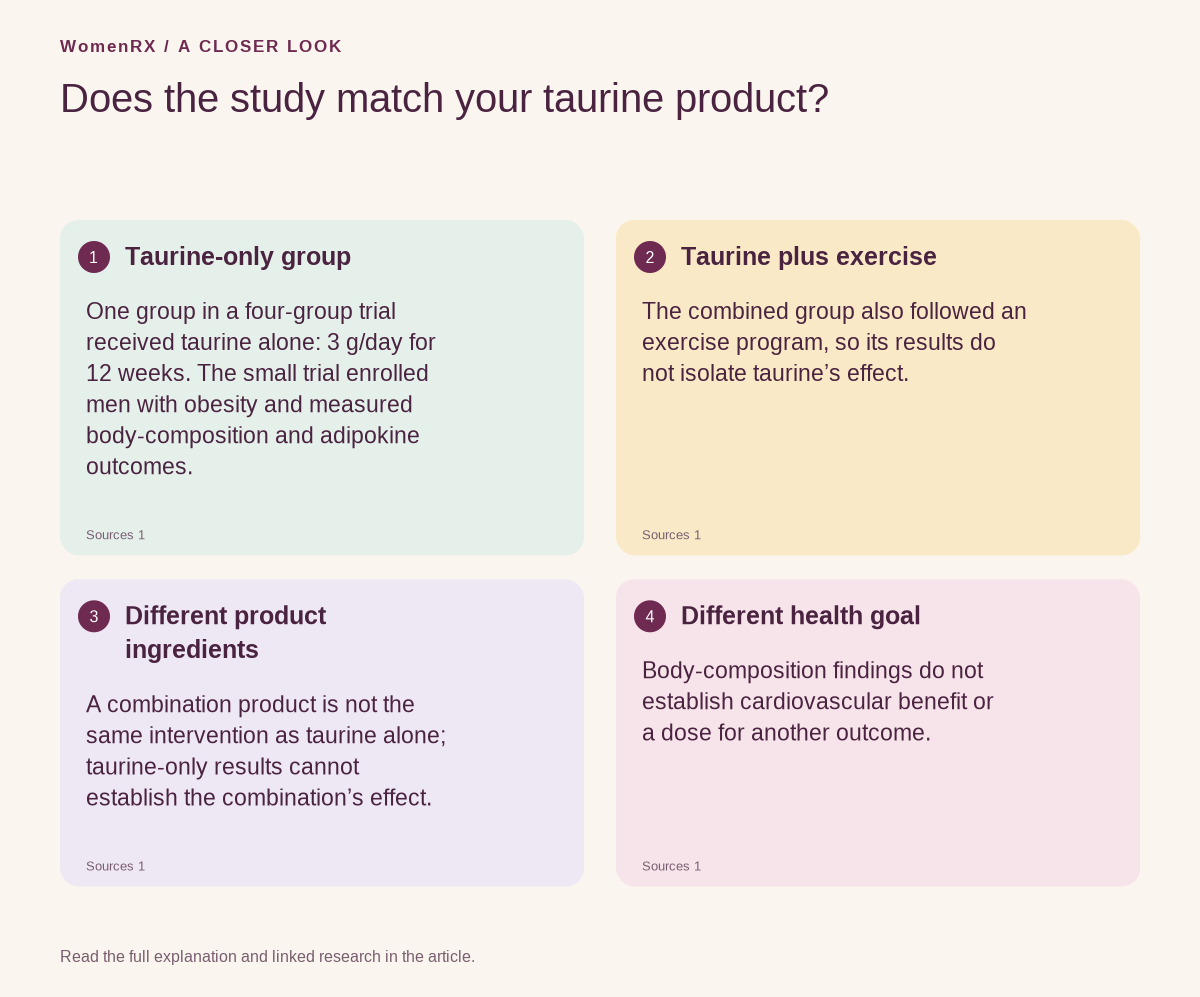
Taurine-only group: One group in a four-group trial received taurine alone: 3 g/day for 12 weeks. The small trial enrolled men with obesity and measured body-composition and adipokine outcomes.1
Taurine plus exercise: The combined group also followed an exercise program, so its results do not isolate taurine’s effect.1
Different product ingredients: A combination product is not the same intervention as taurine alone; taurine-only results cannot establish the combination’s effect.1
Different health goal: Body-composition findings do not establish cardiovascular benefit or a dose for another outcome.1
Read the figure as text
Use these distinctions to see what a study dose can tell you, and where it stops applying.- Taurine-only group: One group in a four-group trial received taurine alone: 3 g/day for 12 weeks. The small trial enrolled men with obesity and measured body-composition and adipokine outcomes.1
- Taurine plus exercise: The combined group also followed an exercise program, so its results do not isolate taurine’s effect.1
- Different product ingredients: A combination product is not the same intervention as taurine alone; taurine-only results cannot establish the combination’s effect.1
- Different health goal: Body-composition findings do not establish cardiovascular benefit or a dose for another outcome.1
More questions, answered
Does a taurine dose used in a study mean I should take the same amount?
No. The 3 g per day amount was used for 12 weeks in a small study of men with obesity, with specific study outcomes. It does not establish a generally appropriate dose or one for a different goal. 1
Does taurine in an energy drink match taurine-only research?
Not necessarily. A product with other active ingredients differs from a taurine-only intervention, so taurine-only findings cannot establish the effect of the full combination. Check the complete ingredient list and the amount of taurine per serving.
Sources you can check
- Combined Aerobic-Resistance Training and Taurine Supplementation Reduce Asprosin and Elevate Spexin in Men with Obesity: A 12-Week Supplement-Blinded, Randomized Controlled Trial.Saedmocheshi S, Dhahbi W, Saeidi A, Rahmani A. · Nutrients · 2026Return to first citation
- Taurine supplementation at the crossroads of metabolism, inflammation and aging: mechanistic and nutritional perspectives.Beine BJ, Castellano M, Fiamoncini J, Hiller K. · Food & function · 2026Return to first citation