Taurine Supplements: What Safety Evidence Can Tell You
Taurine in food, a standalone supplement, and an energy drink are different exposures, and pregnancy or breastfeeding changes what’s worth checking.
The human studies discussed here don’t establish a pregnancy- or breastfeeding-specific taurine supplement dose or answer taurine-specific medicine interaction questions. Ordinary foods containing taurine aren’t equivalent to a concentrated supplement. With energy drinks, check caffeine and the full ingredient list separately: caffeine can reach a baby during pregnancy or breastfeeding, and a drink’s effects can’t be assigned to taurine alone. 1 3 4
Start with the kind of exposure
Taurine is found naturally in the body and in the diet, and it is also sold as a standalone supplement or added to multi-ingredient drinks. Those forms shouldn’t be treated as interchangeable. A review of human cognitive trials describes estimated typical daily taurine intake as 40-400 mg, while the trials it reviewed tested acute supplemental amounts that were generally higher. The review reports results from trials involving healthy participants, but does not provide pregnancy- or breastfeeding-specific results. Those acute cognitive trials don’t establish a safe or useful supplement dose for you. 4
A taurine-containing energy drink adds another layer: caffeine and possibly sugar, vitamins, herbs, or other supplements. MedlinePlus notes that caffeine amounts in energy drinks vary widely and may not be accurately reflected on the label. So feeling wired, shaky, or having trouble sleeping after one cannot automatically be blamed on taurine. 1
Pregnancy: food is not the same question as a supplement
A pregnancy study measured taurine levels in blood from 214 healthy pregnant women in Denmark. It found that maternal taurine concentrations changed during pregnancy and were associated with birth weight. This was an observational analysis of blood levels within a physical-activity trial, not a test of taurine supplements. It can’t show that taking taurine improves pregnancy outcomes or establish the safety of a supplement. 6
General pregnancy guidance advises checking before taking herbs or supplements, because some can harm a developing fetus. It also advises against starting or stopping medicines without a discussion about risks and benefits. That guidance supports a careful review of a taurine product, but it isn’t taurine-specific evidence of harm. 3
If you’re pregnant and considering a standalone product, bring the exact label to your prenatal care team or pharmacist. Ask whether the amount and other ingredients make sense for your situation, and whether there’s a reason to avoid the product. Don’t use a blood-level association or a study of a different population as a reason to start supplementation.
Breastfeeding: separate taurine from caffeine
This research does not answer whether supplemental taurine is safe during breastfeeding or how much might reach breast milk. That question is different from what’s known about caffeine: MedlinePlus says a small amount of caffeine passes into breast milk and recommends checking whether caffeine should be limited or avoided. 1 4
For a drink containing both taurine and caffeine, check the caffeine amount and consider the whole ingredient list. If you’re unsure about a standalone taurine supplement, ask a clinician or pharmacist to review the product rather than assuming that an ingredient’s presence in the diet proves a concentrated supplement is appropriate. General breastfeeding guidance notes that some medicines and other substances can pass through breast milk, so product-specific questions are reasonable. 2
What side effects and interactions are actually documented?
The clinical findings discussed here include one small report of a side effect in people with cirrhosis, but don’t provide a dependable taurine side-effect rate or safe dose for healthy women. A systematic review of non-drug treatments in people with cirrhosis reported mild dyspepsia in one of 10 people in a study using oral taurine. That small finding does not predict the risk for a healthy person. 5
This research does not answer taurine-specific interaction questions; that isn’t proof that no interactions exist. If you take regular medicines, show a pharmacist or prescriber the supplement label, including the amount of taurine and every added ingredient. For an energy drink, ask about caffeine separately: MedlinePlus specifically recommends checking for possible caffeine interactions with certain medicines, including stimulants, some antibiotics, asthma medicines, and heart medicines. 1
A practical label check
Before deciding, identify which product you mean: a food, a standalone taurine supplement, or a drink with several active ingredients. For a drink, look for caffeine and other added ingredients as well as taurine. For a supplement during pregnancy or breastfeeding, ask about that exact product and your regular medicines. A dose used in an acute study of healthy adults or research in people with cirrhosis shouldn’t be treated as a recommended dose for pregnancy or breastfeeding. 3 4 5
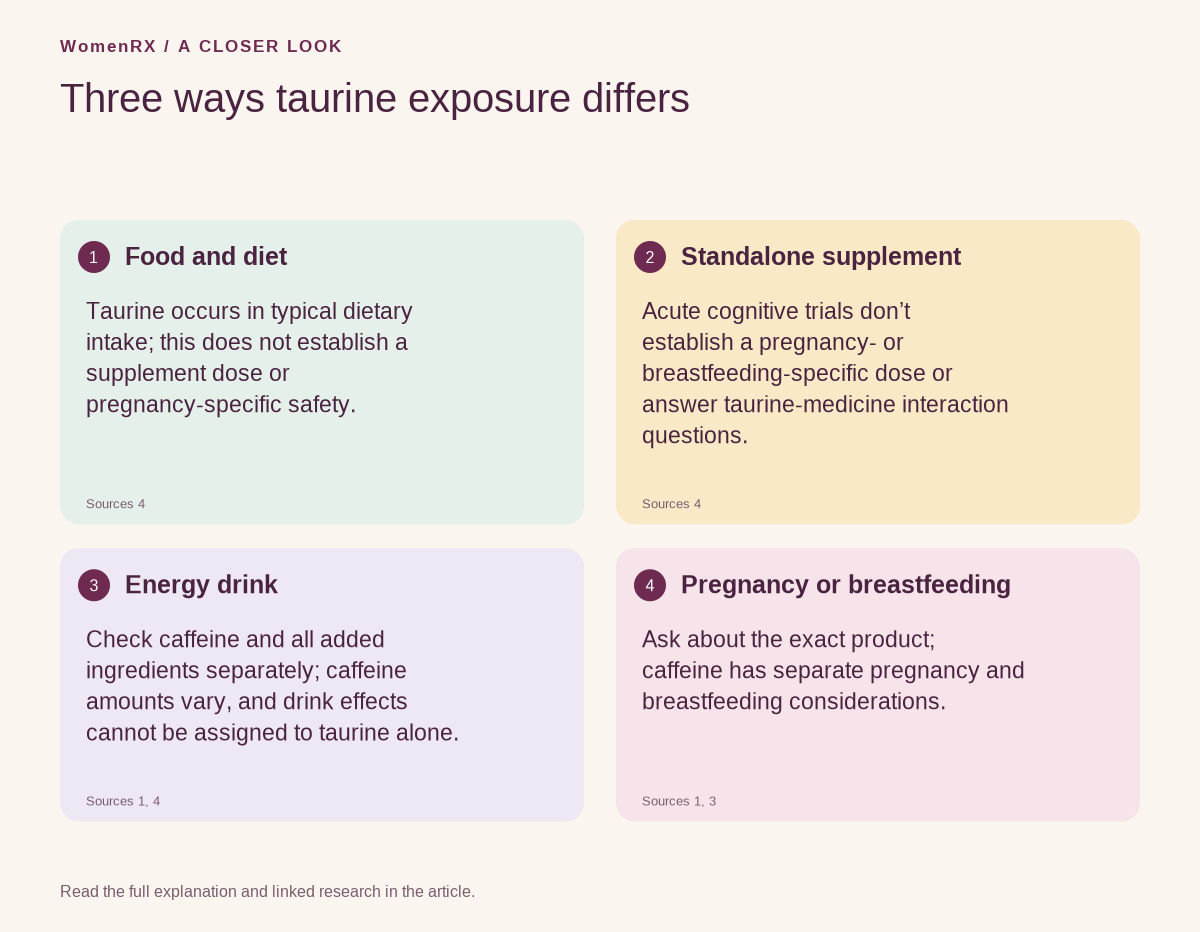
Three ways taurine exposure differs
Food and diet: Taurine occurs in typical dietary intake; this does not establish a supplement dose or pregnancy-specific safety.4
Standalone supplement: Acute cognitive trials don’t establish a pregnancy- or breastfeeding-specific dose or answer taurine-medicine interaction questions.4
Energy drink: Check caffeine and all added ingredients separately; caffeine amounts vary, and drink effects cannot be assigned to taurine alone.14
Pregnancy or breastfeeding: Ask about the exact product; caffeine has separate pregnancy and breastfeeding considerations.13
Read the figure as text
The product form changes what you need to check: diet, supplement concentration, and added caffeine or other ingredients are separate questions.- Food and diet: Taurine occurs in typical dietary intake; this does not establish a supplement dose or pregnancy-specific safety.4
- Standalone supplement: Acute cognitive trials don’t establish a pregnancy- or breastfeeding-specific dose or answer taurine-medicine interaction questions.4
- Energy drink: Check caffeine and all added ingredients separately; caffeine amounts vary, and drink effects cannot be assigned to taurine alone.14
- Pregnancy or breastfeeding: Ask about the exact product; caffeine has separate pregnancy and breastfeeding considerations.13
More questions, answered
Does taurine in an energy drink have the same effects as taurine alone?
Not necessarily. Energy drinks can contain caffeine and other ingredients, and research on drinks that combine taurine and caffeine can’t isolate taurine’s independent effects. Check caffeine and the rest of the label rather than attributing the drink’s effects to taurine alone. 1 4
What should I ask if I take regular medicines?
Show a pharmacist or prescriber the full product label and ask about taurine and each added ingredient. Caffeine is a separate concern: MedlinePlus identifies possible interactions with certain stimulants, antibiotics, asthma medicines, and heart medicines. 1
Sources you can check
- Caffeine: MedlinePlusAccessed 2026-09-25Return to first citation
- Breastfeeding | Benefits of Breastfeeding | MedlinePlusAccessed 2026-09-25Return to first citation
- Pregnancy and Medicines | MedlinePlusAccessed 2026-09-25Return to first citation
- Cognitive Effects of Taurine and Related Sulphur-Containing Amino Acids: A Systematic Review of Human Trials and Considerations for Plant-Based Dietary Transitions.Moore JA, Cousins AL, Taylor RMJ, Griffiths AR, Young HA. · Foods (Basel, Switzerland) · 2026Return to first citation
- Non-pharmacological Interventions for Muscle Cramps and Pain in Patients With Cirrhosis: A Systematic Review.Muller R, Dranoff J, Grimshaw AA, Bastian L, Gunderson C. · Cureus · 2024Return to first citation
- Sulfur-Containing Amino Acid Plasma Concentrations in Pregnancy; Effects of Physical Activity Interventions and Associations with Neonatal Outcomes-The FitMum Randomized Controlled Trial.Jensen IKB, Roland CB, Trammell SAJ, Knudsen SP, Jessen AD, Bendix JM, Molsted S, Grevengoed TJ, Stallknecht BM, Løkkegaard E, Mortensen OH. · Nutrients · 2026Return to first citation