Psyllium: What to Check Before Starting a Fiber Supplement
Before choosing psyllium, match the product to your goal and check its fiber amount, mixing directions, and possible medication timing.
Psyllium may help some adults with chronic constipation, and it’s also used for cholesterol goals, but products and serving sizes aren’t interchangeable. Check how much fiber a serving provides, follow that product’s mixing and fluid directions, and ask a pharmacist about timing if you take oral medicines. Constipation during pregnancy or after birth is common, but general constipation guidance doesn’t establish a psyllium-specific recommendation for those stages. 3 4 6 7
Start with the goal, not the scoop
Psyllium is a soluble fiber made from Plantago ovata husk. When it meets water, it forms a gel. That can affect stool consistency, and research reviews also describe psyllium as a fiber that may help lower LDL cholesterol. Those are different reasons to consider it, so decide which goal matters to you before comparing products. 4 5 6
For constipation, a systematic review and meta-analysis examined 16 randomized trials involving 1,251 adults with chronic constipation. Across all fiber types, 66% of participants assigned to fiber responded, compared with 41% assigned to control. Psyllium was among the fiber types with significant effects, but results varied across studies. The pooled response figures apply to fiber supplements overall, not psyllium alone, to women specifically, or to a particular product. 7
For a cholesterol goal, psyllium has evidence of LDL-lowering potential, but that doesn’t tell you what effect to expect from a particular product. A supplement shouldn’t be treated as a substitute for a cholesterol plan you’ve already made with your clinician. 4 5
Read the label as a product comparison
A scoop, capsule, or tablet is a serving of a particular product, not a universal amount of psyllium. Formulations can differ in fiber content and purity, and mixed products may contain other ingredients. Compare the fiber amount listed per serving and the serving directions on the exact product you’re considering. Don’t assume that two products with similar names deliver the same amount of functional fiber. 4
Also keep a supplement serving separate from a total-daily-fiber goal. Fiber comes from food as well as supplements; adding a supplement doesn’t tell you how much fiber you get from meals. If you’re increasing fiber, do it gradually: a rapid increase can bring gas, bloating, or cramps. 1
Make water and medicines part of the decision
Psyllium’s gel-forming, water-holding behavior makes the product’s mixing and fluid directions worth checking before you start. Inadequate water with psyllium has been associated with gastrointestinal obstruction, and swallowing difficulty is another reason to get advice before choosing a product. Follow the directions on your own package rather than borrowing instructions from a different form. 4 6
If you take oral medicines, ask a pharmacist whether your specific medicine needs to be taken at a different time from psyllium. Viscous fiber may interfere with absorption when taken at the same time. 4
When constipation may need a different next step
Fiber can help, but constipation has many possible causes, including not drinking enough fluid, low activity, and some medicines. If your bowel habits have changed, or you think a medicine may be contributing, ask about that cause rather than simply adding more fiber. 2 3
Pregnancy and the period after giving birth can bring constipation. That makes it reasonable to ask about bowel care during those stages, but general constipation guidance doesn’t specify a psyllium product or regimen. If you’re pregnant or recently gave birth, check whether a fiber supplement fits your circumstances before starting it. 3
If you have pelvic-floor symptoms or a known pelvic-floor condition, ask whether psyllium is the right choice for you. Don’t assume that increasing fiber will address every cause of difficulty passing stool; discuss the specific problem with the person managing your care.
A practical pre-start check
Before buying or using a product, make sure you can answer five questions: Does it fit your goal? How much fiber is in a serving? What does this product say about mixing and fluids? Could it affect the timing of a medicine you take? Do changed bowel habits, swallowing difficulty, or pregnancy or postpartum questions call for clinical advice? If any answer is unclear, bring the product label to a pharmacist or clinician. That’s more useful than choosing by capsule count or assuming all psyllium products work the same way.
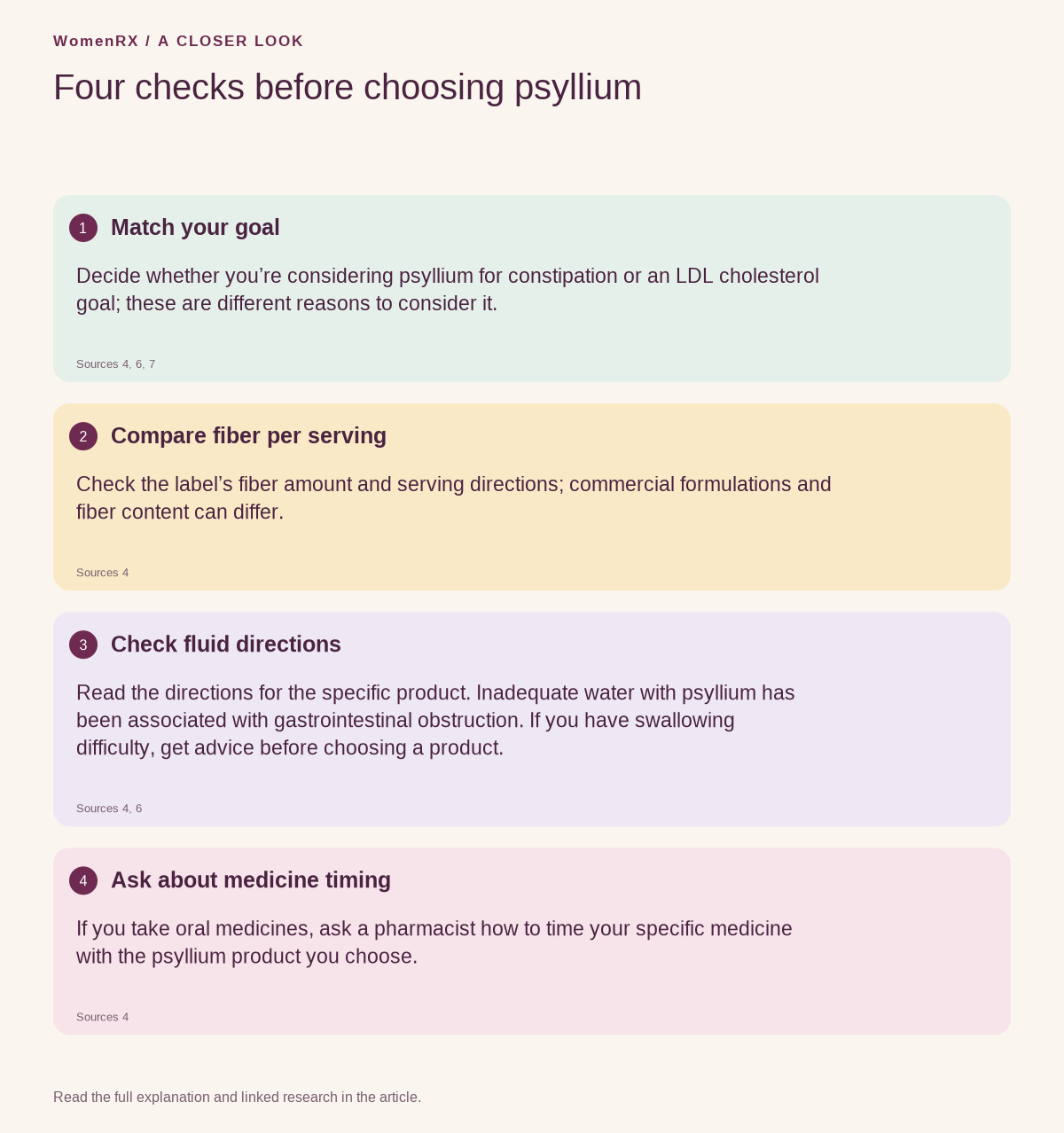
Four checks before choosing psyllium
Match your goal: Decide whether you’re considering psyllium for constipation or an LDL cholesterol goal; these are different reasons to consider it.467
Compare fiber per serving: Check the label’s fiber amount and serving directions; commercial formulations and fiber content can differ.4
Check fluid directions: Read the directions for the specific product. Inadequate water with psyllium has been associated with gastrointestinal obstruction. If you have swallowing difficulty, get advice before choosing a product.46
Ask about medicine timing: If you take oral medicines, ask a pharmacist how to time your specific medicine with the psyllium product you choose.4
Read the figure as text
Use these questions to compare the product. If your bowel habits have changed, check with your provider. If you’re pregnant or recently gave birth, ask whether a supplement fits your circumstances. 2 3- Match your goal: Decide whether you’re considering psyllium for constipation or an LDL cholesterol goal; these are different reasons to consider it.467
- Compare fiber per serving: Check the label’s fiber amount and serving directions; commercial formulations and fiber content can differ.4
- Check fluid directions: Read the directions for the specific product. Inadequate water with psyllium has been associated with gastrointestinal obstruction. If you have swallowing difficulty, get advice before choosing a product.46
- Ask about medicine timing: If you take oral medicines, ask a pharmacist how to time your specific medicine with the psyllium product you choose.4
More questions, answered
Does a psyllium serving count toward my daily fiber?
Yes, fiber from a supplement contributes to total fiber intake, but the serving amount varies by product. Check the label and include fiber from food in your overall picture. 1 4
How should I time psyllium with oral medicines?
Because viscous fiber may affect absorption when taken at the same time, ask a pharmacist how to time your specific oral medicine with the psyllium product you use. 4
Sources you can check
- Dietary Fiber: MedlinePlusAccessed 2026-09-25Return to first citation
- Constipation | MedlinePlusAccessed 2026-09-25Return to first citation
- Constipation - NHSAccessed 2026-09-25Return to first citation
- Psyllium and Glucomannan as Viscous Fiber Modulators of the Gut-Microbiome-Incretin Axis: Molecular Links to Metabolic Inflammation, Barrier Function, and GLP-1 Receptor Agonist Therapy.Yoon Y, Hwang J, Yang CM, Moon M, Lee JJ, Lam KHS, Castro JC, Suryadi T, Suhaimi A, Lee J. · International journal of molecular sciences · 2026Return to first citation
- Psyllium supplementation and lipid profiles: systematic review and dose-response meta-analysis of randomized controlled trials.Gholami Z, Paknahad Z. · Genes & nutrition · 2025Return to first citation
- Psyllium Husk: A Comprehensive Review of its Functional Properties, Health Benefits, Mechanisms of Action, and Potential Adverse Effects.Kumar A, Patel R, Yadav S, Prajapati B, Sharma S, Batta K, Kaushik R, Kumar S, Dudhat K, Rustagi S. · Current nutrition reports · 2026Return to first citation
- The Effect of Fiber Supplementation on Chronic Constipation in Adults: An Updated Systematic Review and Meta-Analysis of Randomized Controlled Trials.van der Schoot A, Drysdale C, Whelan K, Dimidi E. · The American journal of clinical nutrition · 2022Return to first citation