Green Tea Extract: What to Know Before Taking It
A green tea extract capsule can deliver catechins in a more concentrated dose than a cup of tea, so check EGCG, caffeine, and how the product is meant to be taken.
Green tea extract is a concentrated supplement made from Camellia sinensis, not simply brewed tea in capsule form. Its EGCG and caffeine amounts can differ by product, and concentrated doses, especially taken while fasting, have been linked to liver injury. Read the amounts per serving separately, and don’t treat a single EGCG number as a universal safety guarantee. 3 5
Extract isn’t the same as brewed tea
Green tea contains catechins, a group of compounds that includes epigallocatechin gallate (EGCG). An extract concentrates tea components into a supplement, so the way it delivers catechins can differ from sipping brewed tea. A systematic review found liver-related adverse events with some concentrated, catechin-rich preparations taken as large doses, while its review did not find the same signal for brewed tea or extracts consumed in beverages or food. That distinction doesn’t make every supplement unsafe; it does mean tea’s familiar place in a daily routine isn’t proof that a concentrated capsule carries the same risk. 3 5
One reason form and timing matter is that taking a bolus dose of extract repeatedly while fasting can increase the amount of catechins, including EGCG, available in the body. The USP review describes liver injury as the main concern and notes substantial variation in individual susceptibility. 3
Read the label in separate parts
A product’s total extract amount is not automatically its EGCG amount, and neither tells you how much caffeine it contains. Look for each quantity on its own, along with the serving size and any other active ingredients. If a quantity isn’t stated, don’t try to calculate it from the extract amount: the catechin profile can vary with manufacturing, and products may include other caffeine-containing ingredients. 3 6
A laboratory analysis of 53 US supplements found caffeine amounts that ranged widely across products. The study is older and doesn’t describe every product on today’s shelves, but it illustrates why “green tea extract” alone doesn’t tell you the caffeine content. If the label doesn’t make that amount clear, you can’t reliably use it to add up caffeine from multiple products. 6
A quick label check:
- Extract amount: How much extract is in one serving?
- EGCG: Is the amount listed separately from total extract?
- Caffeine: Is caffeine quantified, including from other ingredients?
- Serving and blend: How many servings does the label describe, and what else is included?
- Use and warnings: Does the label address taking it with food or liver concerns?
These details help you compare products; they don’t establish that a product is effective or risk-free.
Don’t mistake a proposed threshold for a guarantee
One systematic review derived an adult safe-intake estimate of 338 mg EGCG per day for solid bolus preparations, and considered a higher observed safe level for tea preparations in beverage form. Those figures apply to different forms and come from a review’s assessment of available safety data, not a promise that any supplement below a particular number is safe for every person. The USP review also describes liver-injury case reports across a wide range of EGCG intakes and notes that susceptibility varies. Use those findings as a reason not to rely on a single cutoff, rather than as a personal dosing target. 3 5
USP’s cautionary label for powdered decaffeinated green tea extract says to take it with food, avoid use with a liver problem, and stop use and seek advice if signs of liver trouble develop. The symptoms it names include abdominal pain, dark urine, or yellowing of the skin or eyes. This is a product-safety caution, not a claim that every extract has the same composition. 3
Keep the benefit claim in proportion
Green tea extract is often included in weight-loss products, but evidence from a particular health condition or product cannot establish a general benefit. A systematic review of green tea catechins, EGCG, and green tea extract in people with fatty liver disease reported a significant body-weight decrease in 9 of 15 studies that assessed body weight. Those findings come from people with that condition and do not establish lasting weight loss from extract alone, or a benefit specific to women. 4
The review included human studies of catechins, EGCG, or green tea extract in the specific context of fatty liver disease. Results from people being studied for a liver condition shouldn’t be treated as proof of a general wellness or weight-loss effect in people without that condition. 4
Pregnancy, breastfeeding, and sex-specific evidence
General pregnancy and breastfeeding guidance doesn’t establish a green tea extract-specific safety level or show that the supplement works differently by sex. MedlinePlus advises checking before taking supplements during pregnancy because some can harm a developing fetus. During breastfeeding, some medicines and substances can pass into breast milk; its general guidance is to raise concerns about a substance with a health care provider. Those are reasons to discuss this specific supplement before using it, not evidence that green tea extract has a known, unique effect in every pregnant or breastfeeding person. 1 2
If you’re comparing products, start with what the label actually tells you: extract, EGCG, caffeine, serving size, and warnings. If those amounts are unclear, the product is harder to compare and its caffeine contribution is harder to track. For concentrated extracts, the food and liver cautions matter more than broad claims about “natural” ingredients. 3 6
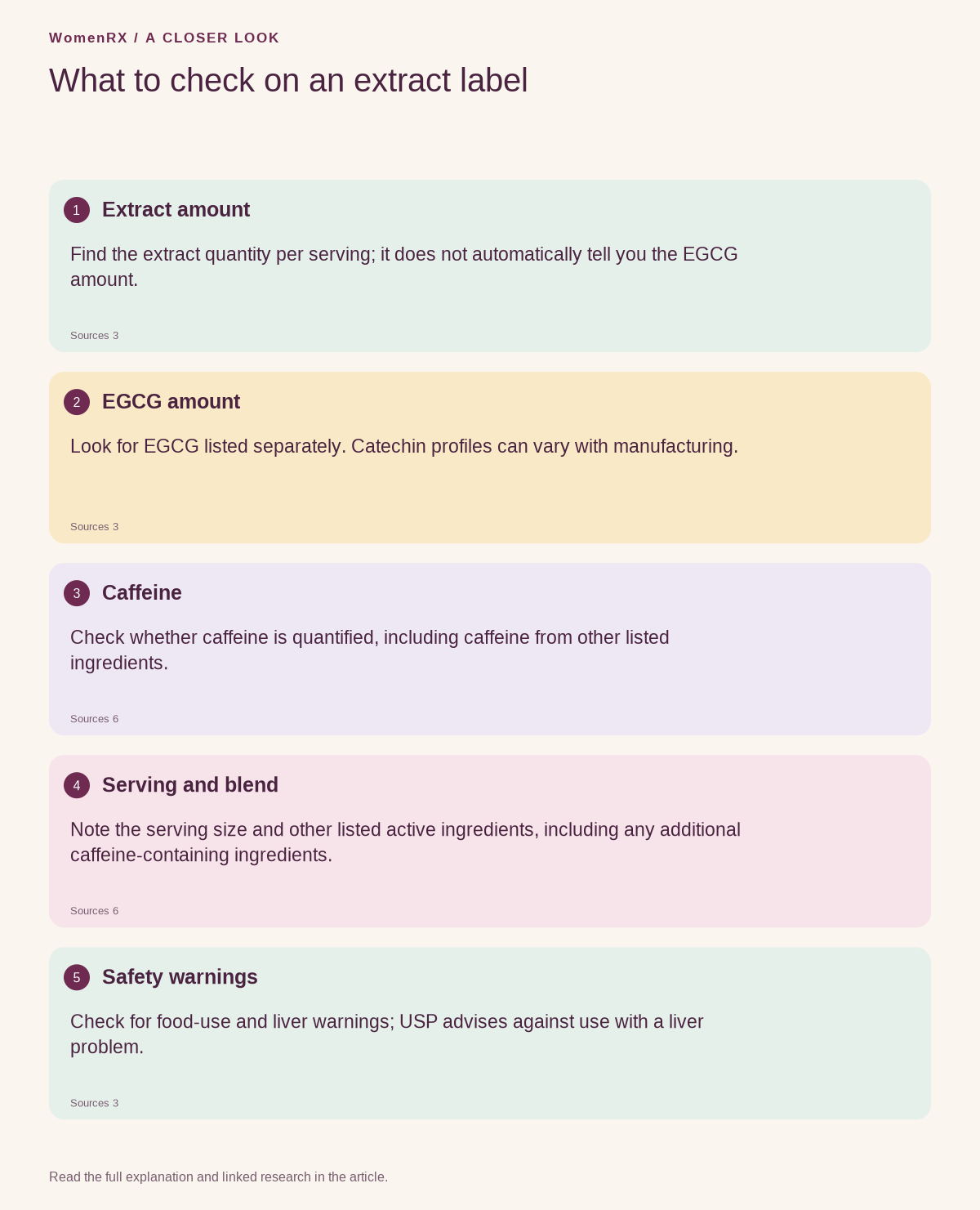
What to check on an extract label
Extract amount: Find the extract quantity per serving; it does not automatically tell you the EGCG amount.3
EGCG amount: Look for EGCG listed separately. Catechin profiles can vary with manufacturing.3
Caffeine: Check whether caffeine is quantified, including caffeine from other listed ingredients.6
Serving and blend: Note the serving size and other listed active ingredients, including any additional caffeine-containing ingredients.6
Safety warnings: Check for food-use and liver warnings; USP advises against use with a liver problem.3
Read the figure as text
Separate the product’s total extract from its EGCG and caffeine amounts, then check serving details and warnings before comparing products.- Extract amount: Find the extract quantity per serving; it does not automatically tell you the EGCG amount.3
- EGCG amount: Look for EGCG listed separately. Catechin profiles can vary with manufacturing.3
- Caffeine: Check whether caffeine is quantified, including caffeine from other listed ingredients.6
- Serving and blend: Note the serving size and other listed active ingredients, including any additional caffeine-containing ingredients.6
- Safety warnings: Check for food-use and liver warnings; USP advises against use with a liver problem.3
More questions, answered
Does brewed green tea have the same safety evidence as extract capsules?
No. A systematic review reported liver-related adverse events with some concentrated, catechin-rich preparations taken as large doses, but not with brewed tea or extracts consumed in beverages or food. That difference is why evidence about a cup of tea shouldn’t be used as proof that a concentrated supplement has the same risk profile. 5
Is green tea extract proven to help women lose weight?
A review found body-weight decreases in some studies of catechins, EGCG, or green tea extract in people with fatty liver disease. That evidence doesn’t establish lasting weight loss from extract alone in generally healthy women, or a benefit specific to women. 4
Sources you can check
- Breastfeeding | Benefits of Breastfeeding | MedlinePlusAccessed 2026-09-25Return to first citation
- Pregnancy and Medicines | MedlinePlusAccessed 2026-09-25Return to first citation
- United States Pharmacopeia (USP) comprehensive review of the hepatotoxicity of green tea extracts.Oketch-Rabah HA, Roe AL, Rider CV, Bonkovsky HL, Giancaspro GI, Navarro V, Paine MF, Betz JM, Marles RJ, Casper S, Gurley B, Jordan SA, He K, Kapoor MP, Rao TP, Sherker AH, Fontana... · Toxicology reports · 2020Return to first citation
- Salubrious Effects of Green Tea Catechins on Fatty Liver Disease: A Systematic Review.Abunofal O, Mohan C. · Medicines (Basel, Switzerland) · 2022Return to first citation
- The safety of green tea and green tea extract consumption in adults - Results of a systematic review.Hu J, Webster D, Cao J, Shao A. · Regulatory toxicology and pharmacology : RTP · 2018Return to first citation
- The caffeine contents of dietary supplements commonly purchased in the US: analysis of 53 products with caffeine-containing ingredients.Andrews KW, Schweitzer A, Zhao C, Holden JM, Roseland JM, Brandt M, Dwyer JT, Picciano MF, Saldanha LG, Fisher KD, Yetley E, Betz JM, Douglass L. · Analytical and bioanalytical chemistry · 2007Return to first citation