Green Tea Extract for Weight Loss: Benefit vs. Risk
Green tea extract may have a modest effect on weight, but concentrated supplements have also been linked to liver injury, unlike brewed tea.
Green tea extract isn’t the same as a cup of brewed green tea. Studies suggest catechins, sometimes combined with caffeine, may produce modest weight changes, but the benefit isn’t assured for a particular product. Concentrated extracts have been linked to liver injury, and empty-stomach use may raise the chance of adverse effects. 1 4 Pregnancy requires a separate safety assessment; LactMed found no studies of oral extract use during breastfeeding. 3
The possible benefit is modest, not a promise
Green tea leaves contain catechins, including EGCG, and brewed tea also contains caffeine. Studies of green tea catechins, with or without caffeine, suggest a possible modest effect on body weight. That finding doesn’t show that every extract works, or that a particular bottle will lead to meaningful weight loss. Products can differ in their ingredients and amounts, and some weight-loss supplements combine green tea extract with other ingredients, making it harder to tell what produced an effect. 1 6
That’s the main tradeoff: a possible small benefit, weighed against a safety concern that’s specifically associated with concentrated extracts. The evidence doesn’t support treating an extract as a more effective version of drinking tea.
Brewed tea and concentrated extract aren’t interchangeable
The NIH Office of Dietary Supplements distinguishes green tea as a beverage, for which its summary reports no safety concerns, from green tea extract, for which it notes concerns including nausea, abdominal discomfort, constipation, increased blood pressure, and liver damage. This is a difference in the form being used, not proof that every extract harms the liver or that brewed tea has no possible effects. Green tea contains caffeine, too. 1
A supplement label may not tell the whole story. In an analysis of 97 supplements implicated in liver injury, catechins were found in 29 of 73 products whose labels did not identify green tea extract or its catechins. The study did not establish that catechin presence or dose was associated with the causality, severity, or pattern of liver injury. It does, however, illustrate why a label and a study of one product may not describe another product reliably. 5 3
Weight-loss supplements may also contain multiple ingredients, and the amounts of active components can vary. So even when a study finds an effect for a particular ingredient or formulation, you can’t assume it applies to a different blend on a store shelf. 1
What the liver-injury reports do, and don’t, tell us
A US Pharmacopeia safety review assessed 216 reports involving green tea products, including 34 reports of liver damage. Its reviewers classified 27 of those liver reports as possibly related to green tea products and seven as probably related. These are reviewed reports, not a count of everyone who used an extract. They cannot tell you how often liver injury occurs or predict an individual person’s risk. 4
The evidence also isn’t a simple proof that catechins explain every case. In the analysis of supplements implicated in liver injury, investigators did not find a statistically significant association between catechin presence or dose and the reported injury’s causality score, severity, or pattern. The authors described the challenge of attributing liver injury to multi-ingredient supplements. 5
The careful takeaway is that liver injury has been reported and judged possibly or probably related in some cases, but its frequency and the risk from a particular product remain unclear. That uncertainty matters when the potential weight benefit is modest.
Empty-stomach use and dieting
The US Pharmacopeia review reported that concentrated green tea extracts taken on an empty stomach were more likely to lead to adverse effects than extracts consumed with food. This finding is a reason not to treat fasting as a harmless way to use an extract; it doesn’t establish a safe dose or guarantee that taking one with food prevents harm. 4
There’s also an animal study that found EGCG caused dose-dependent liver toxicity in mice under dietary restriction, while the same doses did not cause liver injury in normal mice. That is a preclinical finding, not proof that dieting and EGCG cause liver injury in people. 6
Pregnancy and breastfeeding are separate questions
The weight-loss findings don’t answer whether a concentrated extract is safe during pregnancy. That question needs its own safety assessment; familiarity with brewed tea isn’t enough to answer it.
For breastfeeding, LactMed reports that it found no studies examining oral green tea extract use during breastfeeding. That’s an evidence gap, not proof of harm or safety. It also notes that very high caffeine intake can be associated with fussiness, jitteriness, and poor sleep in infants, which is distinct from the unanswered question about oral extract. 3
A practical way to weigh a product claim
If an ad promises substantial or effortless weight loss, compare that promise with the actual evidence: the recognized benefit is only possible and modest, while the concentrated product carries a liver-injury concern and may not match the formulations studied. Check whether the product is an extract or brewed tea, whether it’s a multi-ingredient blend, and what it says about catechin or EGCG content. Those details can help describe the product, but they can’t establish that it’s safe or effective for you. 1 4 5
If you take medicines or other supplements, include green tea extract in that conversation: herbal supplements can interact with prescription or over-the-counter medicines, and a multi-ingredient formula makes the assessment less straightforward. No specific green tea extract-medicine interaction can be identified from this evidence. 2 1
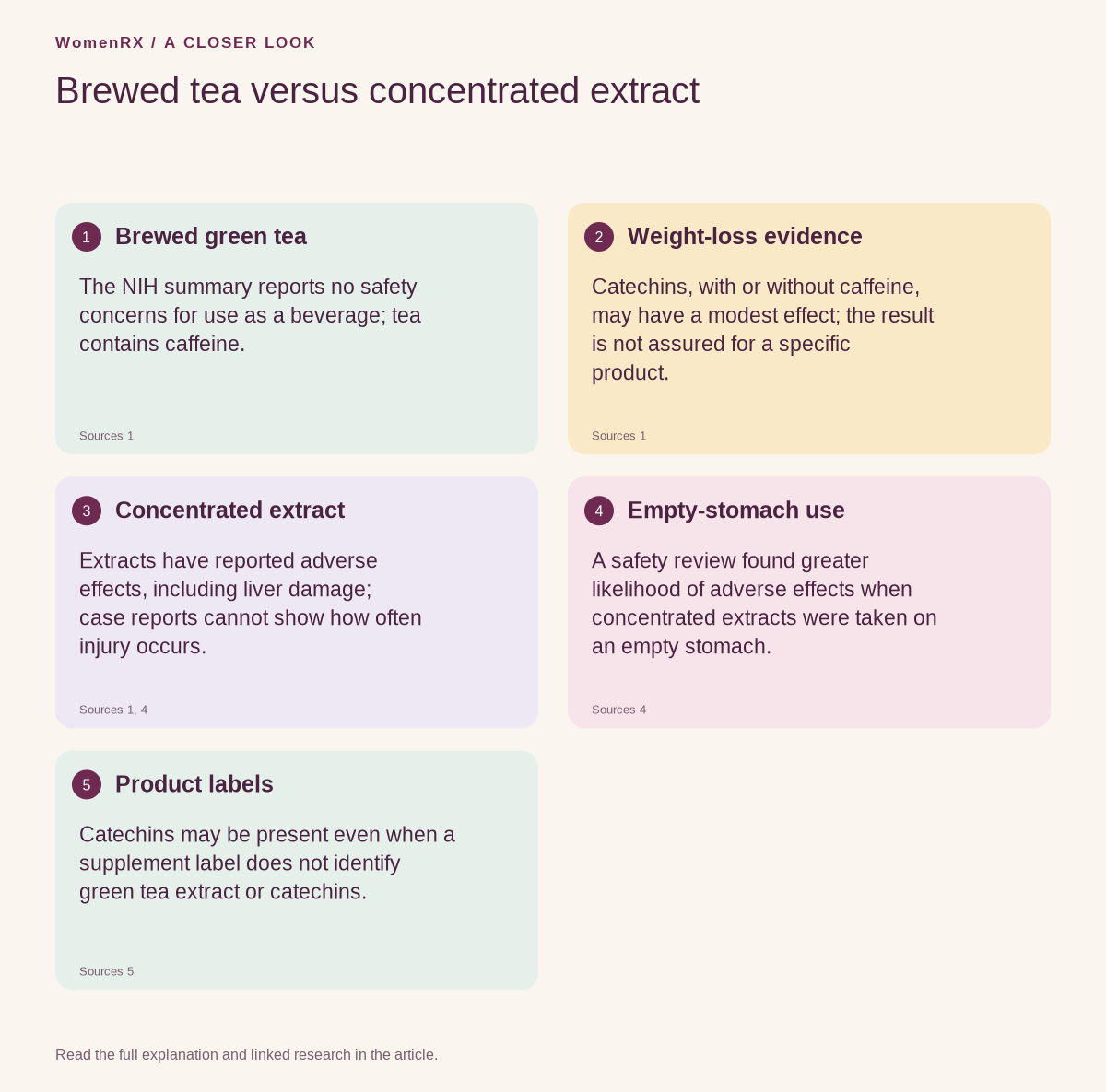
Brewed tea versus concentrated extract
Brewed green tea: The NIH summary reports no safety concerns for use as a beverage; tea contains caffeine.1
Weight-loss evidence: Catechins, with or without caffeine, may have a modest effect; the result is not assured for a specific product.1
Concentrated extract: Extracts have reported adverse effects, including liver damage; case reports cannot show how often injury occurs.14
Empty-stomach use: A safety review found greater likelihood of adverse effects when concentrated extracts were taken on an empty stomach.4
Product labels: Catechins may be present even when a supplement label does not identify green tea extract or catechins.5
Read the figure as text
The form matters: a possible modest weight effect does not make a concentrated supplement equivalent to brewed tea.- Brewed green tea: The NIH summary reports no safety concerns for use as a beverage; tea contains caffeine.1
- Weight-loss evidence: Catechins, with or without caffeine, may have a modest effect; the result is not assured for a specific product.1
- Concentrated extract: Extracts have reported adverse effects, including liver damage; case reports cannot show how often injury occurs.14
- Empty-stomach use: A safety review found greater likelihood of adverse effects when concentrated extracts were taken on an empty stomach.4
- Product labels: Catechins may be present even when a supplement label does not identify green tea extract or catechins.5
More questions, answered
Does taking green tea extract with food make it safe?
A US Pharmacopeia review found concentrated extracts on an empty stomach were more likely to lead to adverse effects than extracts taken in the fed state. That doesn’t establish that taking an extract with food prevents liver injury or makes a product safe. 4
Is green tea extract safe while breastfeeding?
The available LactMed summary reports no studies examining oral green tea extract use during breastfeeding, so safety for this use hasn’t been established. It also discusses possible infant effects from very high caffeine intake, a separate issue from the extract evidence gap. 3
Sources you can check
- Dietary Supplements for Weight Loss - Health Professional Fact SheetAccessed 2026-09-25Return to first citation
- Herbal Medicine: MedlinePlusAccessed 2026-09-25Return to first citation
- Green Tea2006Return to first citation
- Safety of green tea extracts : a systematic review by the US Pharmacopeia.Sarma DN, Barrett ML, Chavez ML, Gardiner P, Ko R, Mahady GB, Marles RJ, Pellicore LS, Giancaspro GI, Low Dog T. · Drug safety · 2008Return to first citation
- Catechins in dietary supplements and hepatotoxicity.Navarro VJ, Bonkovsky HL, Hwang SI, Vega M, Barnhart H, Serrano J. · Digestive diseases and sciences · 2013Return to first citation
- Epigallocatechin Gallate During Dietary Restriction - Potential Mechanisms of Enhanced Liver Injury.Shi Z, Zhu JX, Guo YM, Niu M, Zhang L, Tu C, Huang Y, Li PY, Zhao X, Zhang ZT, Bai ZF, Zhang GQ, Lu Y, Xiao XH, Wang JB. · Frontiers in pharmacology · 2020Return to first citation