Green Tea Extract: Possible Modest Weight Effects in Catechin Trials and Liver Risks
Green tea catechin trials suggest a possible modest weight effect, but they don’t establish when it might appear, and concentrated extracts carry separate liver-safety concerns.
Green tea catechin trials suggest, at most, a possible modest effect on body weight, but the evidence summarized by NIH doesn’t say when a change should appear or establish a reliable timeline. It also doesn’t guarantee that a specific concentrated extract will have that effect. Brewed tea and extracts raise different safety questions, including reported liver injury with extracts. 1 4
The result depends on what was tested
Green tea contains catechins, and some studies have tested catechins with or without caffeine for weight loss. The overall finding is a possible modest effect on body weight, not a dependable or dramatic change. It also doesn’t establish that green tea extract improves blood sugar, cholesterol, or other metabolic measures for every person or product. 1
The research summarized by NIH doesn’t establish how long it might take for a weight change to appear. So there isn’t a dependable number of days or weeks to expect from green tea extract, and the possible modest effect shouldn’t be treated as a promise that a particular product will work. 1
Brewed tea and concentrated extract aren’t interchangeable. A beverage and a capsule can differ in concentration and composition, and studies may not fully describe a product’s active components. Weight-loss supplements may also combine ingredients, making it harder to know which ingredient accounts for an effect or risk. 1
So when a label says “green tea,” don’t treat that phrase alone as a match to a study. Check whether it names an extract, catechins, caffeine, and the amount per serving. If it’s a blend, note the other ingredients and whether their amounts are disclosed. These details help you see what the product actually contains, though they can’t prove it will work like a particular study formulation. 1
A small possible benefit has to be weighed against liver risk
The NIH Office of Dietary Supplements describes green tea catechins as having a possible modest effect on body weight, while also noting safety concerns for green tea extract, including reported liver damage. This is a meaningful tradeoff: an uncertain, modest weight outcome versus potentially serious harm whose frequency these findings cannot establish. 1 4
A prospective study of liver-injury cases identified six women whose acute liver injury was attributed to SLIMQUICK weight-loss products. Green tea extract or catechins appeared on the ingredient lists of five of those six products. Three women were hospitalized and one received a liver transplant. Because the report involved particular branded weight-loss products, it cannot show that every extract causes injury or quantify the risk for someone taking a different product. It also cannot establish that green tea extract alone caused each injury. The findings do show why a concentrated extract in a weight-loss product deserves more scrutiny than the words “green tea” might suggest. 4
A product’s label and marketing aren’t the same as evidence that it produces weight loss or is safe. Dietary supplements aren’t reviewed or approved by the FDA as drugs before sale, and the amounts of active components can vary across products. 1
Check your situation before comparing products
If you’re pregnant: The weight-loss and liver-injury findings above don’t establish whether a concentrated green tea extract is safe during pregnancy. Don’t carry the beverage finding over to an extract. Before considering one, show the complete product label to the clinician managing your pregnancy so the question is about that product, not green tea in general.
If you’re breastfeeding: These findings also don’t establish whether an extract is safe while breastfeeding. Ask your baby’s clinician or your own prescribing clinician to review the complete label, including other ingredients and caffeine, rather than assuming that drinking tea and taking an extract are equivalent. 1
If you take medicines: The weight-loss and liver-injury findings don’t identify specific medicine interactions or rule them out. Bring the complete product label and a list of your current medicines to a pharmacist or prescribing clinician before using an extract. That check addresses your actual combination of products; matching a supplement to a study formulation doesn’t answer a medicine-interaction question. 1
If you’re aiming for a metabolic change: Weight alone doesn’t tell the whole story, and a weight-loss claim doesn’t establish that a supplement treats a metabolic condition. If your goal is related to blood sugar or heart risk, focus on the measures and care plan that apply to you rather than assuming a supplement’s weight claim means it improves those risks. 2 3
A practical label-to-study check
Before considering a product, compare it with the research on four points: form (brewed tea or extract), components (catechins and caffeine), other ingredients (especially in blends), and outcome (weight change versus a metabolic measure). If the label doesn’t give enough detail to make that comparison, you can’t tell whether the study result applies to that product. Even a close label match doesn’t guarantee the same result or safety. 1
For weight goals, the available research supports at most a possible modest effect, not a substitute for approaches with evidence for your health needs. It also doesn’t give you a reliable timeline for when to expect a change. The main decision isn’t simply whether green tea has benefits; it’s whether a small possible weight effect is worth the uncertainty and the specific safety questions raised by a concentrated extract.
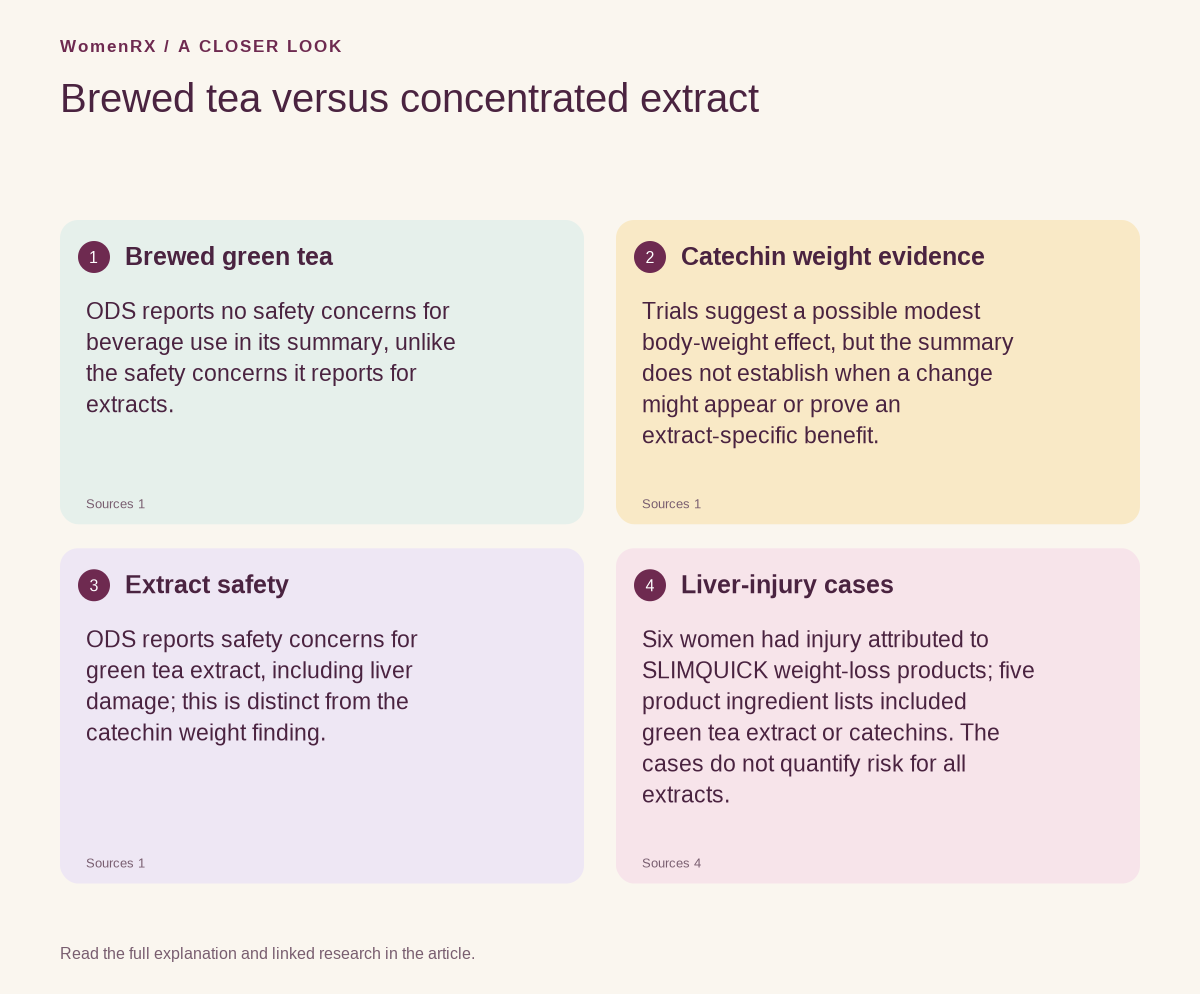
Brewed tea versus concentrated extract
Brewed green tea: ODS reports no safety concerns for beverage use in its summary, unlike the safety concerns it reports for extracts.1
Catechin weight evidence: Trials suggest a possible modest body-weight effect, but the summary does not establish when a change might appear or prove an extract-specific benefit.1
Extract safety: ODS reports safety concerns for green tea extract, including liver damage; this is distinct from the catechin weight finding.1
Liver-injury cases: Six women had injury attributed to SLIMQUICK weight-loss products; five product ingredient lists included green tea extract or catechins. The cases do not quantify risk for all extracts.4
Read the figure as text
Compare the form studied, what a label can tell you, and the safety distinction before treating a product claim as relevant to you.- Brewed green tea: ODS reports no safety concerns for beverage use in its summary, unlike the safety concerns it reports for extracts.1
- Catechin weight evidence: Trials suggest a possible modest body-weight effect, but the summary does not establish when a change might appear or prove an extract-specific benefit.1
- Extract safety: ODS reports safety concerns for green tea extract, including liver damage; this is distinct from the catechin weight finding.1
- Liver-injury cases: Six women had injury attributed to SLIMQUICK weight-loss products; five product ingredient lists included green tea extract or catechins. The cases do not quantify risk for all extracts.4
More questions, answered
How long does green tea extract take to work for weight loss?
There isn’t a reliable timeline to give. The NIH summary describes a possible modest weight effect in trials of green tea catechins, with or without caffeine, but doesn’t establish when a change should appear. It also doesn’t guarantee that a particular extract will produce that effect. 1
Is drinking green tea the same as taking green tea extract?
No. A brewed beverage and a concentrated extract can differ in composition and exposure, and research on one form shouldn’t automatically be applied to the other. The NIH Office of Dietary Supplements reports no safety concerns for green tea as a beverage in its summary, but notes safety concerns for extracts, including liver damage. That beverage finding establishes neither extract safety during pregnancy nor extract safety while breastfeeding. 1
Can a green tea extract supplement improve blood sugar or cholesterol?
The cited summary describes a possible modest effect on body weight; it doesn’t establish that green tea extract improves blood sugar or cholesterol. Don’t infer a metabolic benefit from a weight-loss claim. 1
Sources you can check
- Dietary Supplements for Weight Loss - Health Professional Fact SheetAccessed 2026-09-25Return to first citation
- Body Weight: MedlinePlusAccessed 2026-09-25Return to first citation
- Metabolic Syndrome | MedlinePlusAccessed 2026-09-25Return to first citation
- Risk of Liver Injury Associated with Green Tea Extract in SLIMQUICK(®) Weight Loss Products: Results from the DILIN Prospective Study.Zheng EX, Rossi S, Fontana RJ, Vuppalanchi R, Hoofnagle JH, Khan I, Navarro VJ. · Drug safety · 2016Return to first citation