Green Tea Extract and Weight: Small Effects, Real Risks
Green tea extract may shift the scale a little in some short trials, but longer studies haven’t shown reliable weight loss, and the extract has safety concerns that brewed tea doesn’t share in the same way.
Green tea extract isn’t a dependable way to lose weight. One small trial in women reported a modest within-group weight decrease over 12 weeks, but a larger yearlong trial in postmenopausal women found no change in weight or waist size. Short-term changes in fat-burning measures or waist circumference don’t by themselves show meaningful, lasting fat loss. Extracts also carry potential risks, including liver damage. 2 4 1
What the trials show about the scale
The clearest takeaway is that results vary, and positive findings tend to come from short studies. In one randomized trial, 102 women with central obesity were assigned to green tea extract or placebo for 12 weeks. In the extract group, average weight fell from 76.8 kg to 75.7 kg. That is about a 1.1 kg decrease within that group, not a placebo-adjusted estimate of the extract’s effect. It shouldn’t be read as the amount caused by the extract. 2
A larger, longer study gives a different picture. In a yearlong randomized trial, 237 overweight or obese postmenopausal women received decaffeinated green tea extract or placebo. The researchers found no change in body weight, BMI, or waist circumference with the extract. A separate yearlong trial in men at high risk for prostate cancer also found no reduction in weight or other measured obesity markers with decaffeinated catechins. 4 3
There is a small short-term study that points the other way: among 35 adults with obesity and metabolic syndrome, an extract group lost more weight than a control group over eight weeks. But this mixed-sex study did not report weight outcomes separately for women, and its size and duration make it hard to know whether the finding would hold over time. 5
Taken together, the evidence allows for a small effect in some circumstances, not a dependable or lasting result. NIH’s Office of Dietary Supplements describes green tea’s possible weight effect as modest and notes that studies vary in their ingredients and methods. 1
A metabolic change isn’t the same as fat loss
Green tea catechins, including EGCG, have been studied for their effects on energy use and fat oxidation. But a change in a short-term metabolic measure doesn’t automatically mean a person will lose a meaningful amount of body fat. 1
For example, a 60-day trial in 28 postmenopausal women reported differences in measures including fat oxidation, resting energy expenditure, and waist circumference. Those results are interesting, but they don’t establish lasting weight loss. 6 In another yearlong trial in postmenopausal women, the extract did not change average body weight or waist circumference, even though researchers examined hormone and glucose measures too. 4
Weight, waist size, and body composition answer different questions. A smaller waist or a shift in a metabolic marker may matter for other reasons, but neither should be presented as proof that the supplement reduces body fat. The 60-day trial’s reported metabolic and waist changes don’t establish a sustained reduction in body fat; the yearlong trial found no weight or waist benefit. 6 4
What the evidence says for women
Some trials enrolled only women, including a short study in women with central obesity and a yearlong study in postmenopausal women. Their results don’t point to a consistent benefit: the short study reported a modest within-group weight decrease, while the longer study found no change in weight or waist size. 2 4
That doesn’t show a special effect for women, or tell us whether results differ by menstrual or menopause stage. The longer study applies specifically to postmenopausal women; it can’t answer every question about younger women. A small mixed-sex study reported an overall weight result but didn’t provide a separate result for women. 4 5
The extract has risks that matter
Green tea as a beverage and concentrated green tea extract shouldn’t be treated as interchangeable. NIH’s Office of Dietary Supplements reports that green tea extract can cause constipation, abdominal discomfort, nausea, and increased blood pressure, and lists liver damage as a reported adverse effect. It describes safety differently for brewed tea, which contains caffeine, and for extracts, for which safety concerns have been reported. 1
One small 12-week trial in women reported no adverse events, but that finding doesn’t establish that extracts are safe for everyone or for long-term use. 2 Products can also differ in their active ingredients and amounts, and formulas with multiple ingredients make it harder to know which ingredient contributed to an effect or a problem. 1
So, if you’re considering an extract for weight management, the practical tradeoff is a possible small and uncertain benefit against real safety concerns. The longer-term trials don’t support expecting reliable weight loss, and short-term metabolic changes aren’t a substitute for a demonstrated change in body fat or weight.
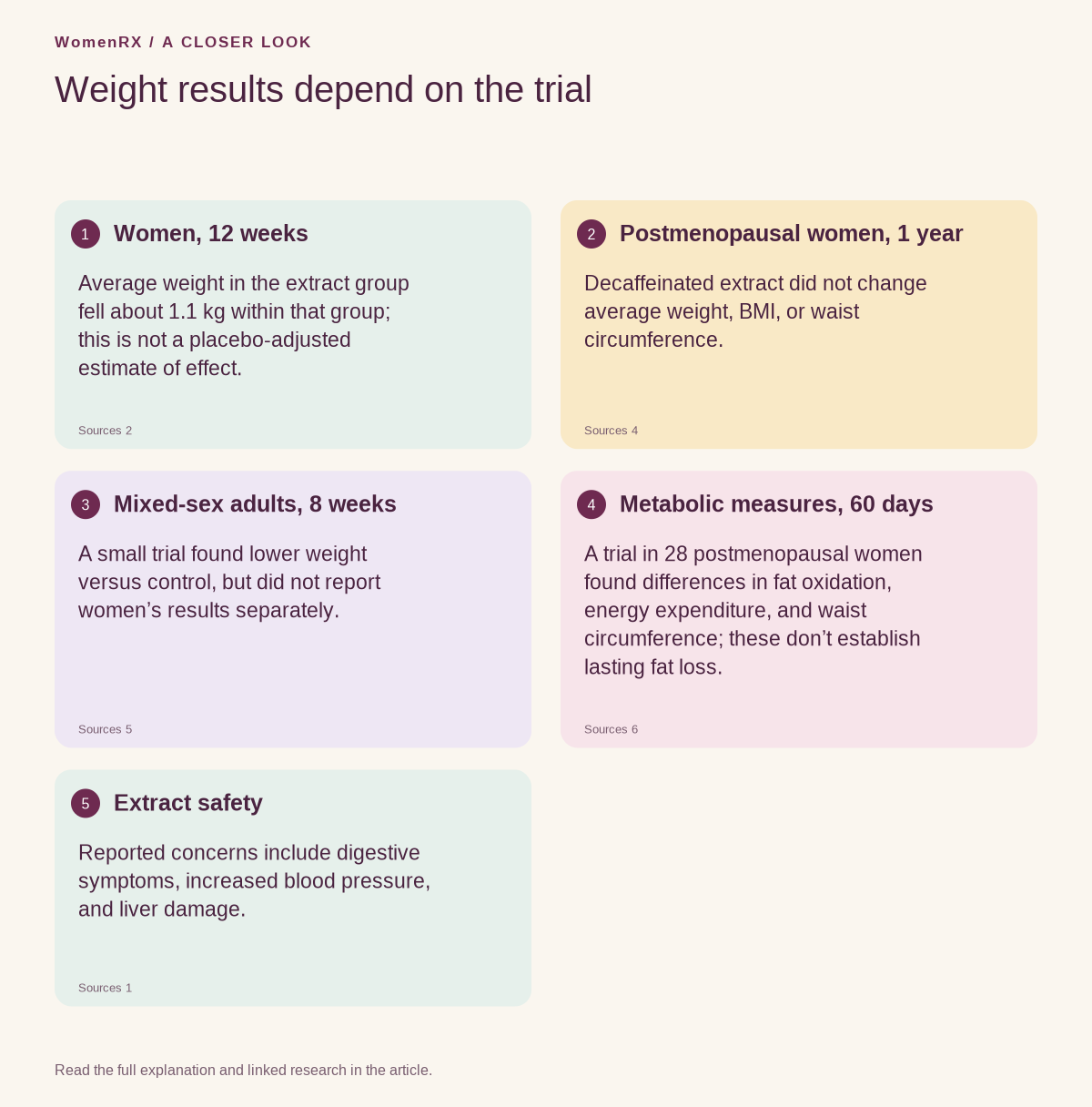
Weight results depend on the trial
Women, 12 weeks: Average weight in the extract group fell about 1.1 kg within that group; this is not a placebo-adjusted estimate of effect.2
Postmenopausal women, 1 year: Decaffeinated extract did not change average weight, BMI, or waist circumference.4
Mixed-sex adults, 8 weeks: A small trial found lower weight versus control, but did not report women’s results separately.5
Metabolic measures, 60 days: A trial in 28 postmenopausal women found differences in fat oxidation, energy expenditure, and waist circumference; these don’t establish lasting fat loss.6
Extract safety: Reported concerns include digestive symptoms, increased blood pressure, and liver damage.1
Read the figure as text
These studies show why a short-term change should not be read as proof of lasting weight or fat loss.- Women, 12 weeks: Average weight in the extract group fell about 1.1 kg within that group; this is not a placebo-adjusted estimate of effect.2
- Postmenopausal women, 1 year: Decaffeinated extract did not change average weight, BMI, or waist circumference.4
- Mixed-sex adults, 8 weeks: A small trial found lower weight versus control, but did not report women’s results separately.5
- Metabolic measures, 60 days: A trial in 28 postmenopausal women found differences in fat oxidation, energy expenditure, and waist circumference; these don’t establish lasting fat loss.6
- Extract safety: Reported concerns include digestive symptoms, increased blood pressure, and liver damage.1
More questions, answered
Does a caffeine-free extract work better for weight loss?
The yearlong randomized trials in postmenopausal women and men used decaffeinated green tea catechins and found no reduction in body weight. Those studies don’t prove that caffeine-free products can never affect weight, but they don’t support expecting weight loss from decaffeinated extract either. 4 3
Is brewed green tea the same as taking an extract?
No. A brewed beverage and a concentrated extract differ in form and exposure, and studies of one can’t automatically establish the effects or safety of the other. NIH’s Office of Dietary Supplements lists potential adverse effects for green tea extract, including liver damage. 1
Sources you can check
- Dietary Supplements for Weight Loss - Health Professional Fact SheetAccessed 2026-09-25Return to first citation
- Therapeutic effect of high-dose green tea extract on weight reduction: A randomized, double-blind, placebo-controlled clinical trial.Chen IJ, Liu CY, Chiu JP, Hsu CH. · Clinical nutrition (Edinburgh, Scotland) · 2016Return to first citation
- Long-term supplementation of decaffeinated green tea extract does not modify body weight or abdominal obesity in a randomized trial of men at high risk for prostate cancer.Kumar NB, Patel R, Pow-Sang J, Spiess PE, Salup R, Williams CR, Schell MJ. · Oncotarget · 2017Return to first citation
- Green Tea Extract and Catechol-O-Methyltransferase Genotype Modify Fasting Serum Insulin and Plasma Adiponectin Concentrations in a Randomized Controlled Trial of Overweight and Obese Postmenopausal Women.Dostal AM, Samavat H, Espejo L, Arikawa AY, Stendell-Hollis NR, Kurzer MS. · The Journal of nutrition · 2016Return to first citation
- Green tea supplementation affects body weight, lipids, and lipid peroxidation in obese subjects with metabolic syndrome.Basu A, Sanchez K, Leyva MJ, Wu M, Betts NM, Aston CE, Lyons TJ. · Journal of the American College of Nutrition · 2010Return to first citation
- A 60-Day Green Tea Extract Supplementation Counteracts the Dysfunction of Adipose Tissue in Overweight Post-Menopausal and Class I Obese Women.Rondanelli M, Gasparri C, Perna S, Petrangolini G, Allegrini P, Fazia T, Bernardinelli L, Cavioni A, Mansueto F, Oberto L, Patelli Z, Tartara A, Riva A. · Nutrients · 2022Return to first citation