Green Tea Extract: Do the Benefits Outweigh the Risks?
For weight loss, the evidence points to little dependable benefit, while concentrated extracts raise safety questions that a cup of brewed tea doesn’t answer.
If you’re considering green tea extract for weight loss, human studies don’t show a dependable, meaningful payoff. One review found no statistically significant weight loss in adults with overweight or obesity, while a separate review in people with type 2 diabetes reported reductions. Concentrated extracts have also been linked to serious liver injury. Check the exact product and don’t treat brewed tea as equivalent. 1 3 4 5
First, match the evidence to your goal
Green tea extract is a concentrated supplement containing green tea compounds, including catechins such as EGCG. It isn’t interchangeable with brewed tea: supplement formulas and amounts can vary, and the safety information for tea as a beverage doesn’t establish the safety of a concentrated extract. 1 2
If your goal is weight loss, the likely payoff is limited. A systematic review of five randomized trials in adults with overweight or obesity found no statistically significant weight loss from green tea or its extracts. The pooled difference was -0.78 kg, with a 95% confidence interval from -2.31 to 0.75 kg, which includes no effect. The review found a small decrease in body-fat percentage, but its authors judged that change not clinically meaningful. These trials included adults of either sex, so they don’t establish a women-specific weight-loss effect. 4
A separate review of 11 articles in people with type 2 diabetes reported reductions in weight, BMI, and body fat. That finding is specific to a diabetes population; it doesn’t establish a meaningful benefit for everyone considering an extract. The NIH Office of Dietary Supplements summarizes the possible weight effect of green tea as modest. 1 3
There’s a different, narrower finding for postmenopausal women. A systematic review of seven randomized trials found lower total cholesterol compared with placebo, based on four studies involving 1,109 participants. The evidence was rated low quality, and the review found no statistically significant effects on its other measured outcomes. This result isn’t evidence of weight loss or relief from menopause symptoms. 2
The safety tradeoff is different for an extract
The NIH Office of Dietary Supplements lists constipation, abdominal discomfort, nausea, increased blood pressure, and liver damage among reported adverse effects of green tea extract. Its summary reports no safety concerns for green tea as a beverage, but that distinction shouldn’t be taken as reassurance about a concentrated product. 1
A prospective liver-injury study attributed six of 1,091 liver-injury cases to SLIMQUICK weight-loss products. All six patients were women; five of the six products listed green tea extract and/or its catechins. Three patients were hospitalized, and one received a liver transplant. These were multi-ingredient products, so the cases raise a serious safety signal but can’t show that green tea extract alone caused each injury or estimate the risk for all supplement users. 5
If you’re still considering one, check the actual product
Start with the reason you’d take it. For weight loss, the evidence doesn’t show a dependable benefit. A cholesterol result in postmenopausal women is a separate outcome, based on low-quality evidence, and shouldn’t be generalized to other goals. 2 3 4
Then read the full ingredient panel. Look for green tea extract or EGCG, caffeine, and other active ingredients. Formulations and amounts vary, so findings from one preparation may not apply to another. If the label states a caffeine amount, consider it alongside your other caffeine sources rather than assuming all extracts contain the same amount. 1 2
These studies don’t establish which medicines interact with green tea extract. That isn’t an interaction screen: have a pharmacist review the complete product label alongside your medicines before deciding.
Pregnancy and breastfeeding are separate questions
Weight-loss studies in adults, findings in people with type 2 diabetes, and research in postmenopausal women don’t establish whether concentrated green tea extract is safe during pregnancy or breastfeeding. Don’t use results from those other groups as reassurance; if you’re considering a product in either situation, have the exact ingredients reviewed by your prenatal or postpartum care clinician. 2 3 4
What Green Tea Extract Evidence Shows
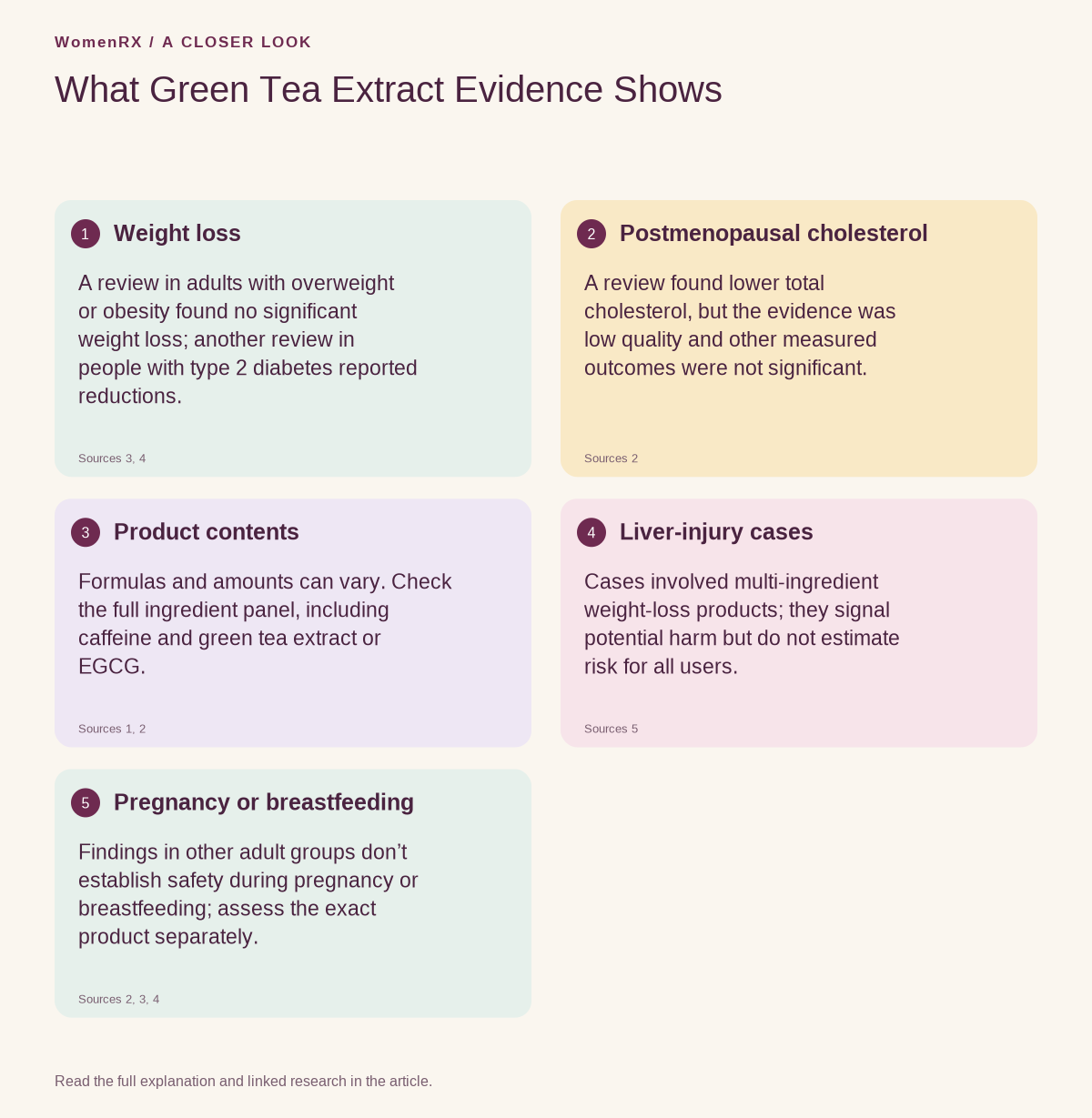
Weight loss: A review in adults with overweight or obesity found no significant weight loss; another review in people with type 2 diabetes reported reductions.34
Postmenopausal cholesterol: A review found lower total cholesterol, but the evidence was low quality and other measured outcomes were not significant.2
Product contents: Formulas and amounts can vary. Check the full ingredient panel, including caffeine and green tea extract or EGCG.12
Liver-injury cases: Cases involved multi-ingredient weight-loss products; they signal potential harm but do not estimate risk for all users.5
Pregnancy or breastfeeding: Findings in other adult groups don’t establish safety during pregnancy or breastfeeding; assess the exact product separately.234
Read the figure as text
Compare the outcomes studied with the safety and product details that matter when considering a concentrated extract.- Weight loss: A review in adults with overweight or obesity found no significant weight loss; another review in people with type 2 diabetes reported reductions.34
- Postmenopausal cholesterol: A review found lower total cholesterol, but the evidence was low quality and other measured outcomes were not significant.2
- Product contents: Formulas and amounts can vary. Check the full ingredient panel, including caffeine and green tea extract or EGCG.12
- Liver-injury cases: Cases involved multi-ingredient weight-loss products; they signal potential harm but do not estimate risk for all users.5
- Pregnancy or breastfeeding: Findings in other adult groups don’t establish safety during pregnancy or breastfeeding; assess the exact product separately.234
More questions, answered
Is green tea extract the same as drinking green tea?
No. Extracts are supplements with variable formulations and amounts of catechins and caffeine. Evidence about green tea as a beverage doesn’t establish the effects or safety of a particular concentrated extract. 1 2
Sources you can check
- Dietary Supplements for Weight Loss - Health Professional Fact SheetAccessed 2026-09-25Return to first citation
- Effects of green tea use on the metabolic profile of postmenopausal women: systematic review and meta-analysis.Zago IHR, Colonetti L, Balbinot EL, Taschetto IS, Grande AJ, da Rosa MI, Colonetti T. · European journal of nutrition · 2026Return to first citation
- Effect of Green Tea on Anthropometric Indices and Body Composition in Patients with Type 2 Diabetes Mellitus: A Systematic Review and Meta-Analysis.Asbaghi O, Fouladvand F, Gonzalez MJ, Aghamohammadi V, Choghakhori R, Abbasnezhad A. · Complementary medicine research · 2021Return to first citation
- [Effect of green tea or green tea extract consumption on body weight and body composition; systematic review and meta-analysis].Baladia E, Basulto J, Manera M, Martínez R, Calbet D. · Nutricion hospitalaria · 2014Return to first citation
- Risk of Liver Injury Associated with Green Tea Extract in SLIMQUICK(®) Weight Loss Products: Results from the DILIN Prospective Study.Zheng EX, Rossi S, Fontana RJ, Vuppalanchi R, Hoofnagle JH, Khan I, Navarro VJ. · Drug safety · 2016Return to first citation