Green Tea Extract After 40: Is It Worth Taking?
Being over 40 or going through menopause doesn’t, by itself, make green tea extract a proven health supplement.
There’s no clear reason to take green tea extract simply because you’re over 40. Menopause guidance does not recommend supplements and herbal remedies for hot flashes or other vasomotor symptoms. In a large trial of postmenopausal women, liver-enzyme elevations were more common with a concentrated EGCG extract than with placebo. Your goal and the product you’re considering matter more than your birthday. 1 2
Start with the goal, not your age
“Over 40” isn’t a meaningful cutoff for deciding whether green tea extract is useful. Studies in postmenopausal women haven’t established that the extract works differently before or after a particular age. The evidence doesn’t establish a special benefit or safety profile for women just because they’re in their 40s. 2 3 4
If you’re considering it for hot flashes, the North American Menopause Society’s 2023 position statement does not recommend supplements and herbal remedies as a category of treatment for vasomotor symptoms. That isn’t proof that every individual supplement has been tested and found ineffective, but green tea extract isn’t an evidence-backed choice for treating hot flashes based on this guidance. 1
For weight loss, a 12-week randomized trial studied 102 women with central obesity who received high-dose green tea extract or placebo. Weight and waist measurements fell in the extract group, but the reported results don’t give a clear between-group difference for those outcomes or establish whether menopausal status changed the effect. A change within the extract group alone can’t tell you how much benefit the supplement added over placebo, particularly if you’re asking about a benefit specific to life after 40. 3
The safety question deserves real weight
The most useful safety finding comes from a randomized, placebo-controlled trial of 1,075 postmenopausal women. Over one year, participants took an extract containing 843 mg of EGCG daily or placebo. Liver-enzyme elevations occurred in 6.7% of the extract group and 0.7% of the placebo group. The study also reported nausea more often with the extract. Most adverse events were described as mild and temporary, but the liver-enzyme difference is a reason not to treat concentrated extract as interchangeable with an ordinary cup of tea. 2
A separate, smaller trial in postmenopausal women with osteopenia found no effect on measured liver or kidney function over 24 weeks among participants taking green tea polyphenols. That’s reassuring for that study’s preparation, participants, and timeframe, but it doesn’t cancel out the liver-enzyme signal in the larger year-long trial. The studies used different preparations and durations, so they don’t establish that every green tea extract has the same risk. 4 2
Check the product and your health context
Before choosing an extract, look for the amount of EGCG and any stated caffeine content on the product label. If caffeine is listed, consider it alongside the coffee, tea, energy drinks, or other supplements you already use. If the label doesn’t make the caffeine content clear, don’t guess that the extract is caffeine-free; ask the manufacturer or a pharmacist what the label means. These checks help you assess a particular product, not predict its effects from the trials above.
For medicines, bring a pharmacist the exact product label and a list of what you take, including prescriptions, over-the-counter medicines, and other supplements. Ask whether anything on that list raises a concern with that product. The trials discussed here do not establish a specific medicine interaction, so they aren’t a sound basis for naming one. If you have a liver condition or a history of abnormal liver tests, the liver-enzyme finding is especially worth raising with your clinician before deciding whether to use a concentrated extract. 2
A simple decision
If your goal is hot-flash relief, don’t count on green tea extract as a proven treatment. If your goal is weight loss, the small trial doesn’t establish a benefit specific to women after 40. For either goal, weigh what you hope to gain against the liver finding and what you can learn about the actual product’s EGCG, caffeine, and fit with your medicines and health history. Age 40 doesn’t answer those questions for you. 1 2 3
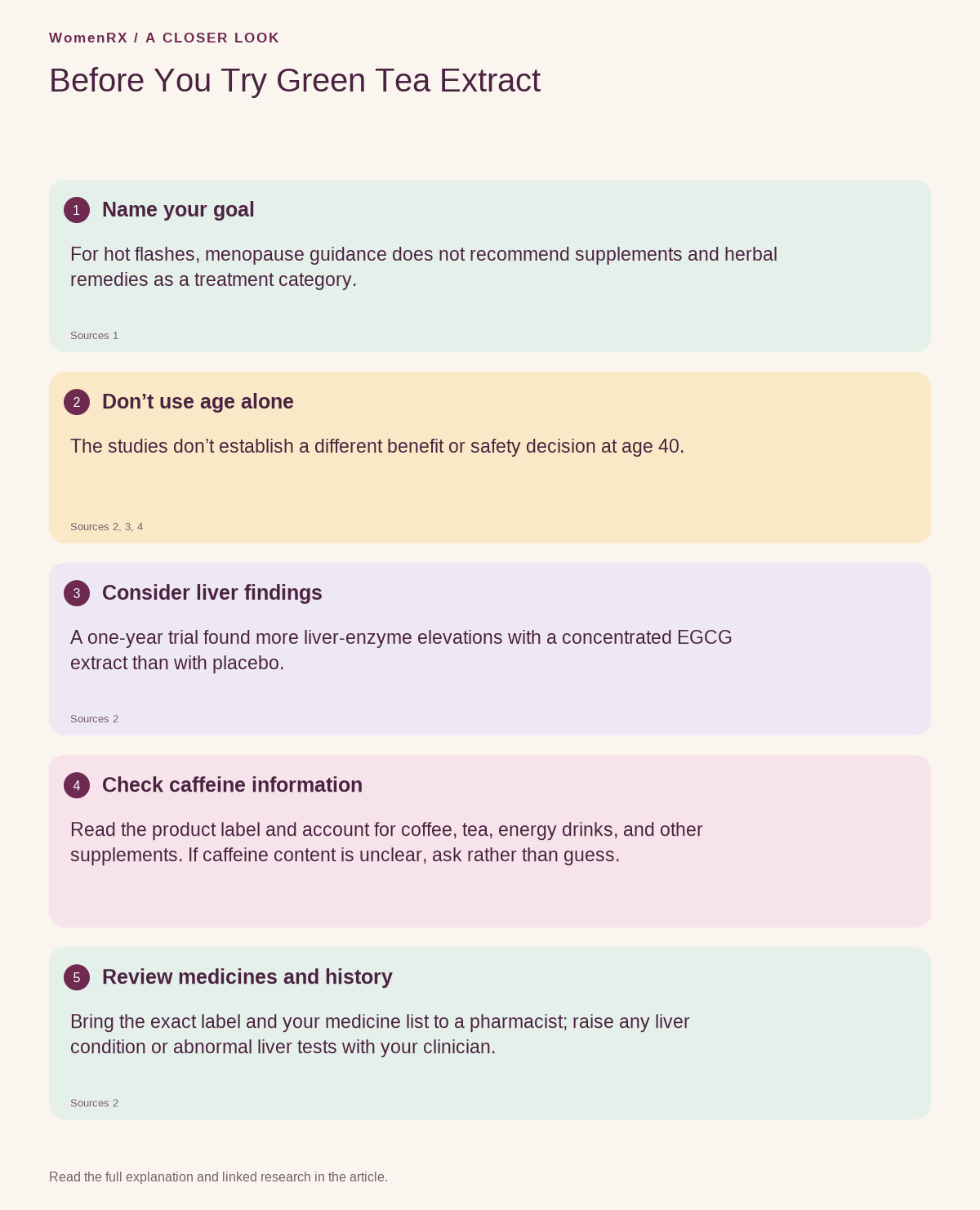
Before You Try Green Tea Extract
Name your goal: For hot flashes, menopause guidance does not recommend supplements and herbal remedies as a treatment category.1
Don’t use age alone: The studies don’t establish a different benefit or safety decision at age 40.234
Consider liver findings: A one-year trial found more liver-enzyme elevations with a concentrated EGCG extract than with placebo.2
Check caffeine information: Read the product label and account for coffee, tea, energy drinks, and other supplements. If caffeine content is unclear, ask rather than guess.
Review medicines and history: Bring the exact label and your medicine list to a pharmacist; raise any liver condition or abnormal liver tests with your clinician.2
Read the figure as text
Use these checks to connect your goal and health context to the product you’re actually considering. They aren’t a safety score.- Name your goal: For hot flashes, menopause guidance does not recommend supplements and herbal remedies as a treatment category.1
- Don’t use age alone: The studies don’t establish a different benefit or safety decision at age 40.234
- Consider liver findings: A one-year trial found more liver-enzyme elevations with a concentrated EGCG extract than with placebo.2
- Check caffeine information: Read the product label and account for coffee, tea, energy drinks, and other supplements. If caffeine content is unclear, ask rather than guess.
- Review medicines and history: Bring the exact label and your medicine list to a pharmacist; raise any liver condition or abnormal liver tests with your clinician.2
More questions, answered
Does green tea extract treat hot flashes?
The 2023 North American Menopause Society position statement does not recommend supplements and herbal remedies for menopause-related vasomotor symptoms. It does not identify green tea extract as a proven hot-flash treatment. 1
Is green tea extract the same as drinking green tea?
The safety trial discussed here tested a concentrated extract supplying 843 mg of EGCG daily, not brewed tea. Its liver-enzyme findings apply to the tested supplement regimen and shouldn’t be assumed to describe every green tea product. 2
Sources you can check
- The 2023 nonhormone therapy position statement of The North American Menopause Society.Menopause (New York, N.Y.) · 2023Return to first citation
- The safety of green tea extract supplementation in postmenopausal women at risk for breast cancer: results of the Minnesota Green Tea Trial.Dostal AM, Samavat H, Bedell S, Torkelson C, Wang R, Swenson K, Le C, Wu AH, Ursin G, Yuan JM, Kurzer MS. · Food and chemical toxicology : an international journal published for the British Industrial Biological Research Association · 2015Return to first citation
- Therapeutic effect of high-dose green tea extract on weight reduction: A randomized, double-blind, placebo-controlled clinical trial.Chen IJ, Liu CY, Chiu JP, Hsu CH. · Clinical nutrition (Edinburgh, Scotland) · 2016Return to first citation
- Green tea polyphenols supplementation and Tai Chi exercise for postmenopausal osteopenic women: safety and quality of life report.Shen CL, Chyu MC, Pence BC, Yeh JK, Zhang Y, Felton CK, Doctolero S, Wang JS. · BMC complementary and alternative medicine · 2010Return to first citation