Green Tea Extract Labels: EGCG, Caffeine, and Safety
Check the EGCG and caffeine amounts separately: a concentrated extract isn’t equivalent to a cup of brewed tea.
There isn’t one green tea extract amount that can be recommended for everyone. Start by checking how much EGCG and caffeine the label lists per serving, then account for how many servings you’d take. Concentrated catechin-rich extracts have been linked with liver effects, especially as large bolus doses; brewed tea and extracts in foods or beverages showed a different safety pattern in a systematic review. 2
Read three parts of the label
Look for the serving size, the amount of green tea extract, and any separate amounts for total catechins, EGCG, and caffeine. These numbers describe different things. EGCG is one catechin in green tea extract; total catechins include more than EGCG. Caffeine is a separate constituent, so an EGCG amount does not tell you how much caffeine is in the product. If the label gives an amount per serving, multiply it by the number of servings you’d take in a day. If it doesn’t disclose EGCG or caffeine, you can’t use the label to determine your exposure to those ingredients.
For example, a label might list extract and total catechins but no EGCG amount. That tells you the product contains catechins, but not how much of that total is EGCG. Don’t treat the extract weight, catechin amount, and EGCG amount as interchangeable.
Why a capsule is not just tea in a smaller form
The form and pattern of intake matter. A systematic review of toxicology and human intervention studies found liver-related adverse events with a limited range of concentrated, catechin-rich preparations, particularly when taken as large bolus doses. The review did not find the same pattern for brewed tea or extracts consumed in beverages or food. That means tea-drinking experience can’t establish that a concentrated capsule is equally safe. 2
The review derived an intake level of 338 mg EGCG per day for adult solid-dose preparations from toxicology and human safety data. It also described an observed safe level of 704 mg per day for tea preparations in beverage form, based on human adverse-event data. These are findings from one systematic review, not personal targets or a guarantee that a supplement at or below either amount is safe for you. The different figures also shouldn’t be used to convert a beverage into an equivalent capsule dose. 2
Consider the goal before taking it
If you’re considering green tea extract for weight management, don’t assume a concentrated product will lead to weight loss. In a 12-month randomized trial subset of 237 overweight or obese postmenopausal women, decaffeinated extract containing 843 mg EGCG daily was not associated with reductions in body weight, BMI, or waist circumference compared with placebo. That trial applies to the women studied and product tested; it doesn’t settle every possible use or product, but it doesn’t support relying on extract for weight loss. 3
A safety check before use
- Check the actual EGCG amount. If only extract weight or total catechins are listed, those figures don’t give you the EGCG amount.
- Check caffeine separately. Include caffeine from other drinks, foods, and medicines when considering your overall intake. Caffeine can raise blood pressure; MedlinePlus notes that some people taking stimulants, certain antibiotics, asthma medicines, or heart medicines should check whether caffeine is appropriate with their medicines. 1
- Take liver risk seriously. Concentrated, catechin-rich extracts have been associated with liver adverse events in human intervention studies. A label amount alone can’t guarantee an individual product will be safe for you. 2
- Review your medicines and supplements. Bring the exact product label and your full list to a pharmacist or clinician. Don’t assume green tea extract interacts with every medicine, but do ask about your particular combination.
Pregnancy and breastfeeding are separate questions
If you’re pregnant, caffeine deserves its own check because it passes through the placenta. Ask your pregnancy care team how to handle caffeine from all sources, and don’t assume a concentrated extract has the same profile as brewed tea. 12
For breastfeeding, the findings discussed above don’t establish a safe amount of green tea extract. Don’t use a brewed-tea comparison as proof that a concentrated supplement is safe during this period. If you’re considering one, review the product and your caffeine intake with your care team.
The useful takeaway is simple: if the label doesn’t clearly state EGCG and caffeine, you can’t make a well-informed comparison. And even a clearly labeled product should be weighed against the uncertain benefit and the distinct liver risk of concentrated extracts.
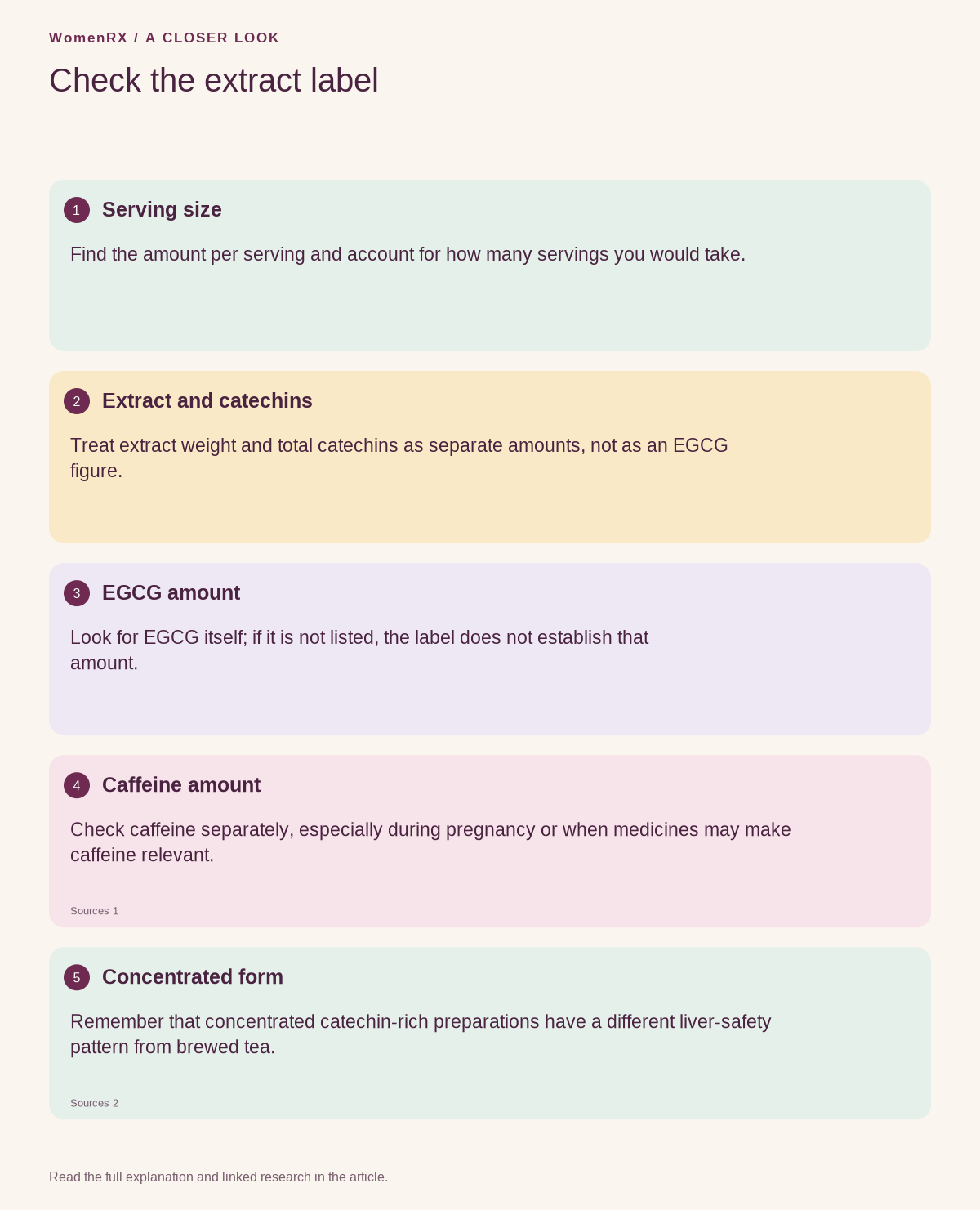
Check the extract label
Serving size: Find the amount per serving and account for how many servings you would take.
Extract and catechins: Treat extract weight and total catechins as separate amounts, not as an EGCG figure.
EGCG amount: Look for EGCG itself; if it is not listed, the label does not establish that amount.
Caffeine amount: Check caffeine separately, especially during pregnancy or when medicines may make caffeine relevant.1
Concentrated form: Remember that concentrated catechin-rich preparations have a different liver-safety pattern from brewed tea.2
Read the figure as text
Use these separate checks to understand what the product lists and what it leaves unclear.- Serving size: Find the amount per serving and account for how many servings you would take.
- Extract and catechins: Treat extract weight and total catechins as separate amounts, not as an EGCG figure.
- EGCG amount: Look for EGCG itself; if it is not listed, the label does not establish that amount.
- Caffeine amount: Check caffeine separately, especially during pregnancy or when medicines may make caffeine relevant.1
- Concentrated form: Remember that concentrated catechin-rich preparations have a different liver-safety pattern from brewed tea.2
More questions, answered
Does the amount of green tea extract equal the amount of EGCG?
No. Extract weight, total catechins, and EGCG are different amounts. Use the EGCG figure if you’re comparing EGCG exposure, and don’t infer it from extract weight alone.
Does decaffeinated green tea extract avoid the liver concern?
Decaffeinated doesn’t mean free of catechins or EGCG. A randomized trial in postmenopausal women used decaffeinated extract containing EGCG, while the liver concern in a systematic review was associated with concentrated catechin-rich preparations. 23
Sources you can check
- Caffeine: MedlinePlusAccessed 2026-09-25Return to first citation
- The safety of green tea and green tea extract consumption in adults - Results of a systematic review.Hu J, Webster D, Cao J, Shao A. · Regulatory toxicology and pharmacology : RTP · 2018Return to first citation
- Green Tea Extract and Catechol-O-Methyltransferase Genotype Modify Fasting Serum Insulin and Plasma Adiponectin Concentrations in a Randomized Controlled Trial of Overweight and Obese Postmenopausal Women.Dostal AM, Samavat H, Espejo L, Arikawa AY, Stendell-Hollis NR, Kurzer MS. · The Journal of nutrition · 2016Return to first citation