Green Tea Extract: Safety Risks and Label Checks
A green tea extract capsule isn’t interchangeable with a cup of tea: check the catechin and caffeine amounts separately, and take liver-injury reports seriously.
Brewed green tea and concentrated extracts aren’t the same exposure. Extracts can contain varying amounts of catechins, including EGCG. Check whether a specific product declares caffeine, too. Rare liver injuries have been reported in connection with green tea extract; a US case series included six injuries attributed to SLIMQUICK products, five of which listed green tea extract or catechins. 2 3 4
Start with the form, not the name
“Green tea” can mean a brewed drink or a concentrated supplement. A cup is made by steeping leaves in water; an extract is a prepared ingredient in a product such as a capsule or weight-loss formula. They shouldn’t be assumed to deliver the same amounts of active compounds or carry the same safety evidence.
Green tea extracts contain catechins, including EGCG, but catechin content can vary. That makes the product’s actual label more useful than the words “green tea” on the front. 2
| What to compare | Brewed tea | Extract supplement |
|---|---|---|
| Form | Leaves steeped in water | Concentrated ingredient in a product |
| Catechins | Amount isn’t specified for an individual cup | Catechin content can vary; check whether EGCG or total catechins are stated 2 |
| Caffeine | Tea contains caffeine; an 8-ounce cup can contain 14-60 mg 1 | Check whether caffeine is listed and how much is in a serving |
| Main safety question | How caffeine affects you and your overall intake | Catechin exposure, caffeine if declared, other ingredients, and rare liver-injury reports 1 3 4 |
A practical label check
Look for these details before comparing an extract with tea or with another supplement:
- Serving size and servings per day. Work out how many servings the label’s suggested daily use would mean, rather than looking only at the amount in one capsule.
- EGCG or total catechins. If the label gives only the weight of “green tea extract,” it doesn’t tell you how much EGCG or total catechins you’re getting. Extracts can vary in catechin content. 2
- Caffeine. Check whether the product states a caffeine amount, including for a blend. If an amount isn’t stated, the label may not give you enough information to count it toward your caffeine intake. Too much caffeine can cause restlessness and shakiness. 1
- Other ingredients. Green tea extract is sometimes included in multi-ingredient weight-loss products. When several ingredients are present, a reported liver injury can be harder to attribute to one component. 4
If the label doesn’t let you tell how much catechin or caffeine a serving contains, you can’t make a dependable dose-to-dose comparison. A larger number for “extract” alone doesn’t resolve that uncertainty.
What the liver-injury evidence says
A review describes liver-toxicity reports involving green tea extract catechins as rare. Those reports don’t tell us how often liver injury occurs among people who use the supplements. A prospective US liver-injury network study described six cases attributed to SLIMQUICK products among 1,091 liver-injury cases enrolled between 2007 and 2011. All six people were women; five of the six products listed green tea extract or its catechins. Three women were hospitalized and one received a liver transplant. This was a case series within a group already being evaluated for liver injury, not a measure of how often supplement users are affected. These cases don’t prove green tea extract caused each injury; it was listed in five of the six products. 3 4
The review’s discussion of drug interactions is more limited: laboratory studies found effects on several drug-metabolizing enzymes, but the review described a clinical study as indicating only a small risk of increased plasma levels for drugs metabolized by CYP3A4, a finding the authors considered not clinically relevant. That does not establish a meaningful interaction with every medicine, or rule out a concern for a particular product and medication. 3
In practice, don’t assume that a supplement is safe for your liver because brewed tea is familiar, or that a product is a “detox” simply because it contains tea extract. If you take medicines, show the full supplement label to a pharmacist or prescriber so they can assess the specific ingredients and your medication. Available interaction findings don’t support a blanket list of medicines that interact with all green tea extracts.
Pregnancy and breastfeeding: caffeine is a separate question
Caffeine passes through the placenta, and a small amount of caffeine consumed by a breastfeeding person passes to the baby. MedlinePlus advises people who are pregnant or breastfeeding to check whether they should limit or avoid caffeine. 1
That caffeine consideration doesn’t settle the safety question for concentrated extracts. Check whether the product declares caffeine, and read any catechin information separately. A caffeine total can’t stand in for understanding the rest of the product. 1 2
The useful bottom line
If you’re choosing between a cup of tea and an extract, compare what’s actually declared: caffeine on both sides where available, and EGCG or total catechins on the supplement label. Brewed tea’s caffeine amount can vary, while extract catechin content can vary too. If key amounts are missing, the product doesn’t offer enough information for a meaningful comparison. 1 2
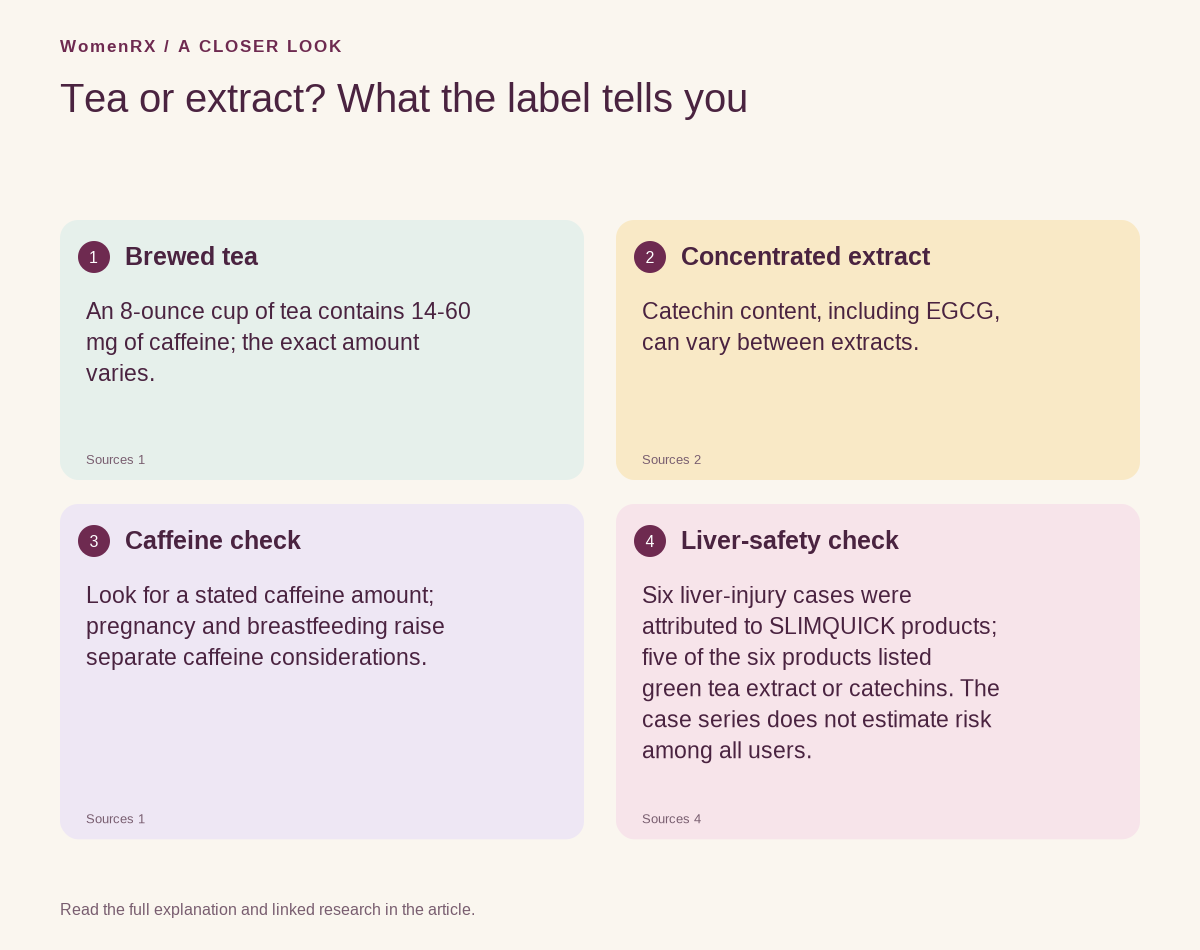
Tea or extract? What the label tells you
Brewed tea: An 8-ounce cup of tea contains 14-60 mg of caffeine; the exact amount varies.1
Concentrated extract: Catechin content, including EGCG, can vary between extracts.2
Caffeine check: Look for a stated caffeine amount; pregnancy and breastfeeding raise separate caffeine considerations.1
Liver-safety check: Six liver-injury cases were attributed to SLIMQUICK products; five of the six products listed green tea extract or catechins. The case series does not estimate risk among all users.4
Read the figure as text
Compare the preparation, declared compounds, and main safety questions without assuming a supplement is equivalent to a cup of tea.- Brewed tea: An 8-ounce cup of tea contains 14-60 mg of caffeine; the exact amount varies.1
- Concentrated extract: Catechin content, including EGCG, can vary between extracts.2
- Caffeine check: Look for a stated caffeine amount; pregnancy and breastfeeding raise separate caffeine considerations.1
- Liver-safety check: Six liver-injury cases were attributed to SLIMQUICK products; five of the six products listed green tea extract or catechins. The case series does not estimate risk among all users.4
More questions, answered
How can I tell whether an extract adds to my caffeine intake?
Check the specific product for a stated caffeine amount. If it isn’t provided, you may not be able to count that product precisely toward your caffeine intake. Keep that question separate from how much EGCG or other catechins the product contains. 1 2
Do green tea extract and my medicine definitely interact?
No blanket interaction is established here. A review describes enzyme effects in laboratory studies, but says a clinical study indicated only a small risk of increased plasma levels for some CYP3A4-metabolized medicines, which the review authors considered not clinically relevant. Check the specific product and medicine with a pharmacist or prescriber. 3
Sources you can check
- Caffeine: MedlinePlusAccessed 2026-09-25Return to first citation
- Liver Injury Caused by Green Tea Extract in PD-1-/- Mice: An Impaired Immune Tolerance Model for Idiosyncratic Drug-Induced Liver Injury.Cho T, Wang X, Yeung K, Cao Y, Uetrecht J. · Chemical research in toxicology · 2021Return to first citation
- Green tea extract and the risk of drug-induced liver injury.Teschke R, Zhang L, Melzer L, Schulze J, Eickhoff A. · Expert opinion on drug metabolism & toxicology · 2014Return to first citation
- Risk of Liver Injury Associated with Green Tea Extract in SLIMQUICK(®) Weight Loss Products: Results from the DILIN Prospective Study.Zheng EX, Rossi S, Fontana RJ, Vuppalanchi R, Hoofnagle JH, Khan I, Navarro VJ. · Drug safety · 2016Return to first citation