How to Vet a Green Tea Extract Label
The most useful label tells you how much EGCG and caffeine you’d get, not just how many milligrams of extract are in a capsule.
Start with the amount of EGCG per serving, then check the serving directions to understand how much you’d get in a day. Look separately for caffeine, product-specific quality documentation, and liver and medicine warnings. Concentrated extract isn’t interchangeable with brewed tea: liver injury has been linked to some catechin-rich supplements, while no comparable safety concern has been reported for green tea consumed as a beverage by adults. 24
First, find out what the number describes
A front label might advertise a large number of milligrams of green tea extract. That’s the weight of the extract, not necessarily the amount of EGCG, the catechin most relevant to the liver-safety research. Extracts can differ substantially in their catechin profiles depending on how they’re made. 3
Turn to the Supplement Facts panel and look for three separate pieces of information: extract per serving, total catechins per serving, and EGCG per serving. If only the extract weight appears, you can’t tell from that number how much EGCG you’re comparing. If the label gives an EGCG percentage rather than milligrams, check whether it clearly says what that percentage refers to. Then read the serving directions. A per-capsule figure and a per-day figure answer different questions.
This isn’t a contest to find the highest EGCG number. A systematic review found that liver-related adverse events in human intervention studies occurred with a limited range of concentrated, catechin-rich preparations taken in large bolus doses, rather than with brewed tea or extracts consumed in beverages or food. The review also found that risk related to the amount of catechins and EGCG consumed. It does not follow that any single number on a supplement label guarantees safety for everyone. 23
Read the caffeine line separately
Green tea contains caffeine, and green tea products vary in composition. Check whether the label gives caffeine in milligrams per serving, then compare that with the serving directions and any other caffeine you regularly consume. If it says only “contains caffeine” or gives no amount, you don’t have a number to use in that comparison. Don’t treat a statement about EGCG or catechins as a statement about caffeine. 4
Caffeine deserves a separate look if you’re pregnant or breastfeeding. During pregnancy, caffeine intake should stay within moderate levels; caffeine also passes into breast milk, and high intake may cause fussiness or poor sleep in an infant. Those points concern caffeine. They don’t establish the safety of a concentrated extract during pregnancy or breastfeeding, so bring the exact product information to your pregnancy or postpartum care team before using it. 4
Ask what the quality paperwork actually verifies
A useful quality question is: Does the company provide documentation for the specific product and lot I’d buy? Look for a document that identifies what was measured, which lot was tested, and whether it reports EGCG, total catechins, and caffeine. If those details aren’t available, the label may still let you compare stated amounts, but it won’t let you check them against lot-specific results.
Keep quality and safety as separate questions. Manufacturing affects an extract’s catechin profile, so measured composition is useful. The United States Pharmacopeia (USP) review also considered possible impurities, but found no evidence in its review that those impurities caused the green tea extract-associated liver injuries it examined. A clean-looking quality document therefore isn’t proof that an EGCG-rich extract cannot cause liver problems. 3
Take liver and medicine warnings seriously
Look for cautions about liver problems, taking the extract on an empty stomach, and symptoms that call for stopping use. USP’s monograph for powdered decaffeinated green tea extract requires a caution not to take it on an empty stomach or use it if you have a liver problem, and to stop and seek medical advice if symptoms such as abdominal pain, dark urine, or yellowing of the skin or eyes develop. That is a requirement for a particular monograph, not a claim that every extract label carries the same wording. Decaffeination doesn’t make the liver question disappear. 3
The concern is relevant to women, not just to studies that pooled everyone together. In a secondary analysis of a 12-month randomized trial involving postmenopausal women, researchers examined liver-test changes during supplementation with a high-dose extract providing 843 mg of EGCG daily. They found differences in liver-test changes by genetic variant among women taking the extract. That result doesn’t predict what will happen with a particular retail product or establish a safe dose for an individual. 1
Finally, compare the product with your medicines, not just with other supplements. Green tea at high doses has been shown to reduce blood levels of nadolol, which could reduce its effectiveness. Green tea extract can reduce blood levels of atorvastatin, and an interaction with raloxifene has also been observed. If you take one of these medicines, have the exact product and its ingredient amounts reviewed before using it; a label that says “natural” doesn’t address an interaction. 4
The practical choice is often between a label that answers these questions and one that leaves you guessing. You don’t need to reward the biggest extract number. You need enough information to understand what you’d actually be taking.
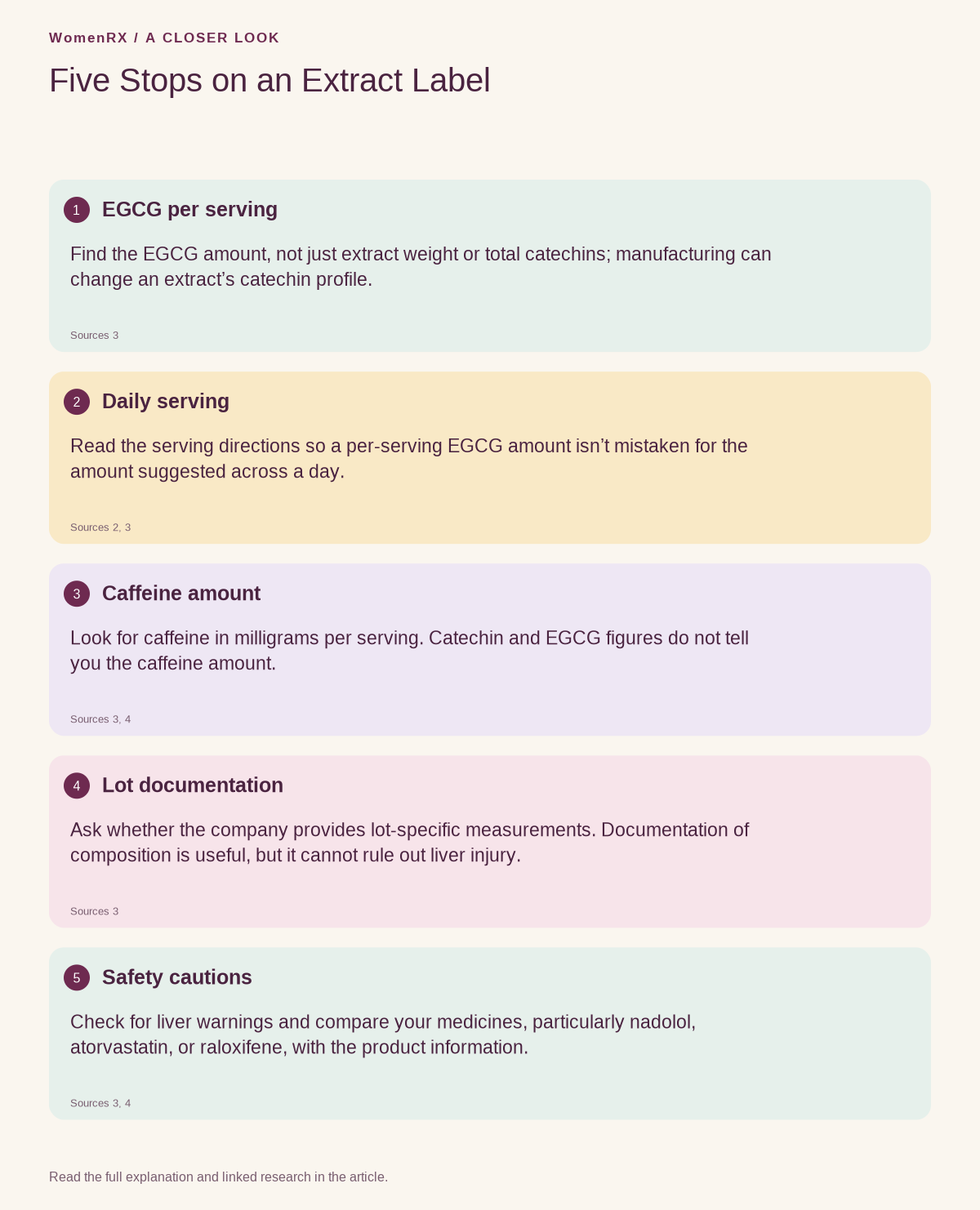
Five Stops on an Extract Label
EGCG per serving: Find the EGCG amount, not just extract weight or total catechins; manufacturing can change an extract’s catechin profile.3
Daily serving: Read the serving directions so a per-serving EGCG amount isn’t mistaken for the amount suggested across a day.23
Caffeine amount: Look for caffeine in milligrams per serving. Catechin and EGCG figures do not tell you the caffeine amount.34
Lot documentation: Ask whether the company provides lot-specific measurements. Documentation of composition is useful, but it cannot rule out liver injury.3
Safety cautions: Check for liver warnings and compare your medicines, particularly nadolol, atorvastatin, or raloxifene, with the product information.34
Read the figure as text
Use these checks to see which comparisons the label supports and which questions remain open.- EGCG per serving: Find the EGCG amount, not just extract weight or total catechins; manufacturing can change an extract’s catechin profile.3
- Daily serving: Read the serving directions so a per-serving EGCG amount isn’t mistaken for the amount suggested across a day.23
- Caffeine amount: Look for caffeine in milligrams per serving. Catechin and EGCG figures do not tell you the caffeine amount.34
- Lot documentation: Ask whether the company provides lot-specific measurements. Documentation of composition is useful, but it cannot rule out liver injury.3
- Safety cautions: Check for liver warnings and compare your medicines, particularly nadolol, atorvastatin, or raloxifene, with the product information.34
More questions, answered
Is decaffeinated green tea extract free of the liver concern?
No. Caffeine and catechins are different components. USP’s liver-related cautionary labeling applies specifically to its powdered decaffeinated green tea extract monograph, so a decaffeinated claim doesn’t settle the EGCG or liver-safety question. 3
Sources you can check
- Hepatotoxicity with High-Dose Green Tea Extract: Effect of Catechol-O-Methyltransferase and Uridine 5'-Diphospho-glucuronosyltransferase 1A4 Genotypes.Acosta L, Byham-Gray L, Kurzer M, Samavat H. · Journal of dietary supplements · 2023Return to first citation
- The safety of green tea and green tea extract consumption in adults - Results of a systematic review.Hu J, Webster D, Cao J, Shao A. · Regulatory toxicology and pharmacology : RTP · 2018Return to first citation
- United States Pharmacopeia (USP) comprehensive review of the hepatotoxicity of green tea extracts.Oketch-Rabah HA, Roe AL, Rider CV, Bonkovsky HL, Giancaspro GI, Navarro V, Paine MF, Betz JM, Marles RJ, Casper S, Gurley B, Jordan SA, He K, Kapoor MP, Rao TP, Sherker AH, Fontana... · Toxicology reports · 2020Return to first citation
- Green Tea: Usefulness and Safety | NCCIHAccessed 2026-09-25Return to first citation