Green Tea Extract for Weight or Blood Sugar?
Green tea extract has a possible modest weight effect, but the blood-sugar claim is unproven and concentrated products carry liver-safety concerns.
Green tea extract may have a modest effect on body weight, but the evidence doesn’t make it a dependable weight-loss strategy. A blood-sugar benefit hasn’t been established. Brewed tea and concentrated extract aren’t interchangeable: liver damage has been reported with extracts, and one trial found more liver-enzyme elevations with extract than placebo. Check what a product contains before treating its claims like study results. 1 2 5
The weight finding needs context
Green tea contains catechins, including epigallocatechin gallate, or EGCG. Researchers have studied whether green tea and its extracts affect energy use and fat metabolism. Those proposed effects don’t tell you how much weight you’d lose. The NIH Office of Dietary Supplements describes the research finding as a possible modest effect on body weight. 1
In one randomized trial, 35 people with obesity and metabolic syndrome were assigned to water, brewed green tea, or green tea extract for eight weeks. Both tea groups had lower body weight than the water group at the end of the trial. That’s a finding worth studying, but eight weeks and 35 participants can’t establish whether weight changes last. The reported weight results weren’t broken down by sex, so they don’t show whether women responded differently. 3
Blood sugar isn’t the same outcome
Losing some weight in a trial doesn’t, by itself, show that an extract improves blood-sugar control. In a pilot randomized trial of 17 women with obesity, glucose was unchanged after eight weeks of EGCG or placebo. No between-group difference in the measured outcomes remained significant after correction for multiple comparisons. That small study can’t settle every possible effect, but it doesn’t support relying on EGCG for blood-sugar control. 5
The eight-week metabolic-syndrome trial also measured fasting glucose. Its reported weight finding does not establish improved glucose control. If blood sugar is your reason for considering a supplement, look for a glucose result rather than assuming a weight result answers the same question. 3
A cup of tea is not a capsule
Brewed green tea and an extract aren’t equivalent ways of getting green tea compounds. The NIH fact sheet says no safety concerns were reported for green tea used as a beverage, while listing nausea, abdominal discomfort, constipation, increased blood pressure, and liver damage among adverse effects reported with extracts. Green tea contains caffeine, and some weight-loss supplement labels don’t declare how much caffeine a product contains. 1
That makes the label useful for two separate questions: Does it state the amount of EGCG, and does it state the amount of caffeine? Neither answer guarantees that a product will work or be safe. But without them, it’s harder to tell whether a capsule resembles anything studied or how much caffeine it adds to what you already consume. 1 2
Pregnancy and breastfeeding call for a different decision than the adult trials discussed here can answer. Tea can contain caffeine, and these studies don’t establish an extract benefit or its safety during either stage. Don’t carry a result from a trial in postmenopausal women over to pregnancy or breastfeeding. 1 2 5
Why the liver finding matters
In a one-year randomized trial of 1,075 postmenopausal women, 6.7% assigned an extract containing 843 mg of EGCG daily had an elevation in ALT, a liver enzyme measured in blood, compared with 0.7% assigned placebo. ALT-related serious adverse events occurred in 1.3% of the extract group. Those numbers describe that particular product, amount, population, and timeframe, not a safe-or-unsafe cutoff for every supplement. 2
A different, 24-week trial in postmenopausal women with osteopenia found no effect of its green tea polyphenol supplement on measured liver or kidney function. Its supplement was reported as an amount of green tea polyphenols, while the one-year trial specified an amount of EGCG. The numbers on those products therefore shouldn’t be treated as equivalent doses. The smaller, shorter trial is reassuring for what it tested; it doesn’t cancel the liver signal in the larger trial. 2 4
The tradeoff is a possible modest weight effect against a safety concern that matters most when you’re considering a concentrated product. If its EGCG and caffeine amounts aren’t clear, even that tradeoff becomes harder to assess. And if blood sugar is the goal, the weight evidence doesn’t supply the missing glucose benefit. 1 2 3 5
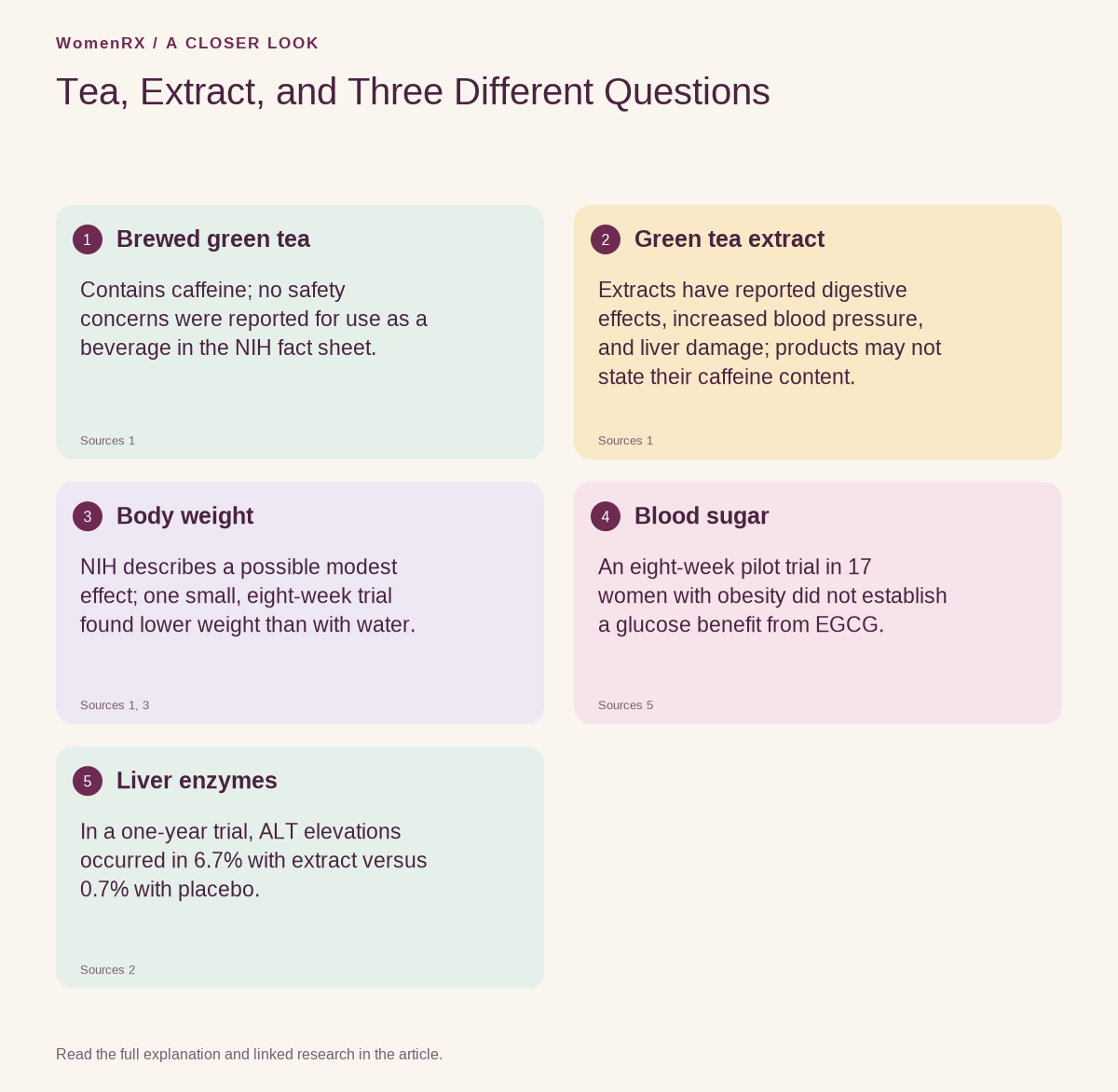
Tea, Extract, and Three Different Questions
Brewed green tea: Contains caffeine; no safety concerns were reported for use as a beverage in the NIH fact sheet.1
Green tea extract: Extracts have reported digestive effects, increased blood pressure, and liver damage; products may not state their caffeine content.1
Body weight: NIH describes a possible modest effect; one small, eight-week trial found lower weight than with water.13
Blood sugar: An eight-week pilot trial in 17 women with obesity did not establish a glucose benefit from EGCG.5
Liver enzymes: In a one-year trial, ALT elevations occurred in 6.7% with extract versus 0.7% with placebo.2
Read the figure as text
Compare the form of green tea with what the weight, glucose, and liver studies actually measured.- Brewed green tea: Contains caffeine; no safety concerns were reported for use as a beverage in the NIH fact sheet.1
- Green tea extract: Extracts have reported digestive effects, increased blood pressure, and liver damage; products may not state their caffeine content.1
- Body weight: NIH describes a possible modest effect; one small, eight-week trial found lower weight than with water.13
- Blood sugar: An eight-week pilot trial in 17 women with obesity did not establish a glucose benefit from EGCG.5
- Liver enzymes: In a one-year trial, ALT elevations occurred in 6.7% with extract versus 0.7% with placebo.2
Sources you can check
- Dietary Supplements for Weight Loss - Health Professional Fact SheetAccessed 2026-09-25Return to first citation
- The safety of green tea extract supplementation in postmenopausal women at risk for breast cancer: results of the Minnesota Green Tea Trial.Dostal AM, Samavat H, Bedell S, Torkelson C, Wang R, Swenson K, Le C, Wu AH, Ursin G, Yuan JM, Kurzer MS. · Food and chemical toxicology : an international journal published for the British Industrial Biological Research Association · 2015Return to first citation
- Green tea supplementation affects body weight, lipids, and lipid peroxidation in obese subjects with metabolic syndrome.Basu A, Sanchez K, Leyva MJ, Wu M, Betts NM, Aston CE, Lyons TJ. · Journal of the American College of Nutrition · 2010Return to first citation
- Green tea polyphenols supplementation and Tai Chi exercise for postmenopausal osteopenic women: safety and quality of life report.Shen CL, Chyu MC, Pence BC, Yeh JK, Zhang Y, Felton CK, Doctolero S, Wang JS. · BMC complementary and alternative medicine · 2010Return to first citation
- Effect of Epigallocatechin Gallate Supplementation on Inflammation, Iron Status, and Metabolomic Profiles in Women With Obesity: A Pilot Randomized Controlled Trial.Aguree S, Turi KN, Handt AR, Kohut M, Reddy MB. · Molecular nutrition & food research · 2026Return to first citation