Green Tea Extract: What to Check Before Continuing
An oral green tea extract deserves a different safety decision from a cup of tea, especially if you plan to keep taking it.
No dose or duration in the cited safety guidance establishes that continued green tea extract use is safe. Liver injury is uncommon but has been reported primarily with extracts in tablets or capsules. 5 Check what you actually take, how long you’ve taken it, any changes, and your medicines. If you develop dark urine, yellowing skin or eyes, or pale stools, stop the extract and seek prompt medical care. 56
Start with the extract, not the tea
Brewed green tea and an oral extract aren’t interchangeable safety comparisons. No safety concerns have been reported for green tea consumed as a beverage by adults, although it contains caffeine. Liver injury has been reported primarily with green tea extracts in tablets or capsules. That doesn’t mean injury is likely for any one person, but years of drinking tea can’t answer whether a concentrated supplement is right for you. 5
Look at the container rather than relying on the words “green tea.” Record the product name, every listed ingredient, the labeled amount, and how much you actually take. A supplement may contain several ingredients, and its actual ingredients or amounts may differ from its label. Results from testing one product may not apply to another. If you’ve switched products or changed how much you take, note that too, even if both labels say “green tea extract.” 4
A quality check does not resolve the safety question. LactMed notes that a manufacturer may use independent verification of a product or its ingredients, but verification does not certify that the supplement is safe or effective. Product details make the decision more specific; they are not a guarantee about continued use. 4
What months of use can and can’t tell you
If you’ve taken the same extract for a long time without noticing a problem, that’s part of your history. Note when you started, whether you take it regularly, and whether the product or amount has changed. The safety guidance does not identify a dose or duration that establishes safety for continued extract use. Green tea extract is among the supplements implicated in liver injury, and a review concerning liver transplant care describes its liver-injury potential as idiosyncratic, meaning individual susceptibility matters. Reports of injury don’t establish your personal chance of harm or a duration after which it disappears. 1235
So the useful question isn’t simply, “How long have I taken it?” It’s, “What am I continuing to take, and what am I getting from it?” For example, if your goal is weight loss, evidence suggests green tea catechins and caffeine may have a modest effect, which can vary with the product. If your goal is cholesterol reduction, trials, mostly of extracts, have found small reductions in total and LDL cholesterol. A hoped-for benefit deserves to be weighed against the liver concern rather than assumed from the word “green” on the label. 5
Know which symptoms change the decision
Nausea and abdominal discomfort are reported side effects of green tea extract supplements; constipation and increased blood pressure are also reported. Nausea or belly discomfort alone can’t tell you whether your liver is injured. 56
Dark urine, yellowing of the skin or eyes, and pale or clay-colored stools are possible signs of liver injury. If these appear while you’re taking an extract, stop taking it and seek prompt medical care rather than waiting to see whether they pass. A clinician can assess the symptoms and check for liver injury; the symptoms alone do not establish that the extract caused it. 56
Check prescription medicines alongside the supplement. This isn’t just a general warning about mixing products: green tea extract can reduce blood levels of atorvastatin, a cholesterol-lowering medicine. If you take atorvastatin, raise that specific combination with your prescriber or pharmacist before continuing the extract. Green tea may interact with other medicines as well, so include your other supplements and medicines in that conversation. 5
Pregnancy and breastfeeding change the question
The liver-injury reporting summarized in clinical reviews and public guidance does not provide a women-specific risk estimate. It cannot tell you how likely liver injury is for you on the basis of sex. 25
If you’re pregnant or might be, don’t use ordinary tea consumption as reassurance about an extract. Green tea is a source of caffeine, and pregnancy advice needs to account for caffeine intake; discuss the extract and its label with your prenatal care team before continuing it. 5
If you’re breastfeeding, LactMed found no studies examining oral green tea extract use during breastfeeding. Information about caffeine from maternal tea drinking doesn’t fill that extract-specific gap. 45
The decision is whether the benefit you expect from this particular extract warrants continuing despite its reported liver-injury concern. A familiar label, previous tea drinking, or time already spent taking the supplement cannot answer that question for you. 145
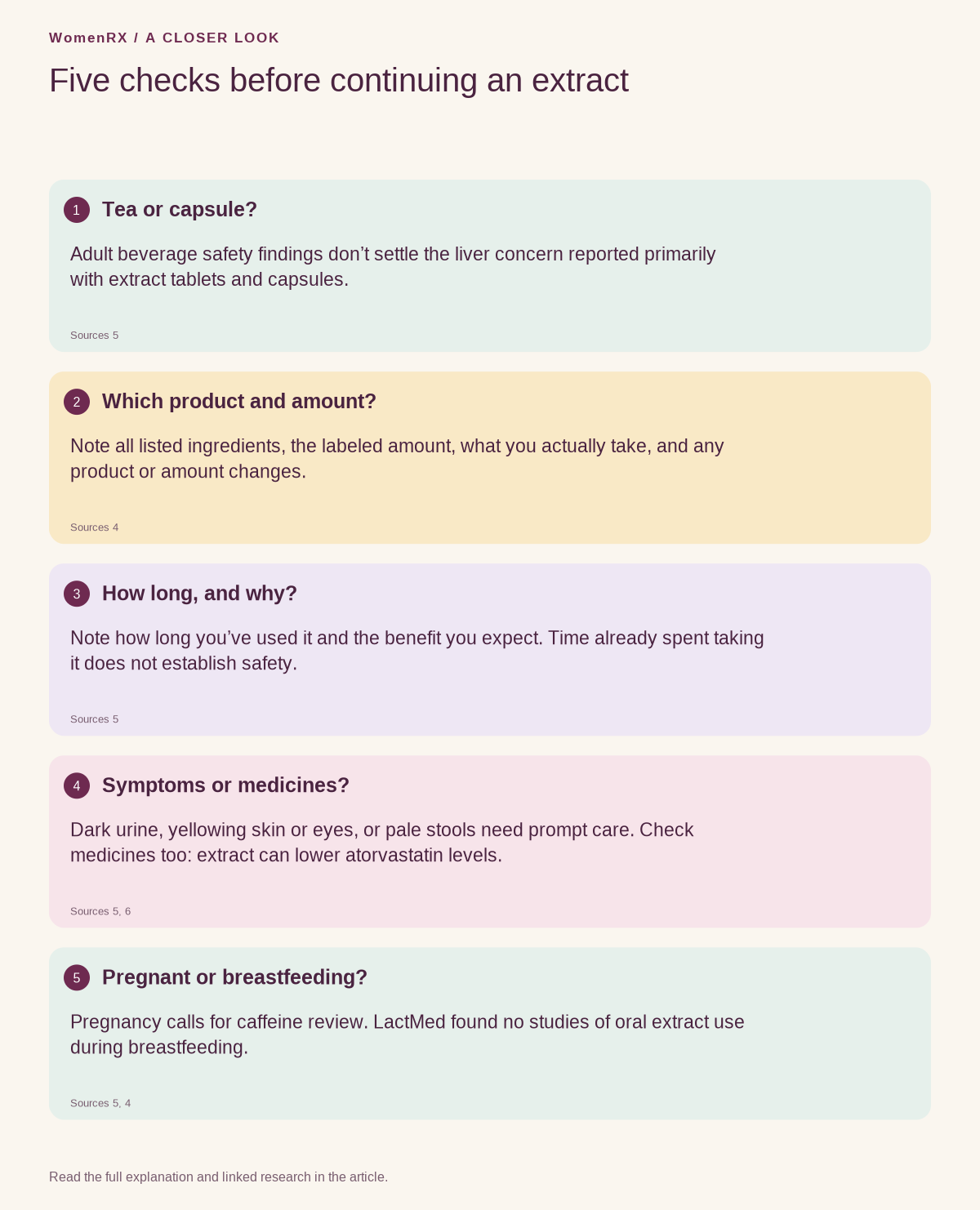
Five checks before continuing an extract
Tea or capsule?: Adult beverage safety findings don’t settle the liver concern reported primarily with extract tablets and capsules.5
Which product and amount?: Note all listed ingredients, the labeled amount, what you actually take, and any product or amount changes.4
How long, and why?: Note how long you’ve used it and the benefit you expect. Time already spent taking it does not establish safety.5
Symptoms or medicines?: Dark urine, yellowing skin or eyes, or pale stools need prompt care. Check medicines too: extract can lower atorvastatin levels.56
Pregnant or breastfeeding?: Pregnancy calls for caffeine review. LactMed found no studies of oral extract use during breastfeeding.54
Read the figure as text
Each check answers a different part of the continued-use decision; none certifies that an extract is safe.- Tea or capsule?: Adult beverage safety findings don’t settle the liver concern reported primarily with extract tablets and capsules.5
- Which product and amount?: Note all listed ingredients, the labeled amount, what you actually take, and any product or amount changes.4
- How long, and why?: Note how long you’ve used it and the benefit you expect. Time already spent taking it does not establish safety.5
- Symptoms or medicines?: Dark urine, yellowing skin or eyes, or pale stools need prompt care. Check medicines too: extract can lower atorvastatin levels.56
- Pregnant or breastfeeding?: Pregnancy calls for caffeine review. LactMed found no studies of oral extract use during breastfeeding.54
Sources you can check
- An update on drug-induced liver injury-What's new?Björnsson ES, Andrade RJ. · Journal of internal medicine · 2026Return to first citation
- Herbal and dietary supplement induced liver injury: Highlights from the recent literature.Woo SM, Davis WD, Aggarwal S, Clinton JW, Kiparizoska S, Lewis JH. · World journal of hepatology · 2021Return to first citation
- Herbal and Non-Herbal Dietary Supplements for Psychiatric Indications: Considerations in Liver Transplantation.Patel S, Tareen K, Patel C, Rosinski A. · Current psychiatry reports · 2024Return to first citation
- Green Tea2006Return to first citation
- Green Tea: Usefulness and Safety | NCCIHAccessed 2026-09-25Return to first citation
- Drug-induced liver injury: MedlinePlus Medical EncyclopediaAccessed 2026-09-26Return to first citation