Green Tea Extract Benefits: What Human Studies Actually Show
Human studies offer a few early, outcome-specific signals, but they don’t establish green tea extract as a reliable treatment for weight loss, PCOS, liver disease, or cancer prevention.
Green tea extract has been studied in people, but results depend on the outcome and the preparation. In a review of PCOS studies, three trials of green tea extract reported weight reductions, while a study of brewed green tea found no significant change in weight or body composition. A postmenopausal review found a low-quality total-cholesterol signal, not broad benefits for women generally. 1 3
The product matters
Green tea extract is one form of green tea studied as a supplement. It isn’t interchangeable with brewed green tea, matcha, or a study of isolated epigallocatechin gallate (EGCG), a green tea catechin. Trials can differ in which preparation they use, how much EGCG or caffeine it contains, and how long people take it. So a result for one product or form doesn’t automatically apply to another. 2 3
That distinction is central to reading the claims. Antioxidant or anti-inflammatory activity in cells and animals can help researchers form a hypothesis. It doesn’t, by itself, show that taking a supplement improves a health outcome in people. Reviews of green tea and liver disease, for example, include both human and animal studies, and the authors call for larger randomized trials to clarify the human effects. 2 4 5
Weight and PCOS: an early signal, not a settled result
A systematic review of green tea research in polycystic ovary syndrome (PCOS) included four human studies and four animal studies. Three human studies tested 500 mg per day of green tea extract and reported weight reductions. The fourth used brewed Lung Chen tea, not an extract supplement, and found no significant effect on body weight, body-fat percentage, or BMI. The review also describes possible changes in blood sugar, insulin, and testosterone, but concludes that more research is needed before drawing firm conclusions about PCOS treatment. 1
That’s a reason to describe weight loss as a possible signal in a few PCOS extract studies, not a proven or dependable supplement benefit. It also doesn’t tell us that green tea extract treats PCOS itself, improves fertility, or works for women without PCOS. Those are different outcomes and need their own evidence.
Cholesterol after menopause: one measured benefit
A systematic review and meta-analysis combined seven randomized trials in postmenopausal women. The researchers found a reduction in total cholesterol with green tea compared with placebo. The evidence was rated low quality. The review found no statistically significant effect on the other evaluated outcomes, which included measures such as weight, blood sugar, and other blood lipids. The intervention could be green tea extract or an infusion, so this finding isn’t evidence for every extract supplement. 3
This is the clearest directly women-specific result in the studies summarized here, but it’s narrow: a change in a blood-test measure doesn’t by itself show that the supplement prevents heart attacks or strokes. It also doesn’t establish the best formulation or whether the result holds over longer periods. The review authors call for better trials with standardized products and study durations. 3
Liver health: promising questions, mixed evidence
Green tea catechins and EGCG have been studied in people with fatty liver disease, as well as in animal models. A systematic review describes 21 human studies involving people with nonalcoholic fatty liver disease and reports that many assessed liver, metabolic, or inflammation-related measures. The review also describes substantial animal research and calls for larger randomized clinical trials before conclusions about treatment are firm. 2
This doesn’t establish green tea extract as a treatment for fatty liver disease. Nor should results from mixed human-and-animal research be treated as a benefit proven specifically in women. A separate review covering matcha, tea catechins, and supplements likewise says that larger studies are needed. 2 4
Cancer prevention: a high-risk group is not the general population
In a randomized trial involving people with familial adenomatous polyposis (FAP), a hereditary condition that causes many colorectal polyps, green tea extract was compared with placebo for two years. The primary outcome, polyp enlargement, tended to be less frequent with extract, but the result was not statistically significant: the risk ratio was 0.43, with a 95% confidence interval of 0.12 to 1.49. Because that range includes no difference, the trial does not show that the extract prevented polyp growth. 6
This was a study of people with FAP, not a test of cancer prevention in the general population. Pregnant and breastfeeding people were excluded, so the trial cannot answer whether the supplement is safe or beneficial during pregnancy or breastfeeding. That exclusion is a limit of this particular study, not proof that no other research exists. 6
What to take from the claims
For women, the most useful distinction is between an outcome that has been measured and a benefit that has actually been established. A change in weight, cholesterol, or a laboratory marker is not the same as a proven improvement in symptoms, long-term health, or disease risk. So far, the results are specific to certain groups and study preparations, and several of the apparent benefits remain uncertain.
When a claim says “green tea extract supports women’s health,” look for the exact outcome, the population studied, and whether researchers tested a supplement, a drink, or an isolated catechin. If those details are missing, the claim may be broader than the human research can support.
What Human Studies Have Tested
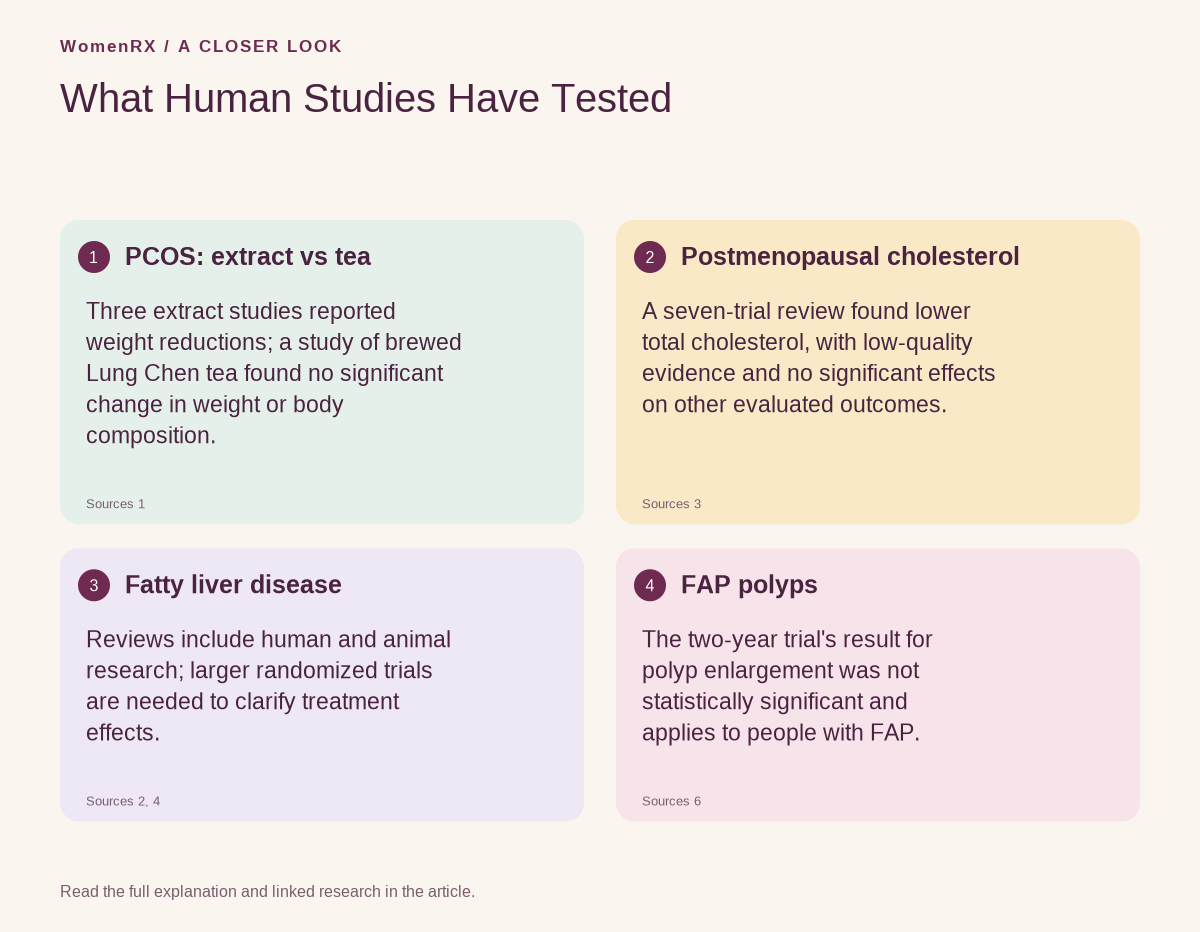
PCOS: extract vs tea: Three extract studies reported weight reductions; a study of brewed Lung Chen tea found no significant change in weight or body composition.1
Postmenopausal cholesterol: A seven-trial review found lower total cholesterol, with low-quality evidence and no significant effects on other evaluated outcomes.3
Fatty liver disease: Reviews include human and animal research; larger randomized trials are needed to clarify treatment effects.24
FAP polyps: The two-year trial's result for polyp enlargement was not statistically significant and applies to people with FAP.6
Read the figure as text
The findings vary by outcome, population, and preparation. This map separates early signals from results that remain uncertain.- PCOS: extract vs tea: Three extract studies reported weight reductions; a study of brewed Lung Chen tea found no significant change in weight or body composition.1
- Postmenopausal cholesterol: A seven-trial review found lower total cholesterol, with low-quality evidence and no significant effects on other evaluated outcomes.3
- Fatty liver disease: Reviews include human and animal research; larger randomized trials are needed to clarify treatment effects.24
- FAP polyps: The two-year trial's result for polyp enlargement was not statistically significant and applies to people with FAP.6
Sources you can check
- A comprehensive insight into effects of green tea extract in polycystic ovary syndrome: a systematic review.Maleki V, Taheri E, Varshosaz P, Tabrizi FPF, Moludi J, Jafari-Vayghan H, Shadnoush M, Jabbari SHY, Seifoleslami M, Alizadeh M. · Reproductive biology and endocrinology : RB&E · 2021Return to first citation
- Salubrious Effects of Green Tea Catechins on Fatty Liver Disease: A Systematic Review.Abunofal O, Mohan C. · Medicines (Basel, Switzerland) · 2022Return to first citation
- Effects of green tea use on the metabolic profile of postmenopausal women: systematic review and meta-analysis.Zago IHR, Colonetti L, Balbinot EL, Taschetto IS, Grande AJ, da Rosa MI, Colonetti T. · European journal of nutrition · 2026Return to first citation
- Influence of Matcha and Tea Catechins on the Progression of Metabolic Dysfunction-Associated Steatotic Liver Disease (MASLD)-A Review of Patient Trials and Animal Studies.Kosik-Bogacka DI, Piotrowska K. · Nutrients · 2025Return to first citation
- Anti-inflammatory activities of green tea catechins along the gut-liver axis in nonalcoholic fatty liver disease: lessons learned from preclinical and human studies.Hodges JK, Sasaki GY, Bruno RS. · The Journal of nutritional biochemistry · 2020Return to first citation
- Potential of green tea extract to suppress colorectal polyp development in patients with familial adenomatous polyposis: a double-blind, randomized controlled trial Japan Familial Adenomatous Polyposis Prevention Study (J-FAPP Study I).Ishikawa H, Mutoh M, Yamane T, Wakabayashi K, Hirata K, Iwama T, Nakamura T, Tomita N, Matsuyama Y, J-FAPP Study I Group. · Genes and environment : the official journal of the Japanese Environmental Mutagen Society · 2026Return to first citation