Green Tea Extract on an Empty Stomach: What Changes?
Fasting can increase exposure to green tea catechins, but taking an extract with food hasn’t been shown to eliminate liver-injury risk.
Taking green tea extract without food may increase how much of some catechins, including EGCG, your body absorbs. Take a direction to use it with food seriously, but don’t assume a label directing fasting use makes that safe. The evidence doesn’t prove that a meal prevents liver injury, and concentrated extracts aren’t interchangeable with brewed green tea. 2 3
Food may change exposure, not erase risk
Green tea extract can deliver concentrated catechins, including EGCG, in a bolus dose. Reviews of human and animal evidence report increased catechin bioavailability with repeated oral doses taken while fasting. More exposure may matter because liver injury has been associated with some concentrated, catechin-rich preparations. 2 3
That finding is a reason to take your product’s food directions seriously. It is not proof that food prevents liver injury. The findings on fasting and catechin exposure do not establish that eating prevents harm. Products also differ in their catechin content and manufacturing, so a result for one preparation may not apply to another. 2 3
Check the directions for your exact product
Look at the label for wording such as “take with food” or “do not take on an empty stomach.” Follow a direction to take it with food rather than assuming another green tea product’s instructions apply. If the label instead directs you to take it while fasting, don’t assume that instruction settles the safety question: repeated fasting doses can increase catechin exposure. The United States Pharmacopeia’s monograph for powdered decaffeinated green tea extract includes a caution to take that product with food. That is a specific extract and standard, not a universal instruction for every product on the market. 2
If your label doesn’t say when to take the extract, research doesn’t establish a timing rule that makes every product safe. Check the product’s ingredients and directions, including how much EGCG it contains if that information is given. Catechin profiles vary among extracts. 2
Extract and brewed tea aren’t the same comparison
A cup of brewed green tea is not equivalent to a concentrated supplement. In a systematic review of 159 human intervention studies, liver-related adverse events were associated with a limited range of concentrated, catechin-rich preparations taken as large bolus doses. The review did not find the same pattern for brewed tea or green tea preparations consumed in beverages or as part of food. These findings distinguish forms and patterns of intake; they don’t prove that food itself protects someone taking a supplement. 3
The fasting concern is about concentrated extract exposure, not a reason to treat ordinary brewed tea as if it were a supplement capsule. And taking a capsule with food shouldn’t be treated as a guarantee against a potentially serious reaction. 2 3
Pay attention to liver symptoms
USP’s caution for powdered decaffeinated green tea extract says to avoid use if you have a liver problem and to stop the product and seek medical advice if symptoms of liver trouble develop. It names abdominal pain, dark urine, and yellowing of the skin or eyes (jaundice). 2
Meal timing doesn’t replace those precautions. If symptoms appear while you’re taking an extract, don’t try to manage the risk just by changing when you take it. 2
Pregnancy, breastfeeding, and women-specific evidence
MedlinePlus advises checking with a health care provider before taking herbs or supplements during pregnancy because some can harm a developing fetus. 1 The meal-timing findings described here don’t establish how food affects green tea extract risk during pregnancy or breastfeeding, or whether the fasting effect differs for women. 2 3
The practical takeaway is straightforward: take directions to use your exact product with food seriously, don’t assume a fasting instruction establishes safety, and don’t treat concentrated extract as equivalent to tea. 2 3
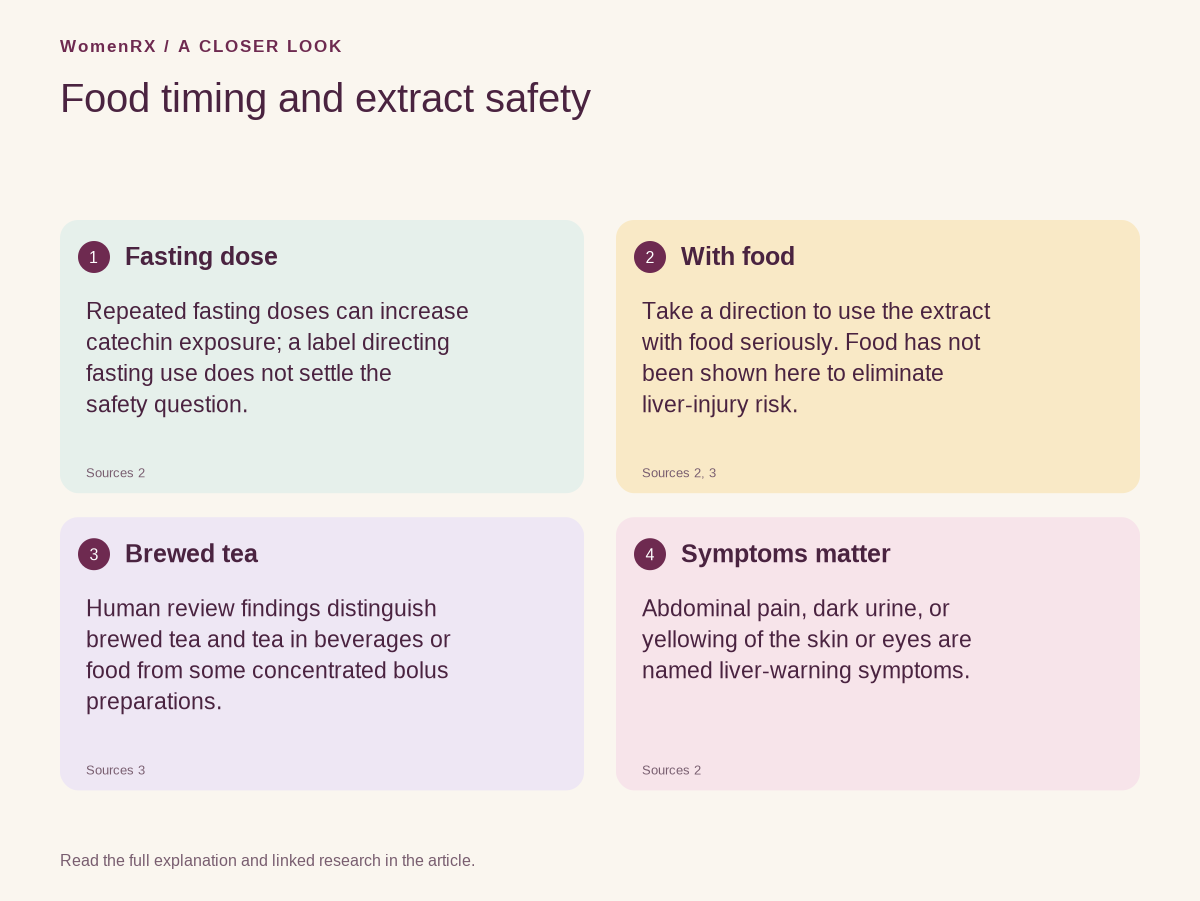
Food timing and extract safety
Fasting dose: Repeated fasting doses can increase catechin exposure; a label directing fasting use does not settle the safety question.2
With food: Take a direction to use the extract with food seriously. Food has not been shown here to eliminate liver-injury risk.23
Brewed tea: Human review findings distinguish brewed tea and tea in beverages or food from some concentrated bolus preparations.3
Symptoms matter: Abdominal pain, dark urine, or yellowing of the skin or eyes are named liver-warning symptoms.2
Read the figure as text
These distinctions separate what meal timing may change from what it cannot establish about liver risk.- Fasting dose: Repeated fasting doses can increase catechin exposure; a label directing fasting use does not settle the safety question.2
- With food: Take a direction to use the extract with food seriously. Food has not been shown here to eliminate liver-injury risk.23
- Brewed tea: Human review findings distinguish brewed tea and tea in beverages or food from some concentrated bolus preparations.3
- Symptoms matter: Abdominal pain, dark urine, or yellowing of the skin or eyes are named liver-warning symptoms.2
More questions, answered
Does taking green tea extract with food prevent liver injury?
The findings on fasting and catechin exposure don’t establish that taking a supplement with food prevents liver injury. Take a direction to use your product with food seriously, but don’t assume a label directing fasting use establishes that it’s safe. 2 3
Is brewed green tea the same as a green tea extract supplement?
No. Human safety findings distinguish brewed tea and tea consumed in beverages or food from some concentrated, catechin-rich preparations taken as large bolus doses. 3
Sources you can check
- Pregnancy and Medicines | MedlinePlusAccessed 2026-09-25Return to first citation
- United States Pharmacopeia (USP) comprehensive review of the hepatotoxicity of green tea extracts.Oketch-Rabah HA, Roe AL, Rider CV, Bonkovsky HL, Giancaspro GI, Navarro V, Paine MF, Betz JM, Marles RJ, Casper S, Gurley B, Jordan SA, He K, Kapoor MP, Rao TP, Sherker AH, Fontana... · Toxicology reports · 2020Return to first citation
- The safety of green tea and green tea extract consumption in adults - Results of a systematic review.Hu J, Webster D, Cao J, Shao A. · Regulatory toxicology and pharmacology : RTP · 2018Return to first citation