Green Tea and Weight Loss: What the Evidence Shows
Green tea may have a small effect on weight in some studies, but the evidence doesn’t make it a dependable weight-loss tool.
Drinking green tea might contribute to a small amount of weight loss, but the research is uncertain and doesn’t show a reliable, meaningful effect. Results from concentrated green tea extracts or supplements aren’t interchangeable with results from a cup of tea. Enjoy brewed green tea if you like it; there’s no good reason in this evidence to take an extract for weight loss. 1 3
A possible effect, not a reliable strategy
If you enjoy green tea, it can be part of what you drink. But the evidence doesn’t support treating it as a dependable way to lose weight. A recent review of randomized trials found that green tea was associated with about 1.2 kg more weight loss than placebo over an average intervention of 10 weeks. The authors rated that evidence as low certainty. Compared with water, the estimated difference was about 1.6 kg, but that result was very low certainty. Most trials had a high risk of bias, and only five trials had longer intervention durations. 3
Those numbers are averages from groups in studies, not a prediction of what will happen to you. They also don’t establish that green tea alone caused the difference in every trial. The practical takeaway is modest: an effect is possible, but it’s uncertain, and it’s unlikely to make green tea a weight-loss treatment.
A cup and a capsule are different things
“Green tea” research can refer to brewed tea, extracts, or preparations with concentrated catechins, sometimes combined with caffeine. These aren’t equivalent products. The NIH Office of Dietary Supplements reports that a typical brewed cup contains catechins and caffeine, while extracts can range from minimally processed leaves to highly concentrated products. 1
In its review of 14 randomized trials of green tea preparations, the NIH fact sheet reports an average 0.95 kg greater weight reduction than placebo over 12 to 13 weeks. But in the six studies conducted outside Japan, the difference wasn’t statistically significant. The trials varied in preparation and caffeine content, so that overall average shouldn’t be read as proof that ordinary tea produces the same result. 1
A separate review found a small additional effect when green tea catechins were taken with caffeine compared with caffeine alone. That finding is about a particular combination, not a reason to assume that brewed tea or catechins by themselves will have the same effect. 1
What the research says about women
The evidence doesn’t establish a special weight-loss effect for women. One trial included in the NIH fact sheet followed 121 postmenopausal women with overweight or obesity who took decaffeinated green tea extract for 12 months. It found no overall effect on body weight, BMI, or waist circumference. That result is useful for this group, but it can’t settle what might happen with other products or in other stages of life. 1
The newer review of tea and coffee trials reports results for adults overall, without giving sex-specific results in its abstract. So it’s not possible to tell from that report whether the average result differed for women and men. 3
Why concentrated extracts deserve more caution
A small and uncertain possible benefit matters less when the product has a different risk profile. The NIH fact sheet says that green tea as a beverage has no reported adverse effects in the reviewed evidence, while reported side effects from extracts include nausea, constipation, abdominal discomfort, and increased blood pressure. It also describes evidence linking some extracts to liver injury. 1
In one study of 1,021 postmenopausal women, a green tea extract taken for 12 months was associated with higher liver enzyme levels than placebo; some participants developed moderate or more severe liver function abnormalities. This is evidence about a concentrated extract, not ordinary brewed tea. 1
Caffeine is another difference to keep in mind. Its amount varies by tea, and some people are more sensitive to its effects. MedlinePlus notes that caffeine can cause problems such as shakiness or restlessness when intake is too high, and that pregnant people should check whether they need to limit or avoid it. 2
A practical choice
If green tea tastes good to you, drink it for that reason, not because you’re counting on it to change your weight. If you’re considering a concentrated extract, weigh the uncertain weight benefit against the specific safety concerns; don’t assume a supplement is simply a stronger, more effective cup of tea. The studies don’t show that brewed green tea is a substitute for a broader approach to weight management. 1 3
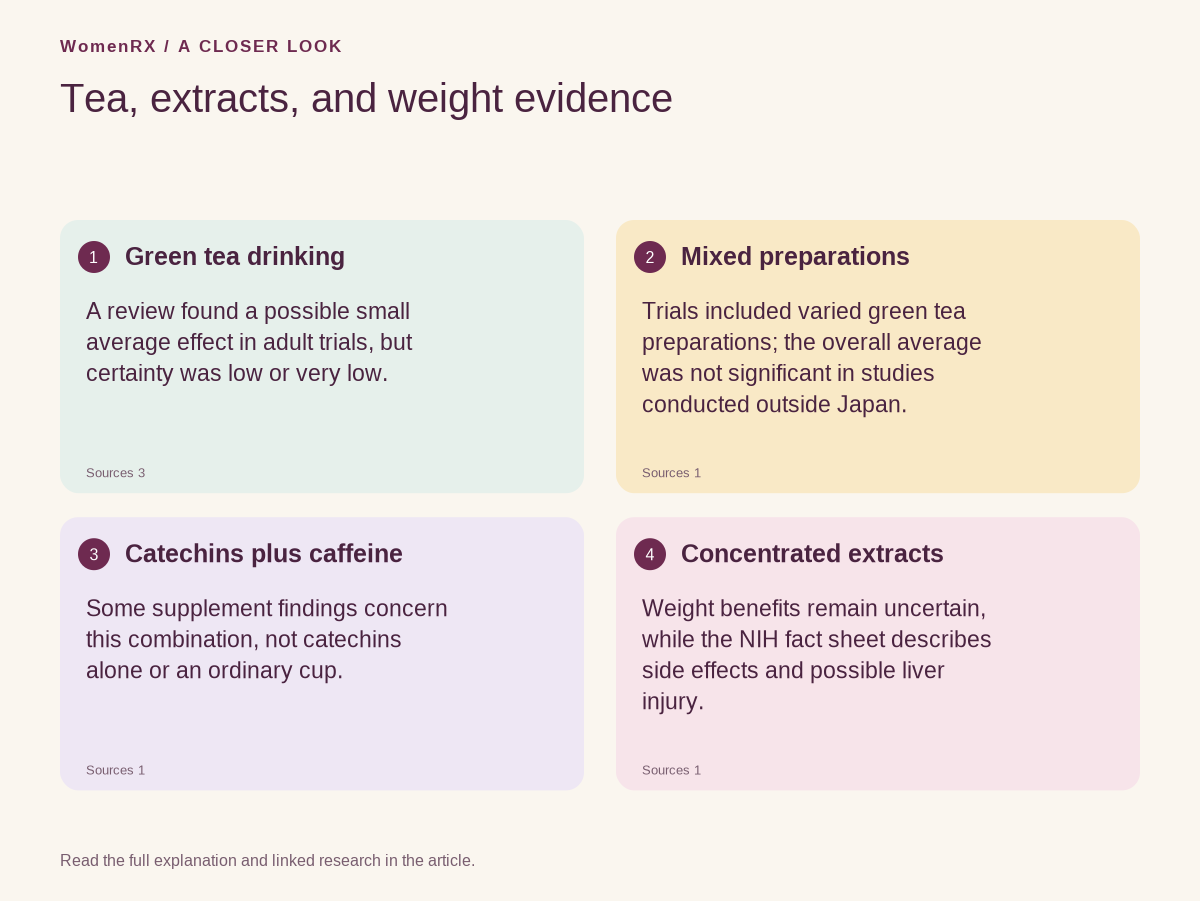
Tea, extracts, and weight evidence
Green tea drinking: A review found a possible small average effect in adult trials, but certainty was low or very low.3
Mixed preparations: Trials included varied green tea preparations; the overall average was not significant in studies conducted outside Japan.1
Catechins plus caffeine: Some supplement findings concern this combination, not catechins alone or an ordinary cup.1
Concentrated extracts: Weight benefits remain uncertain, while the NIH fact sheet describes side effects and possible liver injury.1
Read the figure as text
These findings come from different products and study types, so they should not be treated as one result.- Green tea drinking: A review found a possible small average effect in adult trials, but certainty was low or very low.3
- Mixed preparations: Trials included varied green tea preparations; the overall average was not significant in studies conducted outside Japan.1
- Catechins plus caffeine: Some supplement findings concern this combination, not catechins alone or an ordinary cup.1
- Concentrated extracts: Weight benefits remain uncertain, while the NIH fact sheet describes side effects and possible liver injury.1
More questions, answered
Does decaffeinated green tea have the same weight evidence?
Not necessarily. In one 12-month trial in postmenopausal women with overweight or obesity, decaffeinated green tea extract had no overall effect on weight, BMI, or waist circumference. That study tested an extract, so it doesn’t answer every question about drinking decaffeinated tea. 1
Sources you can check
- Dietary Supplements for Weight Loss - Health Professional Fact SheetAccessed 2026-09-25Return to first citation
- Caffeine: MedlinePlusAccessed 2026-09-25Return to first citation
- Comparative effects of tea and coffee drinking on body weight in adults: a systematic review and network meta-analysis of randomised trials.Jayedi A, Norouziasl R, Aletaha A, Mirrafiei A, Soltani A, Shab-Bidar S. · The British journal of nutrition · 2024Return to first citation