Greens Powders: Compare Labels Before You Buy
Two greens powders can disclose very different amounts, so start with the dietary gap you want to address.
Start with the dietary gap you’re trying to address, then check what each product actually quantifies. Huel Daily Greens lists amounts for individual vitamins and minerals; Field of Greens names plant blends, but the product information reviewed here doesn’t give comparable amounts for each plant. A testing claim is worth checking, but it doesn’t prove a health benefit. Pregnancy or breastfeeding calls for a closer look at added botanicals. 6 7 5 4
A greens powder can look comprehensive while leaving you unsure what you’d actually get from a serving. The most useful comparison isn’t which tub has the longest ingredient list. It’s whether the label and evidence answer a particular question: what gap are you trying to fill, and does this product disclose enough to judge it?
Begin with the gap, not the blend
Write down the specific dietary gap you’re concerned about before comparing products. Then check whether the label identifies a nutrient that relates to that concern and tells you how much is in one serving. A list of plant ingredients alone may tell you what went into a blend, but it may not show how much of any particular nutrient you’d receive.
This matters when a product groups many ingredients together or lists a blend without amounts for its individual components. If the amount you care about isn’t disclosed, you can’t use that information to confirm that the product supplies it. A broad “greens” label isn’t the same as evidence that the powder meets a specific need.
What two current product descriptions let you compare
Huel Daily Greens lists amounts for individual nutrients in its 8.5-gram serving. Its posted information lists 4.8 milligrams of iron, 35 micrograms of iodine and 1 gram of fiber. It also lists vitamin A as retinol acetate and includes botanical ingredients and blends. Those figures let you assess the stated amounts against a particular need and anything else you take. They don’t show that the powder will correct a deficiency or improve your health. 6
Field of Greens names ingredients including kale, wheatgrass, chlorella, fruit, inulin and matcha, along with a vitamin-and-mineral blend. Its product page says it is third-party tested, but the information presented there does not identify an independent verifier or give a test report. It also doesn’t provide comparable individual plant amounts in the product information reviewed here. That’s a difference in what you can check, not proof that either product is better. 7
Neither an ingredient list nor a nutrient panel establishes that a powder replaces produce. For example, Huel describes its greens product as a supplement rather than a meal and lists 1 gram of fiber per serving. Field of Greens markets its scoop as equivalent to servings of fruits and vegetables, but that is the maker’s claim, not a demonstrated substitution for eating produce. 6 7
Ask what “tested” means
An independent quality check can offer useful information, but the word “tested” on its own doesn’t tell you what was checked. Check whether an independent organization verified the finished product or its ingredients, what it checked, and whether the result applies to the product you’re considering. Field of Greens makes a third-party-testing claim; that claim alone does not give you those details. 7
Independent organizations may verify the quality of a supplement or its ingredients, but that does not establish that it is effective. Differences can also occur between a supplement’s label and its actual ingredients or amounts. 2 For a product tested by an independent quality organization, verification can help check labeled contents and screen for harmful levels of contaminants; it still doesn’t show that the powder improves health. 5 2
Keep product claims in proportion to the research
A clinical result with one formula can’t automatically be applied to another greens powder with a different mix. In a 30-day study of a Field of Greens formula, 21 adults aged 50 to 65 with obesity began the study and 19 completed it; 65% of those who began were female. The study was open-label, with no placebo supplement. It reported no significant changes in metabolic markers, body composition or overall gut microbiome diversity. Other exploratory measures moved in different directions, so the findings don’t support a simple claim that the powder slowed aging. These overall results don’t establish a benefit specifically for women. 1
The manufacturer describes that study as proof of health benefits, but the study design and reported results warrant a narrower reading. It also was not a contaminant test. Research on Field of Greens cannot establish an effect for Huel Daily Greens or every other blend. 7 1 When a product claims to support a particular outcome, check whether research tested that formula, in a relevant population, and measured that outcome.
Pregnancy and breastfeeding change the label check
The Field of Greens study involved adults aged 50 to 65, so it doesn’t answer questions about pregnancy or breastfeeding. 1 During pregnancy, the dietary need you’re trying to meet matters more than a general promise of “greens.” Prenatal supplements may be especially important for folate or folic acid, iron, iodine and vitamin D needs. If you already take one, compare its listed nutrients with those in a greens powder rather than assuming the powder replaces it or that adding the two is useful. Huel’s posted iron and iodine amounts, for example, are specific amounts to compare, not a prenatal recommendation. 5 6
Added botanicals deserve a separate look. The blend used in the Field of Greens study included ashwagandha; NCCIH says ashwagandha should be avoided during pregnancy and should not be used while breastfeeding. Because formulas and product information can differ, check the ingredient list on the product you’d actually buy. 1 4 Green tea ingredients raise a different question: caffeine intake during pregnancy and breastfeeding. A botanical supplement may not declare its caffeine amount, and high maternal caffeine intake while breastfeeding can cause fussiness and poor sleep in an infant. If a powder contains green tea or another caffeine-containing botanical and doesn’t disclose the caffeine amount, you can’t judge that part of your intake from its label alone. 5 3 These are ingredient-specific concerns, not evidence that every greens powder has the same risks.
Make the comparison count
For each product, note the specific gap you want to address, whether its label gives relevant amounts, and whether its quality-testing claim has enough detail to check. Then ask whether the evidence matches the formula and the outcome being claimed. Huel’s nutrient panel answers some amount questions that Field of Greens’ ingredient-led description does not; the Field of Greens study answers a limited research question that a nutrient panel cannot. Neither makes a universal winner. 6 7 1
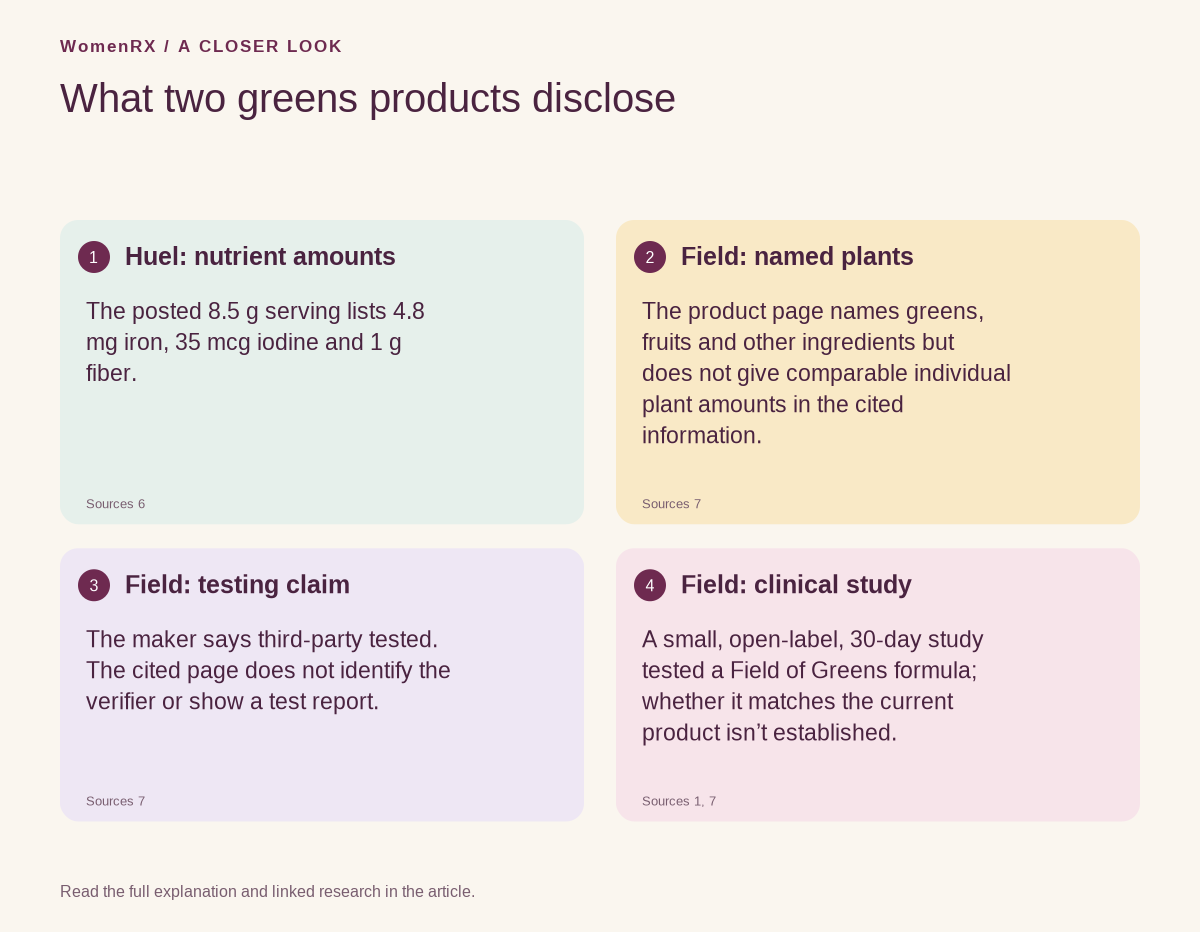
What two greens products disclose
Huel: nutrient amounts: The posted 8.5 g serving lists 4.8 mg iron, 35 mcg iodine and 1 g fiber.6
Field: named plants: The product page names greens, fruits and other ingredients but does not give comparable individual plant amounts in the cited information.7
Field: testing claim: The maker says third-party tested. The cited page does not identify the verifier or show a test report.7
Field: clinical study: A small, open-label, 30-day study tested a Field of Greens formula; whether it matches the current product isn’t established.17
Read the figure as text
A side-by-side reading separates information you can use from claims that need more detail.- Huel: nutrient amounts: The posted 8.5 g serving lists 4.8 mg iron, 35 mcg iodine and 1 g fiber.6
- Field: named plants: The product page names greens, fruits and other ingredients but does not give comparable individual plant amounts in the cited information.7
- Field: testing claim: The maker says third-party tested. The cited page does not identify the verifier or show a test report.7
- Field: clinical study: A small, open-label, 30-day study tested a Field of Greens formula; whether it matches the current product isn’t established.17
More questions, answered
Does independent testing show that a greens powder works?
No. Independent quality testing can help check contents and contaminants, but it does not establish effectiveness. A brand’s statement that it is third-party tested also isn’t a substitute for details about who tested what. 5 2 7
Does research on one greens powder apply to another?
Not automatically. The small Field of Greens study tested a particular blend for 30 days, not greens powders as a category. Its results cannot establish benefits for a different formula. 1 2
Sources you can check
- Epigenetic and microbiome responses to greens supplementation in obese older adults: results from a randomized crossover-controlled trial.Robinson LA, Cavanah AM, Lennon S, Mattingly ML, Pol WV, Huggins KW, Greene MW, Roberts MD, Frugé AD. · Frontiers in nutrition · 2026Return to first citation
- Marine Oils2006Return to first citation
- Green Tea: Usefulness and Safety | NCCIHAccessed 2026-09-25Return to first citation
- Ashwagandha: Usefulness and Safety | NCCIHAccessed 2026-09-25Return to first citation
- Dietary Supplements and Life Stages: Pregnancy - Health Professional Fact SheetAccessed 2026-09-25Return to first citation
- The Huel Daily Greens Formula Explained | Huel USAccessed 2026-09-26Return to first citation
- Field of Greens | Best Greens Powder: Clinically Proven, Doctor FormulatedAccessed 2026-09-26Return to first citation