What Greens Powders Can Actually Prove
One small study measured changes in oxidation markers, not more energy, stronger immunity, or better digestion.
A small human study of one commercial greens powder found changes in some blood markers related to oxidation after four weeks, but it did not show that people felt more energetic, got sick less often, or had better digestion. A separate fruit-and-vegetable powder study was published as a plan, not as results. The Greens+ abstract gives no sex-specific breakdown. 2 1
The claim depends on what was tested
“Greens powder” can mean very different mixes of vegetables, algae, herbs, fiber, probiotics, and other ingredients. Evidence about one formula doesn’t automatically apply to another. Even when a study finds a change in the body, the outcome matters: a blood marker is not the same as feeling less tired, having fewer infections, or improving digestive symptoms.
That distinction is the clearest way to read the human research available for these products. One study tested a particular commercial powder and measured markers related to oxidation. Another paper described a planned trial of a different plant-based powder. Neither answers every popular claim about greens powders. 1 2
What the Greens+ study measured
In a 2011 study, 10 healthy people used a specific commercial product, Greens+, for four weeks. The researchers measured blood markers, including measures of oxidation and antioxidant activity. They reported changes in some of those markers, including a reduction in a measure of lipid oxidation at the higher intake tested. The study did not establish that the powder prevented disease or improved how participants felt day to day. 2
That’s a narrow finding. Oxidation markers can be useful in research, but a change in one doesn’t by itself tell you whether a person has more energy, better digestion, or a lower chance of getting sick. The study was also very small and short, so it can’t establish lasting effects or show that other products with different formulas do the same thing. The study acknowledges Genuine Health for providing the preparation and financial support, another reason to look for independent research before drawing broad conclusions. 2
The Greens+ abstract does not provide a sex-specific breakdown. Its findings therefore don’t establish a benefit for women in particular, or tell us whether results differ by sex or life stage. 2
A planned trial isn’t proof of a benefit
A 2023 paper described a randomized trial planned for 112 middle-aged and older adults. The researchers intended to study an encapsulated fruit-and-vegetable powder concentrate, alone or alongside a separate omega-fatty-acid supplement, and measure outcomes such as cardiovascular markers, inflammation, and cognitive function. The paper is a protocol: it describes what researchers planned to test, not what they found. 1
The protocol says participants would be stratified by gender, but it doesn’t provide trial results or women-specific findings. It also describes a fruit-and-vegetable concentrate in capsules, not every greens powder sold as a drink mix. So it can show that researchers planned to investigate certain outcomes, but it can’t support a claim that the product improved immunity, energy, digestion, or health. 1
How to sort the claims
- Energy: The Greens+ study did not measure whether participants felt less tired or more energetic. A change in oxidation markers can’t stand in for that outcome. 2
- Immunity: The planned trial listed immunity among its areas of interest, but a protocol reports intended research, not a demonstrated effect. 1
- Digestion: Neither study described here tested digestive symptoms as an outcome. An ingredient list alone doesn’t show that a powder improves digestion. 1 2
- Disease prevention: The Greens+ researchers discussed possible implications of oxidation findings, but their small, short study did not show that the product prevents chronic disease. 2
When you see a claim, ask whether a study tested the finished product or just an ingredient, whether it measured the outcome in the claim, and whether the result was a change in a lab marker or a meaningful change in people’s health. For a women-specific claim, check whether women were included and whether results were reported separately. These studies don’t establish a women-specific benefit. 1 2
A greens powder might contain nutrients or plant ingredients, but that doesn’t prove that the blend improves energy, immunity, or digestion. The useful question isn’t whether a formula sounds nutritious. It’s whether that exact product has been tested for the benefit being promised, in people like you, using an outcome you’d notice or care about.
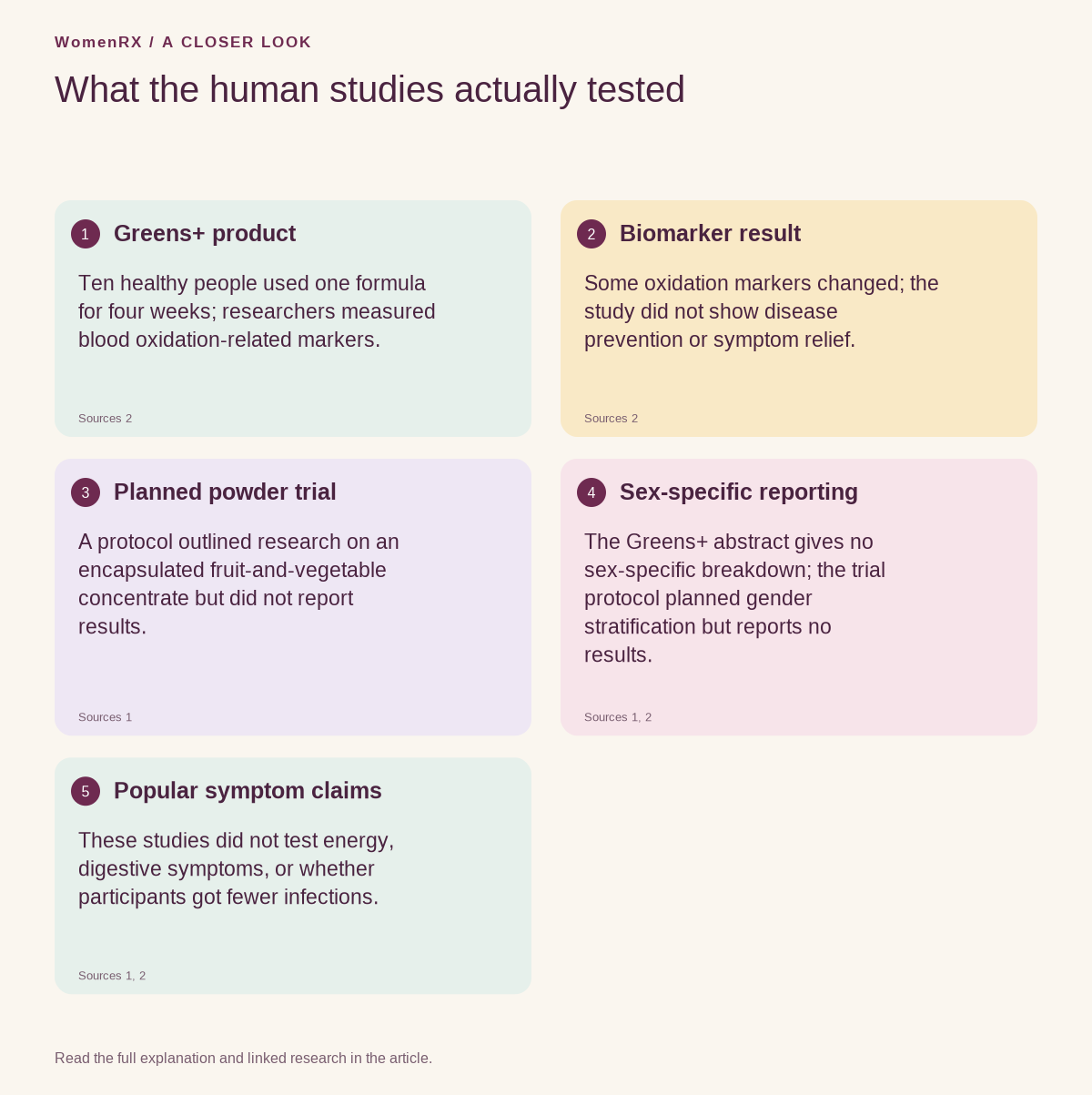
What the human studies actually tested
Greens+ product: Ten healthy people used one formula for four weeks; researchers measured blood oxidation-related markers.2
Biomarker result: Some oxidation markers changed; the study did not show disease prevention or symptom relief.2
Planned powder trial: A protocol outlined research on an encapsulated fruit-and-vegetable concentrate but did not report results.1
Sex-specific reporting: The Greens+ abstract gives no sex-specific breakdown; the trial protocol planned gender stratification but reports no results.12
Popular symptom claims: These studies did not test energy, digestive symptoms, or whether participants got fewer infections.12
Read the figure as text
Separate measured outcomes from planned research and from claims that these studies did not test.- Greens+ product: Ten healthy people used one formula for four weeks; researchers measured blood oxidation-related markers.2
- Biomarker result: Some oxidation markers changed; the study did not show disease prevention or symptom relief.2
- Planned powder trial: A protocol outlined research on an encapsulated fruit-and-vegetable concentrate but did not report results.1
- Sex-specific reporting: The Greens+ abstract gives no sex-specific breakdown; the trial protocol planned gender stratification but reports no results.12
- Popular symptom claims: These studies did not test energy, digestive symptoms, or whether participants got fewer infections.12
Sources you can check
- Effects of long-term consumption of two plant-based dietary supplements on cardiovascular health and low-grade inflammation in middle-aged and elderly people: study protocol for a randomised, controlled trial.Tsiountsioura M, Cvirn G, Meixner-Goetz L, Ziegler T, Lamprecht M. · Journal of health, population, and nutrition · 2023Return to first citation
- In vitro and in vivo antioxidant properties of the plant-based supplement greens+™.Rao V, Balachandran B, Shen H, Logan A, Rao L. · International journal of molecular sciences · 2011Return to first citation