Greens Powder Labels: What to Check Before You Buy
A greens powder’s ingredient list, added nutrients, and quality information matter more than its “natural” or vegetable-inspired branding.
Treat greens powder as a supplement, not a substitute for vegetables. Check the serving size, every named ingredient, added vitamins and minerals, and whether the amounts in blends are disclosed. Compare those nutrients with your other supplements, especially a prenatal. If you take warfarin, are pregnant, or are breastfeeding, review the full label with a pharmacist or clinician before adding it. 1 2 3
Greens powders can combine dried plant ingredients with added vitamins, minerals, flavorings, and other compounds. That variety makes the label more useful than broad promises about energy, detox, or getting your greens. Use it to work out what you’d actually be taking, and whether it overlaps with anything else.
Treat the powder as a supplement, not as a one-for-one replacement for vegetables or a balanced diet. A supplement can add nutrients, but it doesn’t make the rest of your diet interchangeable with a scoop of powder. 4
A quick label audit
1. Confirm the serving you’d use. Note the serving size and how many servings the container suggests. Compare products using the same serving basis. If you’d use a different amount, the listed nutrient amounts may not describe your actual serving.
2. Read the whole ingredient list. Check plant ingredients, added vitamins and minerals, flavorings, sweeteners, and any ingredients you need to avoid because of an allergy or dietary restriction. “Greens blend” or similar wording can group several ingredients together, so look for whether the label gives amounts for each one or only a combined blend amount. If individual amounts aren’t disclosed, you can’t tell how much of each ingredient the blend supplies or compare those ingredients precisely with another product.
3. Look for stimulants and their amounts. Check whether the product names caffeine or another stimulant-containing ingredient, and whether it says how much is present. If the amount is unclear, you can’t estimate your exposure from the label alone. A familiar plant name or “natural” description doesn’t tell you how much of an active ingredient is in a serving.
4. Check for independent quality information. A manufacturer may use an independent organization to verify a product or its ingredients. That kind of verification can provide quality information, but it does not establish that the product is safe or effective for you. Differences between labeled and actual ingredients or amounts have been reported for dietary supplements, and results for one product don’t automatically apply to another. 3
Compare nutrients across your supplements
Write down any vitamins and minerals listed in the greens powder, then compare them with a multivitamin, prenatal, or other supplements you use. Look at the amount per serving, not just the ingredient name. This doesn’t mean a nutrient is harmful simply because it appears in two products; it means the combined intake is worth checking rather than assuming the products fit together.
Vitamin A deserves particular attention if you’re pregnant or could become pregnant. Excessive preformed vitamin A can harm fetal development; beta-carotene and other provitamin A carotenoids aren’t the same form. If the label lists vitamin A, check which form it provides and include your prenatal in the review. 2
If you take warfarin, pay attention to vitamin K. Vitamin K can affect warfarin’s anticoagulant effect, and people taking it need to keep vitamin K intake from foods and supplements consistent. If a greens product contains vitamin K, or the amount is unclear, ask your pharmacist how to handle it before starting or changing the product. 1
Pregnancy, prenatal vitamins, and breastfeeding
During pregnancy, don’t assume a greens powder can stand in for a prenatal or fill a nutrient gap by guesswork. Nutrient needs change, and the pregnancy reference identifies several nutrients that need attention, including folate, iodine, iron, and vitamin A. Review the complete greens-powder and prenatal labels together with your obstetric clinician or pharmacist, especially if the greens powder adds vitamins or minerals. 2
Breastfeeding is another reason to check the full panel rather than relying on a general “safe” claim. Nutrient needs can differ during lactation, and a small cross-sectional study of 112 breastfeeding women with overweight or obesity in Norway found that many had intakes below the study’s reference values for certain nutrients, even when supplements were counted. That study doesn’t establish what any particular greens powder provides or whether it is appropriate for you. 5
What the label can’t settle
An ingredient list can help you spot overlap, allergens, and unclear blend amounts. It can’t show that a product will improve your health, that a blend is equivalent to eating vegetables, or that it is suitable for your medications or life stage. Quality verification also isn’t proof of effectiveness or personal safety. When a label leaves important amounts unclear, that uncertainty is a real limit, not a reason to assume the product is harmless. 3
A useful next step is to take a photo of the full label, including the Supplement Facts panel and ingredient list, and compare it with your other supplements. If you use warfarin, or you’re pregnant or breastfeeding, show the label to your pharmacist or obstetric clinician before adding the powder.
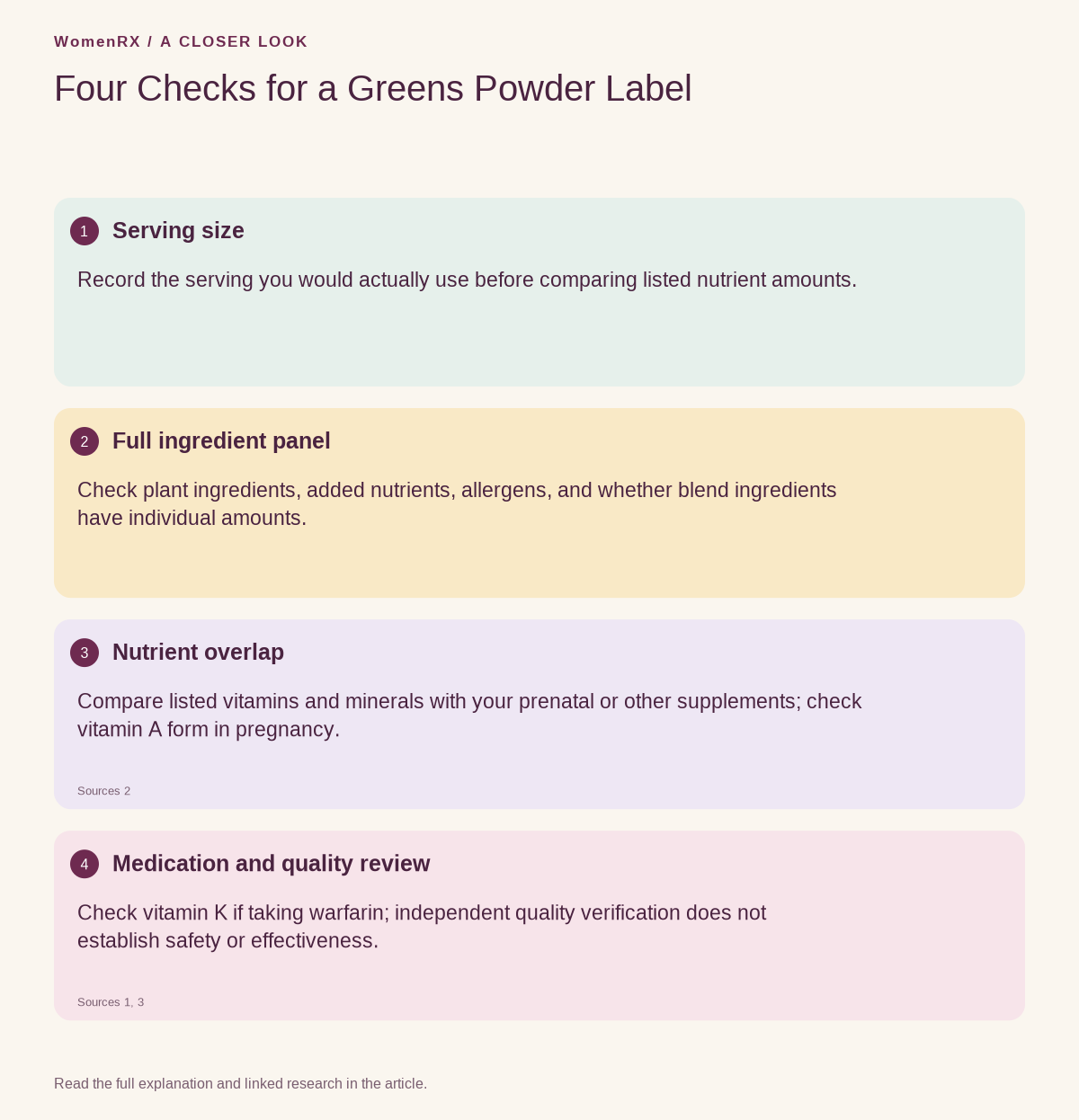
Four Checks for a Greens Powder Label
Serving size: Record the serving you would actually use before comparing listed nutrient amounts.
Full ingredient panel: Check plant ingredients, added nutrients, allergens, and whether blend ingredients have individual amounts.
Nutrient overlap: Compare listed vitamins and minerals with your prenatal or other supplements; check vitamin A form in pregnancy.2
Medication and quality review: Check vitamin K if taking warfarin; independent quality verification does not establish safety or effectiveness.13
Read the figure as text
Use these checks to see what a serving contains, what remains unclear, and what deserves a closer review alongside your other supplements.- Serving size: Record the serving you would actually use before comparing listed nutrient amounts.
- Full ingredient panel: Check plant ingredients, added nutrients, allergens, and whether blend ingredients have individual amounts.
- Nutrient overlap: Compare listed vitamins and minerals with your prenatal or other supplements; check vitamin A form in pregnancy.2
- Medication and quality review: Check vitamin K if taking warfarin; independent quality verification does not establish safety or effectiveness.13
More questions, answered
Does a greens powder count as a serving of vegetables?
Don’t treat it as a one-for-one replacement. A supplement may add nutrients, but that alone doesn’t make it equivalent to vegetables or a balanced diet. 4
What if a blend doesn’t list amounts for each ingredient?
You can’t tell how much of each ingredient the blend provides or compare those ingredients precisely across products. Independent quality verification, if present, doesn’t establish safety or effectiveness. 3
Sources you can check
- Vitamin K - Health Professional Fact SheetAccessed 2026-09-25Return to first citation
- Dietary Supplements and Life Stages: Pregnancy - Health Professional Fact SheetAccessed 2026-09-25Return to first citation
- Marine Oils2006Return to first citation
- Optimisation of Micronutrient Supplementation During Pregnancy: Interactions Between Bioactive Compounds, Their Impact on Health, and Regulatory Considerations.Makó RA, Sipos P. · Biomolecules · 2026Return to first citation
- Nutrient Intake Among Lactating Women With Overweight and Obesity in Norway: A Comparison With the Nordic Nutrition Recommendations 2023.Fossli M, Øhman EA, Andal M, Løland BF, Holven KB, Brekke HK. · Journal of human nutrition and dietetics : the official journal of the British Dietetic Association · 2025Return to first citation