Greens Powder After 40: What Actually Changes?
Turning 40 doesn’t create a general need for greens powder; a specific nutrient gap is a better reason to consider any supplement.
Age alone doesn’t show that you need a greens powder, and a broad blend isn’t automatically a menopause-specific solution. Start with the nutrient or goal you’re trying to address, then check how much the product actually provides and whether that overlaps with other supplements. One age-related change worth knowing: women’s recommended calcium intake rises at 51, while menopause also affects bone health. 1
Start with the gap, not the blend
A greens powder may look like a shortcut to “more nutrition,” but the useful question is narrower: What do you want it to provide? If you can’t name a nutrient or a specific dietary obstacle, it’s hard to tell whether a multi-ingredient powder is a good fit.
Turning 40, having irregular periods, or reaching menopause doesn’t by itself establish that you’re deficient. Healthy eating is about an overall pattern that supplies the nutrients you need, shaped around your preferences and circumstances. 2 For a practical comparison, look for a stated amount of the nutrient you’re interested in, rather than relying on a long list of plant ingredients.
Try naming the problem in practical terms: “I rarely eat vegetables,” “I avoid dairy and fortified alternatives,” or “I want to check whether I get enough calcium.” Each points to a different next step. A general greens blend may not answer any of them unless its label gives you useful amounts for the nutrients you’re looking for.
What menopause changes, and what it doesn’t
Menopause is relevant to bone health. Falling estrogen after menopause affects calcium absorption and loss, and women’s calcium RDA rises from 1,000 mg daily at ages 19-50 to 1,200 mg after 50. That’s a recommendation for total daily intake, not an amount to automatically take as a supplement. 1
Calcium can come from foods such as yogurt, milk, calcium-fortified soy beverages, tofu made with calcium salts, canned fish with bones, and some vegetables. The amounts differ: for example, the NIH fact sheet lists 299 mg in a cup of milk and 253 mg in a half-cup of calcium-set firm tofu. 1
So if calcium is your concern, compare your usual food sources with the calcium amount on the powder’s label. Don’t assume that “greens” means the product supplies a substantial amount. If the label doesn’t list a useful amount, the product may not address that particular goal. Menopause changes the calcium conversation; it doesn’t establish a need for a broad greens blend.
A quick label check before you buy
- Name the goal. Are you looking for a particular nutrient, or simply hoping the product will make your diet healthier? A specific goal makes the label easier to evaluate.
- Check the amount per serving. Look for the amount of the nutrient you care about, not just a list of plant ingredients. If the amount isn’t stated, you can’t use the label to compare its contribution with your needs.
- Check what you already take. Compare the listed nutrients with your multivitamin or individual supplements. Overlap can make it harder to understand how much you’re getting from each product.
- Ask whether it fits your routine. If you’re trying to eat more vegetables, consider whether adding or replacing a food you enjoy is a more direct solution. A healthy eating pattern can include different foods and should work with your preferences, traditions, and budget. 2
- Match the evidence to the claim. An ingredient being present doesn’t, by itself, show that the finished blend improves menopause symptoms or prevents a health problem. Be wary of a product pitch that promises a broad benefit without explaining what the product contains and what evidence supports that outcome.
When a targeted approach makes more sense
If you avoid dairy, calcium-fortified foods and some nondairy choices can contribute calcium; people who avoid dairy are among those more likely to have inadequate calcium intakes. 1 If a specific nutrient is the concern, compare your diet and product label for that nutrient rather than relying on the word “greens.”
If you’re unsure whether your usual diet meets your needs, bring the exact product label and a short description of what you typically eat to a registered dietitian or your clinician. That’s more useful than asking whether greens powder is “good for women over 40” in general, because the answer depends on the product and the gap you’re trying to fill.
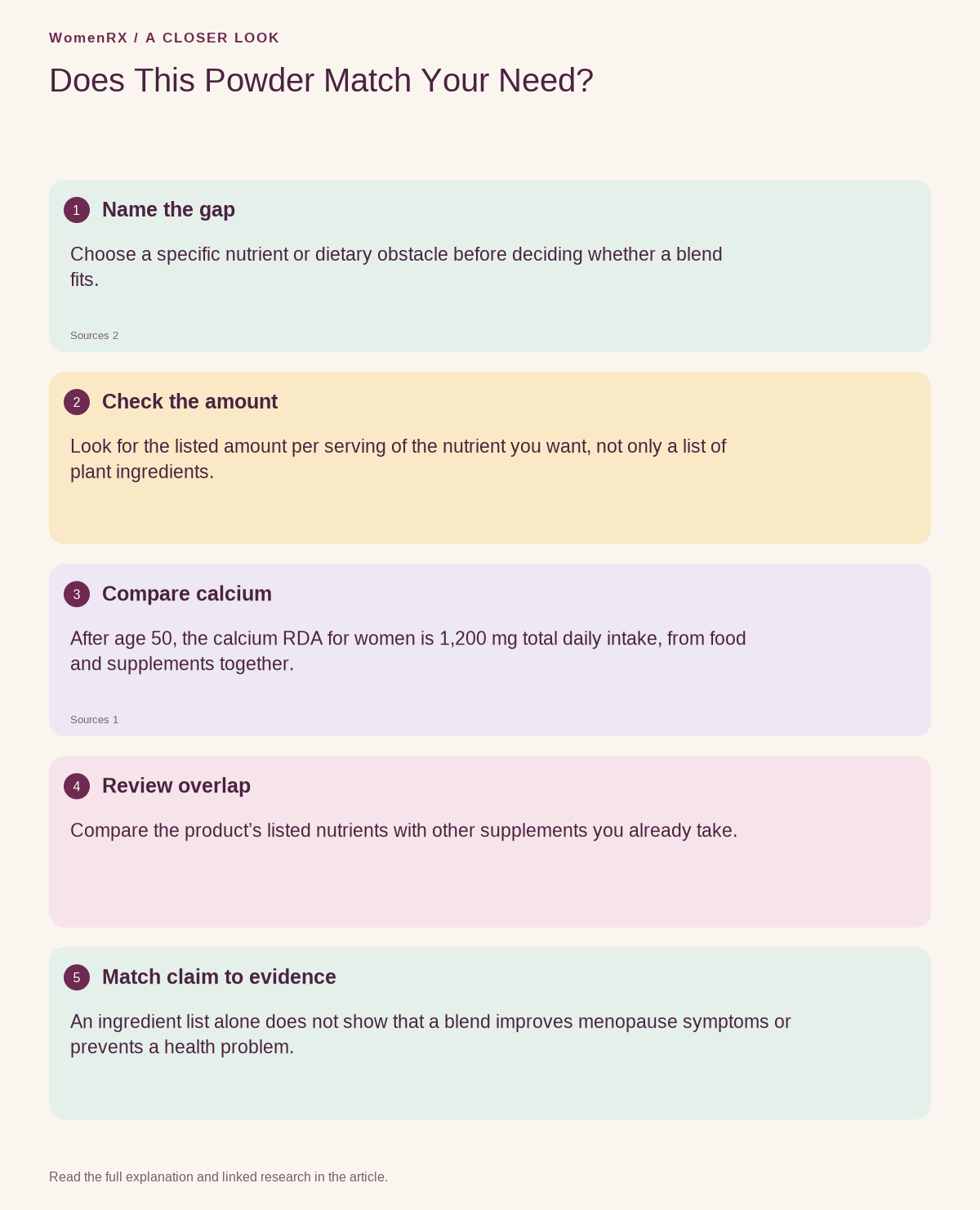
Does This Powder Match Your Need?
Name the gap: Choose a specific nutrient or dietary obstacle before deciding whether a blend fits.2
Check the amount: Look for the listed amount per serving of the nutrient you want, not only a list of plant ingredients.
Compare calcium: After age 50, the calcium RDA for women is 1,200 mg total daily intake, from food and supplements together.1
Review overlap: Compare the product’s listed nutrients with other supplements you already take.
Match claim to evidence: An ingredient list alone does not show that a blend improves menopause symptoms or prevents a health problem.
Read the figure as text
Use this label-first check to separate a specific nutrient goal from a broad promise.- Name the gap: Choose a specific nutrient or dietary obstacle before deciding whether a blend fits.2
- Check the amount: Look for the listed amount per serving of the nutrient you want, not only a list of plant ingredients.
- Compare calcium: After age 50, the calcium RDA for women is 1,200 mg total daily intake, from food and supplements together.1
- Review overlap: Compare the product’s listed nutrients with other supplements you already take.
- Match claim to evidence: An ingredient list alone does not show that a blend improves menopause symptoms or prevents a health problem.
More questions, answered
Does menopause mean I should take calcium in a greens powder?
No. Menopause is associated with bone changes, and the calcium RDA for women rises after age 50, but that recommendation is for total intake from food and supplements together. Check your usual food sources and the product’s listed calcium amount before deciding whether it addresses a gap. 1
Can a greens powder replace vegetables?
If your goal is to eat more vegetables, consider adding vegetables you enjoy to your usual meals. A healthy eating pattern can include a variety of foods and should fit your preferences, traditions, and budget. 2
Sources you can check
- Calcium - Health Professional Fact SheetAccessed 2026-09-25Return to first citation
- Nutrition: MedlinePlusAccessed 2026-09-25Return to first citation