How to Review a Greens Powder for Ongoing Use
The useful question isn’t whether greens powders are safe as a group, but what your particular powder adds to everything else you take.
You can’t judge a greens powder’s long-term fit from its name or a “daily wellness” claim. Read the serving size and each disclosed ingredient amount, then check for overlap with your multivitamin, prenatal, other supplements, and fortified foods. Pay particular attention to botanicals, pregnancy or breastfeeding, and medicines: vitamin K, for example, can affect warfarin treatment. 13
A tub can look like one simple addition to your morning routine. For an ongoing decision, treat it as a list of ingredients instead. A powder that supplies substantial vitamins and minerals raises different questions from one whose main additions are botanical extracts. Research on multivitamin/mineral supplements cannot establish the benefits or long-term safety of a powder with a different combination of ingredients. 13
Start with what the label lets you count
Find the serving size, then look at the amounts listed for vitamins and minerals. Compare them with anything you already take regularly, including a multivitamin or prenatal supplement and fortified foods or drinks. The concern isn’t that two products share an ingredient. It’s that their contributions add up: NIH’s Office of Dietary Supplements notes that combining multivitamins with other supplements and fortified foods can push some nutrient intakes above established upper limits, where the potential for adverse effects increases. 1
For example, if your powder lists zinc and your multivitamin lists zinc, look at both amounts rather than deciding either product is modest on its own. A percent Daily Value helps compare labeled nutrient amounts; it isn’t a personalized target or a guarantee that more is better. Recommended intakes can vary by age, sex, and life stage, while the Daily Value on a label is a single comparison value. 1
If an ingredient appears without an individual amount, you can still identify that it’s present, but you can’t reliably add up how much of it you’re getting from that powder and your other products. That’s a meaningful limit if you’re considering daily use.
Read the extras as ingredients, not decoration
Next, read beyond the familiar vitamins. Write down any named herbs, extracts, or other added ingredients and ask what each one is doing in a product you plan to take regularly. A broad review of natural-product supplements describes variable formulations, limited clinical validation for some compounds, and potential herb-drug interactions. It does not show that any particular greens powder causes those problems. 2
Medication questions should be ingredient-specific. One clear example is vitamin K: people taking warfarin should discuss a supplement containing vitamin K with the clinician or pharmacist managing that medicine, because vitamin K intake affects warfarin’s effectiveness and is considered when treatment is managed. Don’t change your medicine or avoid vitamin-K-containing foods on the basis of a powder label alone. Bring the actual label so the amount can be assessed in context. 1
Does it fit your life stage?
If you could become pregnant, are pregnant, or are breastfeeding, don’t treat a general wellness blend as a substitute for a supplement chosen for that stage. Pregnancy has specific nutrient needs, and guidance discussed by NIH recommends a prenatal vitamin during pregnancy. Greens-powder ingredients and amounts need to be checked separately from that recommendation. 1
Pregnancy also makes the form of a nutrient matter. Excess preformed vitamin A, such as retinol, can increase the risk of birth defects; that warning does not apply in the same way to beta-carotene. If a powder contains vitamin A, check how it’s listed and consider it alongside your prenatal rather than looking at the powder in isolation. 1
If you’re breastfeeding, check the full ingredient list and the supplements you’re already using before making a blend an everyday habit. A product’s plant-based description does not, by itself, establish that every added ingredient is suitable during lactation. 2
Later in life, a different question may be whether you need a specific nutrient rather than a broad blend. For example, NIH notes that adults over 50 may need to obtain vitamin B12 from fortified foods or supplements because absorption of naturally occurring B12 from food can decline. That’s a reason to assess B12 intake, not a reason to assume a greens powder contains a useful amount. 1
Check quality claims, then decide what you’re buying it for
Look for a clearly identified independent testing or certification program, and check whether its information applies to the product you’re holding. Third-party certification can reduce some quality risks, but it doesn’t eliminate them or demonstrate that the ingredients improve health. Those findings come from a review focused on supplements used in sport, so they’re a useful quality-check principle, not a safety rating for greens powders. 4
Finally, name the job you want the powder to do. If it’s meant to cover a particular nutrient gap, the label needs to show that nutrient in a useful, assessable amount. If it’s meant to stand in for vegetables, remember that supplements don’t supply the full range of components found in a varied diet. And if it’s simply something you enjoy, you can still decide whether its disclosed ingredients, overlap, and quality information make sense for regular use. 1
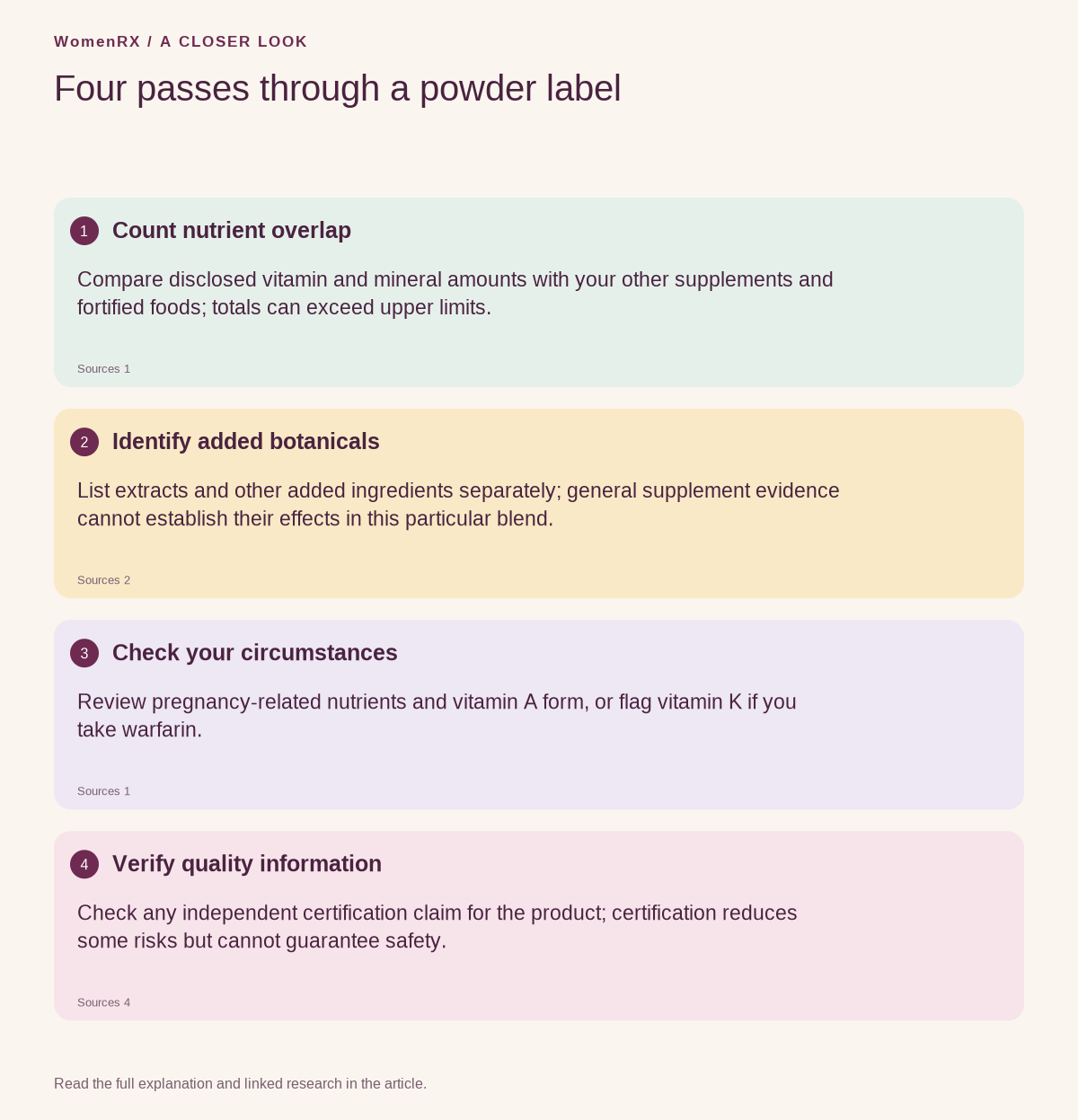
Four passes through a powder label
Count nutrient overlap: Compare disclosed vitamin and mineral amounts with your other supplements and fortified foods; totals can exceed upper limits.1
Identify added botanicals: List extracts and other added ingredients separately; general supplement evidence cannot establish their effects in this particular blend.2
Check your circumstances: Review pregnancy-related nutrients and vitamin A form, or flag vitamin K if you take warfarin.1
Verify quality information: Check any independent certification claim for the product; certification reduces some risks but cannot guarantee safety.4
Read the figure as text
Use these checks to turn one product label into specific questions about regular use.- Count nutrient overlap: Compare disclosed vitamin and mineral amounts with your other supplements and fortified foods; totals can exceed upper limits.1
- Identify added botanicals: List extracts and other added ingredients separately; general supplement evidence cannot establish their effects in this particular blend.2
- Check your circumstances: Review pregnancy-related nutrients and vitamin A form, or flag vitamin K if you take warfarin.1
- Verify quality information: Check any independent certification claim for the product; certification reduces some risks but cannot guarantee safety.4
More questions, answered
Is a greens powder enough to replace a multivitamin?
Not necessarily. Compare the listed nutrients and amounts against what you’re trying to obtain; don’t assume that two products with several vitamins serve the same purpose. Supplement formulations can differ substantially, and even multivitamins don’t all contain the same nutrients or amounts. 1
Does third-party testing mean a powder is safe to take every day?
No. Certification can help address certain quality risks, but it doesn’t settle whether the ingredient mix, nutrient totals, or medicine interactions fit you. Evidence on certification and contamination risk cited here comes from sports supplements, not a trial of daily greens-powder use. 4
Sources you can check
- Multivitamin/mineral Supplements - Health Professional Fact SheetAccessed 2026-09-25Return to first citation
- Natural Products as Nutritional Supplements in Human Disease Prevention and Management: From Molecular Mechanisms to Clinical Translation.Dakanalis A, Papadopoulou SK, Mentzelou M, Migdanis A, Migdanis I, Giaginis C. · Nutrients · 2026Return to first citation
- Dietary Supplements in Public Health: Benefits, Risks, and Emerging Gel/Hydrogel Delivery Systems.Raiciu AD, Alexandru G, Luntraru CM, Neagu M, Manoliu C, Manea C, Tomescu JA, Eremia MC, Stefaniu A. · Gels (Basel, Switzerland) · 2026Return to first citation
- Reducing the Risk of Unintentional Doping From Supplements: A Practical Guide for Athletes and Support Teams.Mancin L, Close GL, Jeukendrup A, Freschi M, Pugh J, Sala M, Baioccato V, Vecchiato M, D'Antona G, Palermi S. · Translational sports medicine · 2026Return to first citation