Perimenopause Supplements: Match the Claim to Your Symptom
For hot flashes, the strongest guidance favors proven treatments over supplements; for other symptoms, the exact outcome and life stage studied matter just as much.
Start with the symptom you want to change. For hot flashes and night sweats, a menopause society guideline does not recommend supplements or herbal remedies, including soy products, as treatment. Black cohosh results are inconsistent. One small trial studied a specific supplement combination in perimenopausal women, but it cannot establish that its ingredients work separately. Magnesium’s nutritional role does not answer whether it relieves perimenopause symptoms. 1245
First, name the change you’re hoping for
A bottle labeled “menopause support” might promise help with sleep, mood, and hot flashes all at once. Those are different outcomes. A study measuring hot flashes cannot tell you whether a product improves sleep, and a study of one formula cannot establish that a different product works.
Life stage matters, too. Perimenopause is the transition before the final menstrual period, but supplement research often focuses on postmenopause. In one analysis of 253 US-related supplement publications from 2000 to 2024, 234 focused on postmenopause. That count describes the publications in that analysis, not all research, but it shows why “studied in menopause” may not answer your question about the transition. 6
If hot flashes or night sweats are the problem
Black cohosh has been tested for menopausal symptoms, including hot flashes and night sweats. A review of 16 randomized trials involving 2,027 women found insufficient evidence to support or oppose its use. The trials differed in their preparations, duration, design, and findings, so they do not give a clear answer specifically for perimenopause or for a particular bottle on a shelf. 1
There is a safety tradeoff even when the benefit is uncertain. Stomach upset and rash were the most commonly reported effects in black cohosh trials and were generally mild and temporary. Most studies lasted six months or less, leaving long-term safety unresolved. 1
Soy foods, soy extracts, and equol are also promoted for hot flashes. The North American Menopause Society’s 2023 guidance does not recommend them as treatments for hot flashes and night sweats. That is a judgment about treating those symptoms, not a reason to avoid eating soy foods. The same guidance does not recommend supplements and herbal remedies as a group for this purpose. 4
If hot flashes are disrupting your days or nights, you have options beyond choosing a supplement. Hormone therapy is the most effective treatment for these symptoms, though its benefits and risks depend on individual circumstances. Evidence-supported nonhormone options include cognitive behavioral therapy, clinical hypnosis, and certain prescription medicines. The useful comparison is between treatments for your hot flashes, not between products that all use the word “menopause.” 34
If a product promises better mood, sleep, and more
There is a perimenopause-specific trial worth understanding, but it does not validate a whole category of products. A randomized, double-blind, placebo-controlled trial enrolled 106 perimenopausal women aged 50 or younger with mild to moderate symptoms. It tested a particular succinate-based supplement together with a vitamin B complex. Researchers reported improvements on several symptom, anxiety, depression, mood, and well-being measures, with few reported adverse effects that were mild and temporary. 5
The trial tested the combination, not either component alone. It also does not show that another formula with similar-sounding ingredients will produce the same results, or how long improvements might last. If sleep or mood is the reason you’re considering a product, look for that specific outcome rather than accepting a broad claim that it “supports perimenopause.” 5
Where magnesium fits
Magnesium is an essential nutrient involved in muscle and nerve function. Foods that provide it include leafy greens, legumes, nuts, seeds, and whole grains. Those nutritional facts are not evidence that a magnesium supplement will relieve hot flashes, disrupted sleep, or mood changes during perimenopause. The NIH magnesium reference covers nutrition and safety; it does not evaluate magnesium as a treatment for those perimenopause symptoms. 2
More is not automatically better. Excess magnesium from supplements or medicines can cause diarrhea, nausea, and abdominal cramping; very high amounts can cause serious toxicity. If the reason you’re looking at magnesium is concern about your intake, that is a different question from whether it treats a symptom. 2
Make the claim earn its place
For any supplement you’re considering, compare three things: the symptom measured, whether participants were perimenopausal, and the exact preparation tested. A hot-flash result does not cover every symptom. A postmenopause result may not answer a transition-specific question. And a trial of a combination does not prove that one ingredient, or another company’s blend, has the same effect. These distinctions let you compare the product’s promise with what was actually tested before deciding whether it belongs among your options. 156
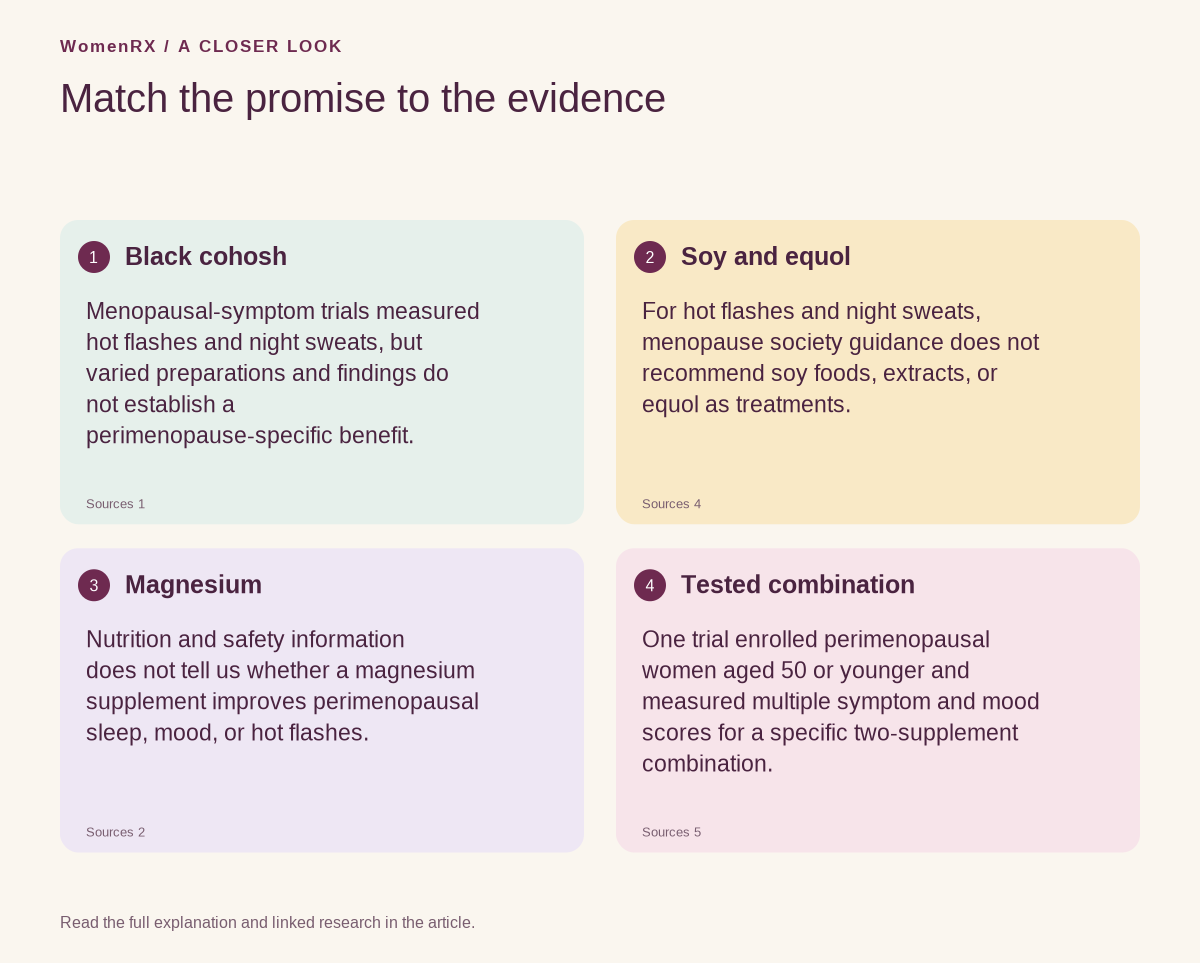
Match the promise to the evidence
Black cohosh: Menopausal-symptom trials measured hot flashes and night sweats, but varied preparations and findings do not establish a perimenopause-specific benefit.1
Soy and equol: For hot flashes and night sweats, menopause society guidance does not recommend soy foods, extracts, or equol as treatments.4
Magnesium: Nutrition and safety information does not tell us whether a magnesium supplement improves perimenopausal sleep, mood, or hot flashes.2
Tested combination: One trial enrolled perimenopausal women aged 50 or younger and measured multiple symptom and mood scores for a specific two-supplement combination.5
Read the figure as text
Four common supplement claims differ in the symptom measured, the women studied, and how closely a product can match the tested preparation.- Black cohosh: Menopausal-symptom trials measured hot flashes and night sweats, but varied preparations and findings do not establish a perimenopause-specific benefit.1
- Soy and equol: For hot flashes and night sweats, menopause society guidance does not recommend soy foods, extracts, or equol as treatments.4
- Magnesium: Nutrition and safety information does not tell us whether a magnesium supplement improves perimenopausal sleep, mood, or hot flashes.2
- Tested combination: One trial enrolled perimenopausal women aged 50 or younger and measured multiple symptom and mood scores for a specific two-supplement combination.5
Sources you can check
- Black Cohosh - Health Professional Fact SheetAccessed 2026-09-25Return to first citation
- Magnesium - Health Professional Fact SheetAccessed 2026-09-25Return to first citation
- The 2022 hormone therapy position statement of The North American Menopause Society.“The 2022 Hormone Therapy Position Statement of The North American Menopause Society” Advisory Panel. · Menopause (New York, N.Y.) · 2022Return to first citation
- The 2023 nonhormone therapy position statement of The North American Menopause Society.Menopause (New York, N.Y.) · 2023Return to first citation
- Clinical Evaluation of Effectiveness and Safety of Combined Use of Dietary Supplements Amberen® and Smart B® in Women with Climacteric Syndrome in Perimenopause.Kachko VA, Shulman LP, Kuznetsova IV, Uspenskaya YB, Burchakov DI. · Advances in therapy · 2024Return to first citation
- Dietary supplements for menopausal symptoms and health: a bibliometric analysis of US research (2000-2024).Canino MC, Cohen B, Byrd C, Gahche JJ. · Menopause (New York, N.Y.) · 2026Return to first citation