Heavy Periods: Possible Causes and What Happens Next
Heavy bleeding has several possible causes, and the pattern can help guide an evaluation without identifying the cause on its own.
Heavy menstrual bleeding can be linked to changes in ovulation, uterine conditions such as fibroids, some medicines, or a bleeding disorder. The mix of possibilities can differ by life stage, but age alone can’t tell you the cause. If pregnancy is possible, mention it early: bleeding during pregnancy has several possible causes. If you recently missed a period and have unusual bleeding with abdominal or pelvic pain, seek urgent assessment because an ectopic pregnancy is possible. 1 2 7 8
What counts as heavy, and why the pattern matters
A period may be heavy if you need to change a pad or tampon every hour or two, use more than one product at once, or feel tired or short of breath. It also matters if bleeding disrupts school, work, sleep, or everyday activities. You don’t have to measure blood loss to bring up a concern. 1 4
Heavy bleeding is a symptom, not a diagnosis. Clinicians group possible causes outside pregnancy into structural changes in the uterus and nonstructural causes such as ovulation problems, bleeding disorders, or medication effects. Several possibilities can overlap, and a flow description alone can’t confirm one. 6
Possible causes and useful clues
| Possible cause or consideration | What may be useful to mention |
|---|---|
| Changes in ovulation or hormones | Whether cycles are irregular as well as heavy, and when that pattern began. Irregular, anovulatory cycles are common in the first years after periods start. Thyroid problems and polycystic ovary syndrome are among conditions associated with heavy bleeding. 2 5 |
| A uterine condition | Any history of fibroids or other uterine findings. Fibroids, polyps, and adenomyosis are included among structural causes of abnormal uterine bleeding. Their presence doesn’t prove they explain your bleeding. 1 6 |
| A bleeding disorder | Whether heavy bleeding began with your first periods, and whether you or relatives have a known bleeding disorder or a history of unusual bleeding. This possibility deserves consideration in adolescents as well as adults. 2 3 5 |
| Medicine or treatment effects | The names of medicines and treatments you use, including anticoagulants or chemotherapy. 1 |
| Possible pregnancy | Say if pregnancy could be involved, even if the bleeding seems like a period. Bleeding during pregnancy has several possible causes. If you’ve missed a period and have unusual bleeding with abdominal or pelvic pain, an ectopic pregnancy is one possibility that needs urgent assessment. 7 8 |
These are clues for an evaluation, not a home diagnostic test. For example, irregular cycles may point toward an ovulation question, while a family history may make a bleeding disorder worth discussing. Neither clue settles the cause. Research in adolescents has found several different causes, and one systematic review classified many cases as having an indeterminate origin. 3
How life stage can shape the questions
In adolescence, cycles can be irregular in the first years after menarche because ovulation may not yet be regular. A bleeding disorder is another possibility, especially when heavy bleeding starts with the first periods or there is a relevant family history. So it’s worth discussing persistent or disruptive bleeding rather than assuming it is simply part of puberty. 3 5
During the reproductive years, clinicians may consider structural causes, ovulation problems, bleeding disorders, and medication effects. If pregnancy is possible, mention it early because bleeding during pregnancy needs a different assessment. Contact a healthcare provider right away about bleeding during pregnancy; unusual bleeding after a missed period with abdominal or pelvic pain needs urgent assessment because it could be an ectopic pregnancy. 1 2 7 8
After pregnancy and approaching menopause, periods may be heavier at some times. That timing doesn’t identify the cause, so a new or disruptive pattern still deserves attention in context. 1
What an evaluation may involve
Expect questions about when the bleeding began, how long it lasts, which days are heaviest, whether cycles are regular, and how often you change products. Mention flooding, overnight changes, clots, bleeding through clothes or bedding, and effects on school, work, or activities if these apply. Also share relevant medical and family history and your medicines. These details can make a conversation more useful even if you don’t know exact amounts. 4
The evaluation may include a physical examination and laboratory tests. Imaging or sampling of the uterine lining may be considered when indicated; the right approach depends on the history and findings. For adolescents with heavy bleeding, evaluating for iron deficiency or iron-deficiency anemia is also recommended. If pregnancy could be involved, a pregnancy test may be part of assessing unusual bleeding. 4 6 7
When to seek care
Bleeding through clothes or bedding, needing double protection, or changing a pad or tampon every hour or two are signs that bleeding may be heavy. Bring them up when arranging care; they don’t identify the cause on their own. 1
If you’re pregnant and bleeding, contact a healthcare provider right away. If you’ve recently missed a period and have unusual bleeding plus abdominal or pelvic pain, seek urgent assessment because this combination could signal an ectopic pregnancy. 7 8
Arrange an appointment if heavy bleeding is affecting your life, has been a persistent problem, comes with severe period pain, or happens between periods or after sex. Pain when you pee, have a bowel movement, or have sex is another reason to discuss the pattern. Mention recurring tiredness or shortness of breath, too. 1
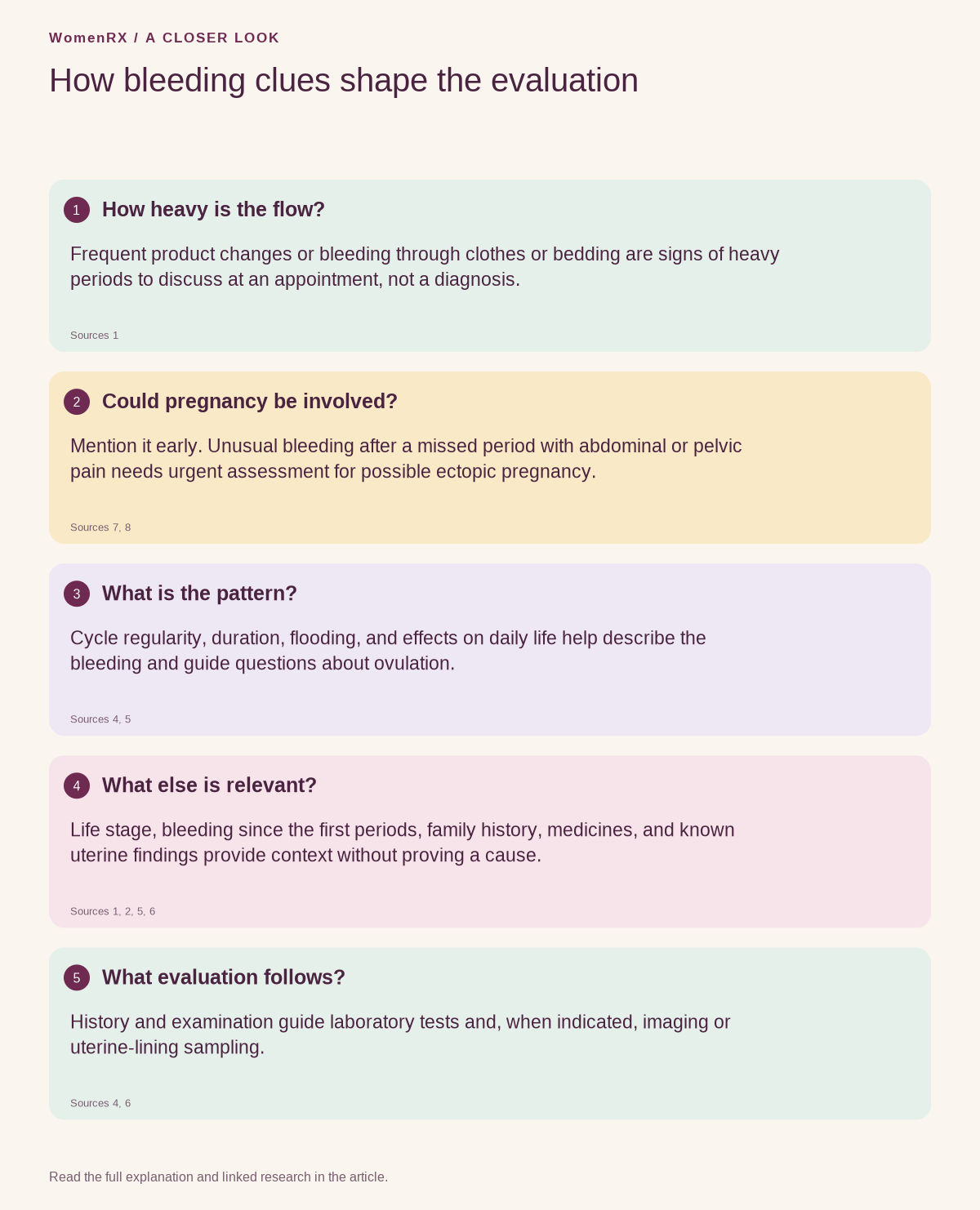
How bleeding clues shape the evaluation
How heavy is the flow?: Frequent product changes or bleeding through clothes or bedding are signs of heavy periods to discuss at an appointment, not a diagnosis.1
Could pregnancy be involved?: Mention it early. Unusual bleeding after a missed period with abdominal or pelvic pain needs urgent assessment for possible ectopic pregnancy.78
What is the pattern?: Cycle regularity, duration, flooding, and effects on daily life help describe the bleeding and guide questions about ovulation.45
What else is relevant?: Life stage, bleeding since the first periods, family history, medicines, and known uterine findings provide context without proving a cause.1256
What evaluation follows?: History and examination guide laboratory tests and, when indicated, imaging or uterine-lining sampling.46
Read the figure as text
Consider pregnancy-related warning signs and describe the flow. Then add the pattern and relevant history; no single clue diagnoses the cause.- How heavy is the flow?: Frequent product changes or bleeding through clothes or bedding are signs of heavy periods to discuss at an appointment, not a diagnosis.1
- Could pregnancy be involved?: Mention it early. Unusual bleeding after a missed period with abdominal or pelvic pain needs urgent assessment for possible ectopic pregnancy.78
- What is the pattern?: Cycle regularity, duration, flooding, and effects on daily life help describe the bleeding and guide questions about ovulation.45
- What else is relevant?: Life stage, bleeding since the first periods, family history, medicines, and known uterine findings provide context without proving a cause.1256
- What evaluation follows?: History and examination guide laboratory tests and, when indicated, imaging or uterine-lining sampling.46
More questions, answered
Does heavy bleeding always mean something is wrong?
Not necessarily. Heavy periods can happen at different life stages, and treatment isn’t always needed. But bleeding that disrupts your life, persists, or comes with the symptoms described above is worth discussing. 1
What should I write down before an appointment?
Note how long bleeding lasts, which days are heaviest, how often you change products, whether you need double protection or nighttime changes, and how bleeding affects daily activities. Add relevant medicine and family history if you know it. 4
Sources you can check
- Heavy periods - NHSAccessed 2026-09-25Return to first citation
- Etiology and diagnosis of heavy menstrual bleeding among adolescent and adult patients: a systematic review and meta-analysis of the literature.Comishen KJ, Bhatt M, Yeung K, Irfan J, Zia A, Sidonio RF, James P. · Journal of thrombosis and haemostasis : JTH · 2025Return to first citation
- Systematic review and meta-analysis of the etiology of heavy menstrual bleeding in 2,770 adolescent females.Hall EM, Ravelo AE, Aronoff SC, Del Vecchio MT. · BMC women's health · 2024Return to first citation
- Call to action: identifying an underlying bleeding disorder in adolescents with heavy menstrual bleeding.Gupta S, Castaman G, Funkhouser K, Lewandowska M, Weyand AC, Di Michele S, Fulghesu AM, Gaudreau H, Shapiro AD. · Research and practice in thrombosis and haemostasis · 2026Return to first citation
- Heavy Menstrual Bleeding in Adolescent: Normal or a Sign of an Underlying Disease?Luiro K, Holopainen E. · Seminars in reproductive medicine · 2022Return to first citation
- Abnormal Uterine BleedingMikes BA, Vadakekut ES, Sparzak PB. · 2025Return to first citation
- Vaginal bleeding between periods or after sex - NHSAccessed 2026-09-25Return to first citation
- Vaginal Bleeding | Uterine Fibroids | MedlinePlusAccessed 2026-09-25Return to first citation