Heavy Periods With Clots: What to Record and Report
Clots are one detail, not a diagnosis; the pattern of bleeding and how it affects your day give a clearer picture.
Write down how often you change or empty your period product, whether you leak overnight or through clothes, how long bleeding lasts, the size and frequency of clots, pain, and what you have to miss or change. Arrange a medical visit if heavy bleeding is disrupting your life. If you’re changing a pad or tampon every 1 to 2 hours or often feel short of breath, don’t wait to finish a month of notes before reaching out. 1
Clots matter, but they don’t tell the whole story
Passing a clot can be unsettling. A clot by itself, though, doesn’t tell you how much blood you’ve lost or what is causing the bleeding. Pay attention to its size and pattern alongside how often you change products, how long bleeding lasts, and whether it affects your daily life. A UK health service lists clots larger than about 2.5 cm, bleeding for more than 7 days, changing a pad or tampon every 1 to 2 hours, needing two products together, or bleeding through clothes or bedding as signs of heavy periods. These are useful details to report, not a diagnosis. 1
Research on whether simply having clots is linked with heavy bleeding has not been consistent, so don’t try to judge your blood loss by clots alone. 3
Make a short record you can actually use
You don’t need to measure blood or fill out a formal chart. If you’re already planning to seek advice, start noting these details during your period. Don’t put off asking for help just to complete a record.
- Product changes: Note the type of product and how often you change it or empty it. If you need to change a pad or tampon every 1 to 2 hours, record that; for a teen, also note if more than five products are soaked in a day. 1 4
- Leaks and overnight changes: Write down whether you change protection overnight, use two types at once, or bleed through clothes or bedding. 1 4
- Clots and duration: Note how often clots appear and the largest one you notice, using a familiar comparison if helpful. Record the first and last day of bleeding, especially if it lasts longer than 7 days. 1 4
- Pain and daily impact: Describe the pain and what bleeding changes: for example, leaving work or school, missing an activity, or needing to stay near a bathroom. Heavy bleeding is worth discussing when it affects daily life. 1 2 3
You can also add whether this pattern is new or longstanding, and any other bleeding symptoms or family history of bleeding problems. A menstrual history that includes prolonged bleeding, nighttime product changes, large clots, or other bleeding clues can help clinicians decide whether to evaluate for a bleeding disorder, particularly in adolescents. 4
When to reach out
Contact a clinician if heavy bleeding is affecting your life, keeps happening, lasts more than 7 days, or comes with severe period pain. Also seek advice for bleeding between periods or after sex. If you’re changing a pad or tampon every 1 to 2 hours or often feel short of breath with heavy periods, reach out without waiting to complete a month of tracking. 1
For adolescents, heavy bleeding from the first periods is a useful reason to raise the issue rather than assume it is simply how periods are. In this age group, prolonged periods, frequent product changes, nighttime changes, large clots, or a personal or family history of other bleeding can prompt evaluation for a bleeding disorder. Heavy bleeding can also occur around the time periods first begin, so these clues guide a conversation; they don’t establish a diagnosis. 1 4
A new or changing pattern later on is also worth describing, including any medicines you take. Heavy periods can have different causes, including conditions affecting the uterus or ovaries and some medicines, so a record helps show what has changed without presuming the reason. 1
A simple summary to bring
You could say: “My bleeding lasts __ days. On the heaviest days I change or empty my product about every . I do/do not change it overnight or leak through clothes or bedding. I pass clots about __ often, with the largest around . The pain is , and bleeding affects .” Add whether this is a new pattern, any bleeding between periods or after sex, and any other bleeding history. 1 4
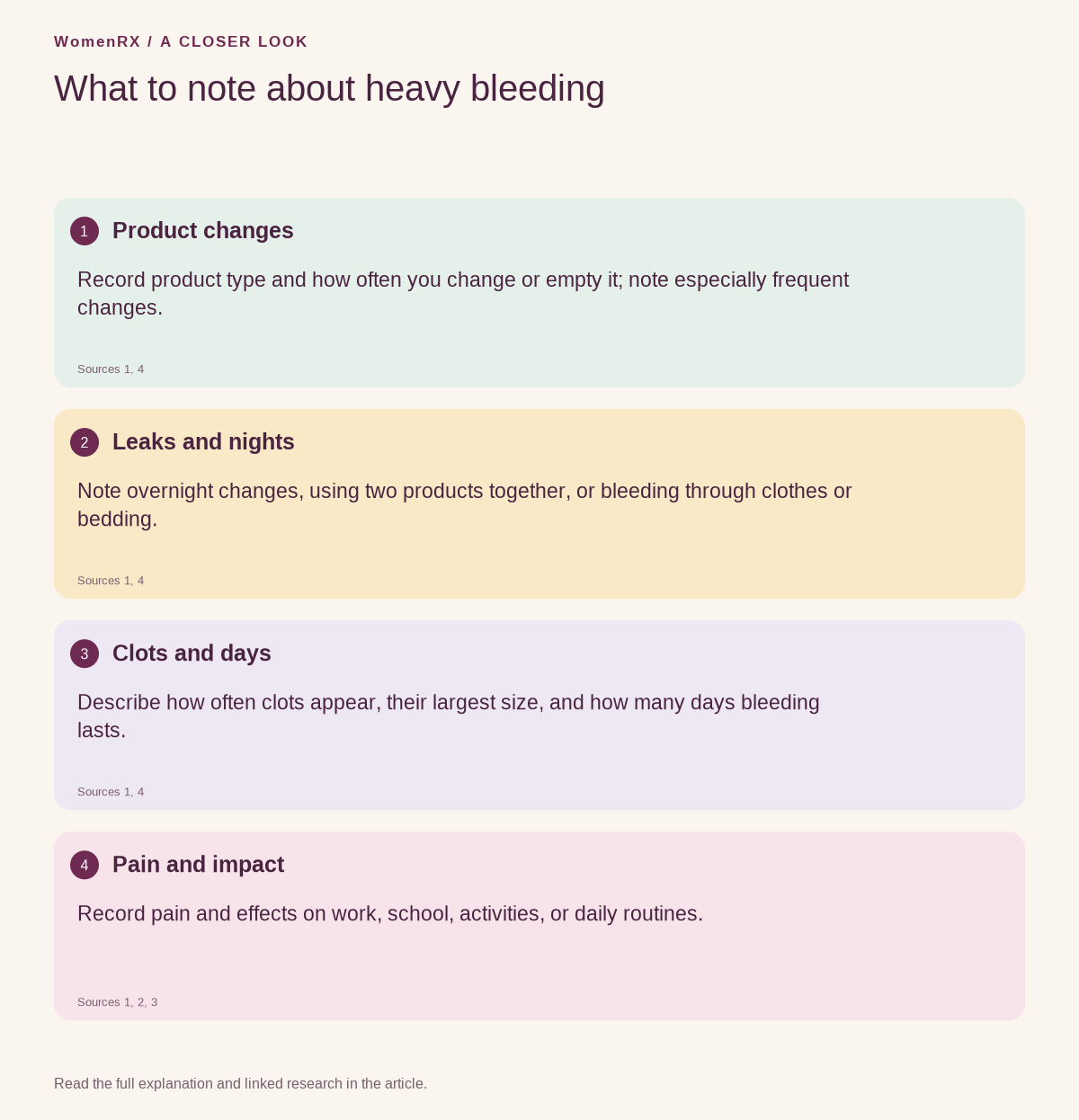
What to note about heavy bleeding
Product changes: Record product type and how often you change or empty it; note especially frequent changes.14
Leaks and nights: Note overnight changes, using two products together, or bleeding through clothes or bedding.14
Clots and days: Describe how often clots appear, their largest size, and how many days bleeding lasts.14
Pain and impact: Record pain and effects on work, school, activities, or daily routines.123
Read the figure as text
Use these observations to give a clinician a clearer account of the bleeding pattern and its effect on your life.- Product changes: Record product type and how often you change or empty it; note especially frequent changes.14
- Leaks and nights: Note overnight changes, using two products together, or bleeding through clothes or bedding.14
- Clots and days: Describe how often clots appear, their largest size, and how many days bleeding lasts.14
- Pain and impact: Record pain and effects on work, school, activities, or daily routines.123
More questions, answered
Does a clot mean I have a specific condition?
No. Clots are one part of the bleeding pattern, and their presence alone doesn’t identify a cause. Note their size and frequency alongside duration, product changes, leaks, and daily impact. 1 3
What if heavy bleeding started with my first periods?
Bring it up, especially if periods last more than 7 days, products soak through quickly, you need overnight changes, or you have other bleeding symptoms or a family history of bleeding problems. Those clues can lead to evaluation for a bleeding disorder, but they don’t prove you have one. 4
Sources you can check
- Heavy periods - NHSAccessed 2026-09-25Return to first citation
- Efficacy of regular prophylaxis with a plasma-derived von Willebrand factor/factor VIII concentrate with a 1:1 activity ratio in reducing heavy menstrual bleeding in girls/women with von Willebrand disease.Kiss C, Boda Z, Khayat CD, Boban A, Dubey L, Sidonio RF. · AJOG global reports · 2025Return to first citation
- Prevalence of Heavy Menstrual Bleeding and Its Associated Factors Among Women Attending Kilimanjaro Christian Medical Centre In Northern Eastern, Tanzania: A Cross-Sectional Study.Ibrahim PM, Samwel EL. · The East African health research journal · 2023Return to first citation
- Evaluation and management of heavy menstrual bleeding in adolescents: the role of the hematologist.O'Brien SH. · Blood · 2018Return to first citation