Period Blood Clots: When Bleeding Needs Attention
A clot is one clue; how much you’re bleeding, how long it lasts, and how you feel give it meaning.
Don’t judge a period clot by size alone. Look at the whole pattern: bleeding that repeatedly soaks a pad or tampon within 1 to 2 hours, lasts more than 7 days, disrupts your day, or comes with severe pain or frequent tiredness deserves assessment. If pregnancy is possible, contact a care provider promptly about bleeding. After birth, unusually heavy bleeding calls for prompt contact with your maternity care team. 3725
A clot is a clue, not the whole picture
Seeing a clot can be startling, especially if your period usually looks different. Clots are one sign clinicians consider when assessing heavy periods, but their appearance alone can’t tell you why you’re bleeding or whether you’re losing too much blood. Pay at least as much attention to the flow around them: how quickly you use period products, how many days the bleeding lasts, and whether you feel unwell. 3
For example, a clot on a day when your flow is manageable tells a different story from clots arriving while you’re repeatedly bleeding through clothes. Neither observation gives you a diagnosis. The second pattern does give you a reason to seek care rather than waiting to see whether the clots get bigger. 3
What makes a period worth checking
Heavy bleeding isn’t defined only by a measured amount of blood. Practical signs include needing a new pad or tampon every 1 to 2 hours, using two types of period product together to contain the flow, bleeding through clothes or bedding, or having a period that lasts more than 7 days. Missing work, exercise, or other ordinary activities because of the bleeding matters too. 3
Make an appointment if heavy periods are affecting your life, have continued over time, or come with severe period pain. Bleeding between periods or after sex also needs assessment, even if you haven’t seen a clot. 3 A change from your usual pattern is worth describing: “I’m changing products much more often than I used to” is useful information, even if you can’t estimate the amount of blood.
Heavy periods can happen around the first years of menstruation, after pregnancy, or as menopause approaches. They can also be associated with fibroids, adenomyosis, endometriosis, conditions that make bleeding easier, or certain medicines, including some anticoagulants. Bleeding between periods or after menopause has a broader range of possible causes and shouldn’t be treated as an ordinary period. 37 If heavy bleeding has been present since your first periods, or you also have a personal or family history of unusual bleeding, mention that: an inherited bleeding disorder may be part of the assessment. 6
Notice how the blood loss is affecting you
Repeated heavy periods can lead to iron-deficiency anemia. That’s one reason fatigue and shortness of breath belong in the picture alongside pads, days, and clots. Anemia can also cause dizziness, headaches, or feeling unusually cold. These symptoms have other possible causes, so blood tests can help establish whether anemia or iron deficiency is involved. 34
There’s no need to solve the cause yourself before asking for help. Assessment may include blood tests and, depending on your symptoms, an examination or imaging. Treatment depends on what’s causing the bleeding and how much it affects you. Options for heavy periods can include hormonal treatments or a medicine that reduces bleeding, such as tranexamic acid. If testing finds anemia, its treatment depends on the type and cause. 347
Pregnancy and the weeks after birth are different situations
If you are pregnant, or think you could be, don’t assume bleeding with clots is a period. Bleeding during pregnancy has several possible causes and isn’t always serious, but it warrants prompt contact with a care provider. Severe bleeding may require emergency care. 71 Whether you see clots is less useful here than making sure the pregnancy possibility is part of the conversation.
After birth, spotting or bleeding can come and go for up to six weeks. That expected bleeding is not a reason to apply an ordinary-period clot rule to bleeding that seems unusually heavy. Contact your maternity care team promptly about unusually heavy bleeding after birth; postpartum hemorrhage can worsen quickly. 25
The useful question, then, is not simply “How big was the clot?” It’s “What else is happening?” The amount and duration of bleeding, pain, symptoms such as dizziness or breathlessness, and whether pregnancy or a recent birth is involved all change the next step. 3457
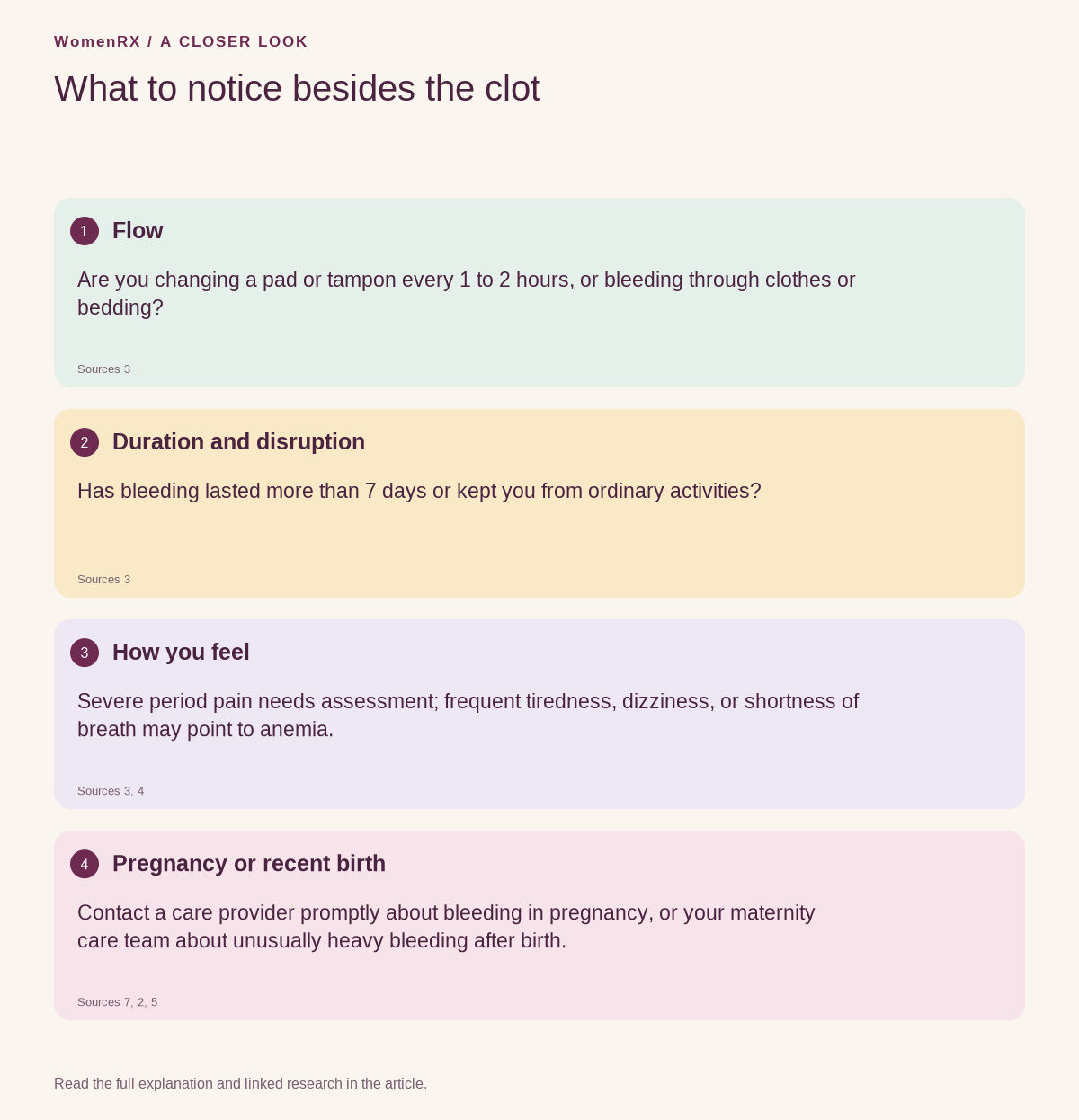
What to notice besides the clot
Flow: Are you changing a pad or tampon every 1 to 2 hours, or bleeding through clothes or bedding?3
Duration and disruption: Has bleeding lasted more than 7 days or kept you from ordinary activities?3
How you feel: Severe period pain needs assessment; frequent tiredness, dizziness, or shortness of breath may point to anemia.34
Pregnancy or recent birth: Contact a care provider promptly about bleeding in pregnancy, or your maternity care team about unusually heavy bleeding after birth.725
Read the figure as text
Four different observations help put bleeding in context; this is not a diagnostic score.- Flow: Are you changing a pad or tampon every 1 to 2 hours, or bleeding through clothes or bedding?3
- Duration and disruption: Has bleeding lasted more than 7 days or kept you from ordinary activities?3
- How you feel: Severe period pain needs assessment; frequent tiredness, dizziness, or shortness of breath may point to anemia.34
- Pregnancy or recent birth: Contact a care provider promptly about bleeding in pregnancy, or your maternity care team about unusually heavy bleeding after birth.725
More questions, answered
Can heavy periods cause low iron even if I feel mostly fine?
Yes. Heavy menstrual bleeding can lead to iron-deficiency anemia, and a blood test can check for it. Don’t wait for pronounced fatigue or shortness of breath if your bleeding is consistently heavy or affecting daily life. 34
Sources you can check
- Hemorrhage | Bleeding | MedlinePlusAccessed 2026-09-25Return to first citation
- Postpartum Care: MedlinePlusAccessed 2026-09-25Return to first citation
- Heavy periods - NHSAccessed 2026-09-25Return to first citation
- Anemia | MedlinePlusAccessed 2026-09-25Return to first citation
- Out-of-hospital care of postpartum hemorrhage: a scoping review.Soh R, Silvestri L, Pearce A, Pearce J. · JBI evidence synthesis · 2025Return to first citation
- Gynaecological and obstetric management of women with inherited bleeding disorders.Demers C, Derzko C, David M, Douglas J, Society of Obstetricians and Gynaecologists of Canada. · International journal of gynaecology and obstetrics: the official organ of the International Federation of Gynaecology and Obstetrics · 2006Return to first citation
- Vaginal Bleeding | Uterine Fibroids | MedlinePlusAccessed 2026-09-25Return to first citation