What Causes Heavy Periods, and When Is Bleeding Urgent?
Heavy periods have several possible causes, but a sudden episode with dizziness or breathlessness needs prompt attention.
Heavy periods can come from changes in the uterus, disrupted ovulation, a bleeding disorder, or certain medicines. Fibroids are only one possibility. A sudden heavy episode with dizziness or shortness of breath calls for urgent medical assessment; recurring periods that disrupt your life also deserve care and an anemia check. If pregnancy is possible, treat the bleeding as a separate concern and seek prompt advice. 62314
A heavy period is worth discussing when it changes what you can do, not just when it meets a measured blood-loss cutoff. Needing to change a pad or tampon every one to two hours, using two kinds of period protection together, bleeding for more than seven days, or bleeding through clothes or bedding are useful details to mention. You don’t have to measure the blood you’ve lost to describe what’s happening. 2
When bleeding needs attention now
A heavy period that has become suddenly much heavier is different from a familiar pattern across several cycles. Acute abnormal uterine bleeding can sometimes require rapid care. If a sudden heavy episode comes with dizziness or shortness of breath, seek urgent medical assessment rather than waiting for a routine visit. Those symptoms can occur with anemia; they aren’t an at-home test of how much blood you’ve lost. There’s no single number of pads or tampons that reliably sorts an emergency from a non-emergency. 312
Heavy bleeding across several periods also needs assessment, especially if it’s affecting work, sleep, school, or ordinary plans. Severe period pain, bleeding between periods, or bleeding after sex are additional reasons to arrange care. 2
If you’re pregnant or might be pregnant, don’t assume the bleeding is a period. Pregnancy-related bleeding has different possible causes and sits outside the heavy-period cause map below. Contact a healthcare provider right away about bleeding during pregnancy. 46
The cause map is wider than fibroids
Clinicians use a framework called PALM-COEIN to organize causes of abnormal uterine bleeding in nonpregnant people. PALM names structural changes, meaning changes in the uterus that may be investigated with imaging or examination. COEIN names causes that aren’t grouped as structural changes. It’s a way to consider possibilities, not a way to diagnose yourself from how heavy a period feels. 6
PALM: polyps, adenomyosis, leiomyomas, malignancy or hyperplasia. Polyps are growths in the uterine lining. Adenomyosis involves tissue from the uterine lining within the muscular wall of the uterus. Leiomyomas are fibroids. The last category includes abnormal growth of the lining and cancer. Cancer is a less common explanation for heavy periods, but bleeding patterns such as bleeding between periods or after sex still deserve assessment. Finding a fibroid also shouldn’t end the search automatically if the full bleeding pattern points to another concern. 62
COEIN: coagulopathy, ovulatory dysfunction, endometrial causes, iatrogenic causes, and causes not otherwise classified. In everyday terms, that includes problems with blood clotting, changes in ovulation, bleeding arising from how the uterine lining functions, effects of medicines or treatments, and causes that don’t fit the other groups. A bleeding disorder such as von Willebrand disease and some anticoagulant medicines are examples worth mentioning during an assessment. Hormone and thyroid problems can also be relevant to abnormal bleeding. 624
Not every condition associated with heavy or painful periods fits neatly into a quick explanation of the letters. Endometriosis and pelvic inflammatory disease can also be associated with heavy bleeding. Pain or other symptoms may help guide what a clinician investigates, but heaviness alone cannot identify the cause. 2
The timing of life matters as well. Periods can be heavier when they first begin and as menopause approaches; irregular cycles can also be common at those times. Timing is a clue, though, not a reason to dismiss bleeding that is persistent, disruptive, or accompanied by other symptoms. Bleeding after menopause is not a period and needs a separate assessment. 254
Ask about the effects of bleeding, not only its cause
Repeated heavy periods can contribute to anemia. Anemia may leave you tired, cold, dizzy, or short of breath, and it’s diagnosed with blood tests. Tell the clinician about those symptoms even if your main concern is the bleeding itself. 1 You can ask whether blood tests are needed to check for anemia and whether your iron status needs assessment. Finding anemia addresses an effect of the bleeding; it doesn’t, by itself, explain why you’re bleeding heavily. 12
For a non-urgent visit, the most useful account is a concrete one: for example, whether you’re changing protection every one to two hours, using two products together, bleeding between periods, or having severe pain. Say what has changed from your usual pattern and how it affects your day. These details help make the conversation more useful than calling a period simply “heavy.” 2
Treatment depends on what the assessment finds and what you need from it. Options described in clinical guidance include some hormonal contraceptives and medicines that reduce bleeding. The immediate goal may be different if the bleeding is acute or anemia is part of the picture. 231
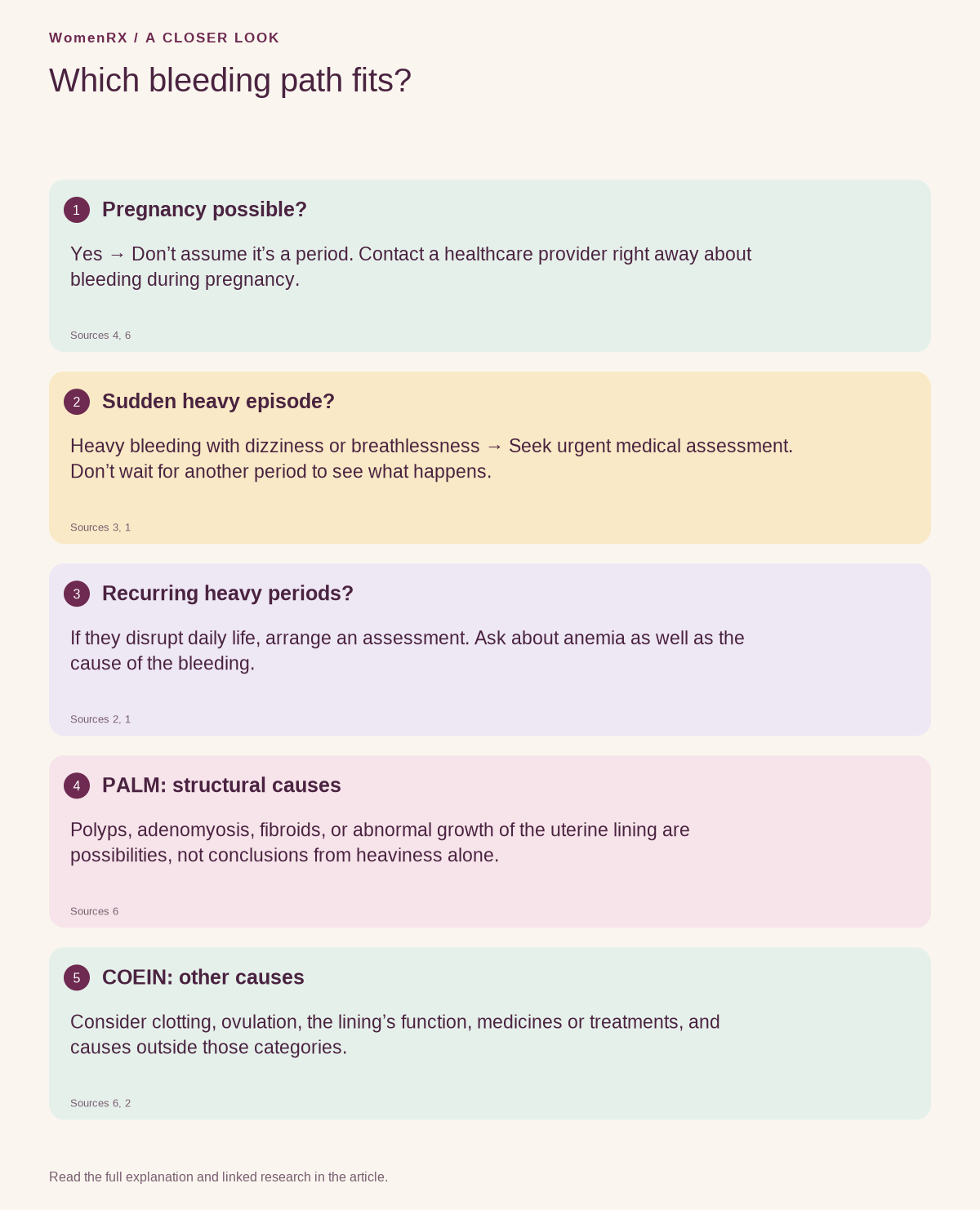
Which bleeding path fits?
Pregnancy possible?: Yes → Don’t assume it’s a period. Contact a healthcare provider right away about bleeding during pregnancy.46
Sudden heavy episode?: Heavy bleeding with dizziness or breathlessness → Seek urgent medical assessment. Don’t wait for another period to see what happens.31
Recurring heavy periods?: If they disrupt daily life, arrange an assessment. Ask about anemia as well as the cause of the bleeding.21
PALM: structural causes: Polyps, adenomyosis, fibroids, or abnormal growth of the uterine lining are possibilities, not conclusions from heaviness alone.6
COEIN: other causes: Consider clotting, ovulation, the lining’s function, medicines or treatments, and causes outside those categories.62
Read the figure as text
Start with pregnancy possibility and the current episode. The cause branches apply to recurring bleeding, not to deciding whether sudden bleeding needs urgent care.- Pregnancy possible?: Yes → Don’t assume it’s a period. Contact a healthcare provider right away about bleeding during pregnancy.46
- Sudden heavy episode?: Heavy bleeding with dizziness or breathlessness → Seek urgent medical assessment. Don’t wait for another period to see what happens.31
- Recurring heavy periods?: If they disrupt daily life, arrange an assessment. Ask about anemia as well as the cause of the bleeding.21
- PALM: structural causes: Polyps, adenomyosis, fibroids, or abnormal growth of the uterine lining are possibilities, not conclusions from heaviness alone.6
- COEIN: other causes: Consider clotting, ovulation, the lining’s function, medicines or treatments, and causes outside those categories.62
More questions, answered
Could heavy bleeding still be worth treating if it has always been normal for me?
Yes. A longstanding pattern can still affect your daily life, and treatment can help. You don’t need a new change in your cycle before bringing up bleeding that limits what you can do. 2
Sources you can check
- Anemia | MedlinePlusAccessed 2026-09-25Return to first citation
- Heavy periods - NHSAccessed 2026-09-25Return to first citation
- Management of obstetric and gynecologic hemorrhage: a narrative review of current guidelines and evidence.Ichim M, Marin AG, Bot M, Borislavschi A, Boiangiu AG, Vladareanu R, Filipescu A. · Journal of medicine and life · 2026Return to first citation
- Vaginal Bleeding | Uterine Fibroids | MedlinePlusAccessed 2026-09-25Return to first citation
- Period problems - NHSAccessed 2026-09-25Return to first citation
- Abnormal Uterine Bleeding: A Pictorial Review on Differential Diagnosis and Not-So-Common Cases of Interventional Radiology Management.Viganò S, Smedile A, Cazzella C, Marra P, Bonaffini PA, Sironi S. · Diagnostics (Basel, Switzerland) · 2024Return to first citation