Iron Deficiency and Perimenopause: When to Ask
Heavier or longer periods can raise the question of iron loss, but fatigue alone can’t tell you whether iron is low.
Yes. Iron deficiency can occur during perimenopause if changing periods become heavy or prolonged. If bleeding is affecting daily life, lasts more than seven days, or you’re feeling persistently tired or short of breath, ask whether a complete blood count and ferritin test make sense. Fatigue has many possible causes, and bleeding after periods have stopped needs evaluation rather than being assumed to be perimenopause. 3 5 6
When changing periods make iron worth discussing
Perimenopause can bring changes in menstrual bleeding, and heavy periods are one possible reason to ask about iron. Blood loss can reduce iron stores and, in some cases, lead to iron-deficiency anemia. A study of 454 women referred to a specialist clinic for heavy menstrual bleeding found anemia in about 35% and ferritin below 15 μg/L in about 43%. Because these women were referred for heavy bleeding, those figures don’t estimate how often iron deficiency occurs in everyone going through perimenopause. 3 5
The pattern of bleeding is more useful than the life stage alone. Signs of heavy periods can include needing to change a pad or tampon every one to two hours, periods lasting more than seven days, or needing two types of period products at once. Heavy bleeding that affects your daily life is also a reason to raise it, even if you’ve come to think of it as normal for you. Heavy periods can happen as menopause approaches, but they can also have other causes, including fibroids and adenomyosis. 3
What blood tests can and can’t tell you
A complete blood count (CBC) measures blood cells, including red blood cells, and includes measures such as hematocrit. It can help identify anemia, but it isn’t the same as directly checking iron stores. Ferritin is a blood test used to assess those stores. In a specialist-clinic study of women with heavy bleeding, the researchers measured both a CBC and ferritin, illustrating why someone may ask about both when blood loss is a concern. 1 5
It’s also worth separating “iron deficiency” from “anemia.” Anemia means the blood doesn’t carry enough oxygen; iron deficiency can be present without anemia. In a study of reproductive-age women taking anticoagulants, some participants with ferritin at or below 30 ng/mL had hemoglobin of at least 12 g/dL. That population had a specific risk factor, so the result isn’t a perimenopause estimate, but it shows why a CBC alone may not answer every question about iron stores. 2 4
Fatigue, dizziness, feeling cold, headaches, and shortness of breath can occur with anemia, but these symptoms don’t establish that iron is the cause. If fatigue is your main concern and your bleeding hasn’t changed, it’s still reasonable to describe the symptom and ask what evaluation fits your situation. 2
After periods stop, bleeding is a different question
Once you’ve reached menopause, bleeding isn’t just another changing period to watch. Postmenopausal bleeding requires evaluation for possible problems in the uterus, including precancerous or cancerous changes. Iron tests may be relevant if there has been blood loss, but checking iron does not replace investigating why bleeding occurred. 6
A useful way to frame the conversation
You might say: “My periods have become heavier or longer, and I’m wondering whether blood loss could affect my iron. Would a CBC and ferritin help answer that?” If bleeding is your concern, describe what has changed and how it affects daily life. If fatigue is the concern, mention whether it comes with bleeding changes or other symptoms. The goal is to connect the test question to your actual pattern, rather than assume that every tired spell is iron deficiency.
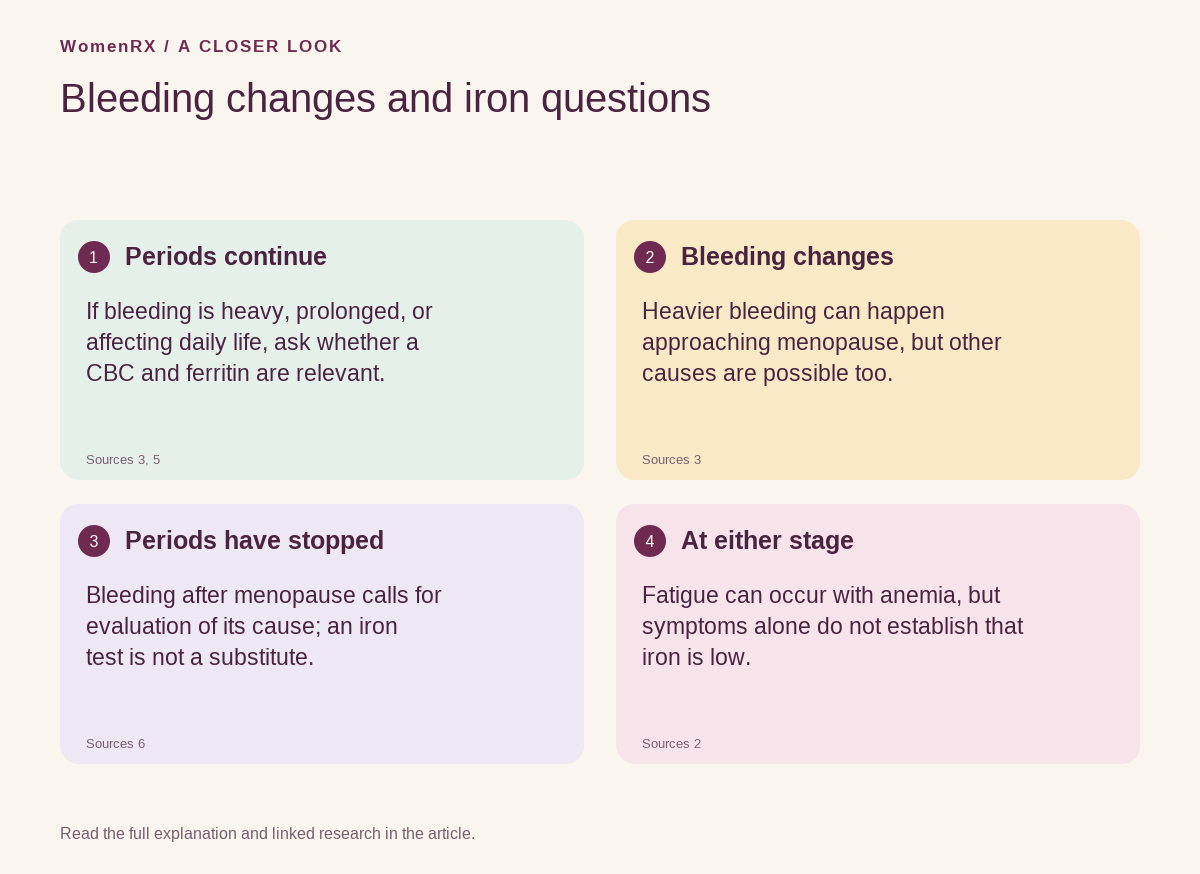
Bleeding changes and iron questions
Periods continue: If bleeding is heavy, prolonged, or affecting daily life, ask whether a CBC and ferritin are relevant.35
Bleeding changes: Heavier bleeding can happen approaching menopause, but other causes are possible too.3
Periods have stopped: Bleeding after menopause calls for evaluation of its cause; an iron test is not a substitute.6
At either stage: Fatigue can occur with anemia, but symptoms alone do not establish that iron is low.2
Read the figure as text
The question shifts with menstrual stage: consider blood loss while periods continue, and investigate bleeding after menopause rather than treating it as a changing period. Fatigue is a separate consideration at either stage.- Periods continue: If bleeding is heavy, prolonged, or affecting daily life, ask whether a CBC and ferritin are relevant.35
- Bleeding changes: Heavier bleeding can happen approaching menopause, but other causes are possible too.3
- Periods have stopped: Bleeding after menopause calls for evaluation of its cause; an iron test is not a substitute.6
- At either stage: Fatigue can occur with anemia, but symptoms alone do not establish that iron is low.2
More questions, answered
Can a normal CBC rule out low iron stores?
Not necessarily. A CBC helps assess anemia, while ferritin is used to assess iron stores. In a study of reproductive-age women taking anticoagulants, some people with ferritin at or below 30 ng/mL had hemoglobin of at least 12 g/dL. 1 4
Should bleeding after menopause be treated like a heavy period?
No. Bleeding after menopause needs evaluation for its cause, including possible uterine pathology; it shouldn’t be attributed to perimenopause. 6
Sources you can check
- Blood Count Tests: MedlinePlusAccessed 2026-09-25Return to first citation
- Anemia | MedlinePlusAccessed 2026-09-25Return to first citation
- Heavy periods - NHSAccessed 2026-09-25Return to first citation
- Prevalence of iron deficiency in reproductive-age females on anticoagulation.Bakow BR, Zon RL, Agarwal S, Akpan IJ, Lim MY, Parks AL, Pfeffer MA, Rajpurkar M, Rosovsky RP, Samuelson Bannow B, Yang X, Baumann Kreuziger L. · Thrombosis research · 2026Return to first citation
- Evaluation of coagulation disorders and iron deficiency in women with heavy menstrual bleeding.Rugeri L, Fruchou Y, Brodbeck C, Bastien M, Lioux A, Gouy G, Cortet M, Dubernard G, Dargaud Y. · International journal of gynaecology and obstetrics: the official organ of the International Federation of Gynaecology and Obstetrics · 2026Return to first citation
- Visually directed hysteroscopic biopsy in the evaluation of abnormal uterine bleeding and postmenopausal bleeding: a Joint Society Practice Guideline. Joint Society Practice Guideline from AAGL-ESGE-GCH. · Facts, views & vision in ObGyn · 2026Return to first citation