Can Iron Deficiency Change Your Appetite or Weight?
Iron deficiency and anemia aren’t the same, and a change in appetite or weight can’t tell you whether iron is the cause.
Iron deficiency can occur before iron-deficiency anemia, and a change in weight alone can’t identify either one. Studies in adult women taking iron have reported different appetite and weight patterns, so they don’t establish that iron deficiency causes weight gain or loss. If your weight has changed unexpectedly, consider other explanations as well as whether iron testing makes sense. 1 2 4 6
A change in appetite or weight can happen at the same time as low iron, but that doesn’t tell you which came first or whether one caused the other. Research in adult women is limited and mixed. Findings about appetite in children with iron-deficiency anemia don’t establish what happens to appetite or weight in adult women. 4 5 6
Low iron and anemia are different stages
Iron deficiency means the body’s iron stores are low. It can be present before hemoglobin drops enough to meet the definition of iron-deficiency anemia. 2 One adult treatment study specifically enrolled premenopausal women with iron-deficiency anemia, and the study of young children also studied anemia. The other adult study enrolled women treated for iron deficiency but doesn’t clearly establish which participants had anemia. Findings in these groups can’t be assumed to describe women with low iron stores but no anemia. 4 5 6
Iron-deficiency anemia can cause symptoms such as fatigue, weakness, difficulty concentrating, or gastrointestinal disturbances, though it may not cause symptoms at first. Those symptoms don’t tell you whether your appetite or weight change is due to iron. 2 3
What studies in adult women report
One prospective observational study followed 119 women aged 18 to 45 who were receiving oral iron for iron deficiency. After three months, average weight and several appetite measures decreased, though appetite changes varied by the food or measure assessed. Because the study compared participants before and after treatment, it can’t show that iron itself caused those changes. 4
A separate observational study in premenopausal women with iron-deficiency anemia reported increased appetite and weight in two treatment groups, but not in the group treated every other day. This doesn’t settle the question: the study compared treatment schedules, and its findings don’t establish what iron deficiency itself does to weight. 6
Taken together, these studies don’t support a simple rule such as “low iron causes weight gain” or “iron makes you lose weight.” They also don’t tell us whether the same patterns apply to women with iron deficiency but no anemia. 4 6
Appetite findings in children don’t answer the adult question
In a study of 19 children aged 12 to 24 months with iron-deficiency anemia, appetite and daily food intake increased during three months of iron treatment, alongside accelerated growth. That may reflect children catching up in growth after anemia, but it can’t predict what will happen to an adult woman’s appetite or weight. 5
Some contexts help explain why someone might have low iron, without explaining a change in appetite or weight by themselves. Heavy menstrual bleeding can contribute to iron loss; digestive conditions can affect iron absorption or cause blood loss. 2 3
Pregnancy is another context where iron needs rise as maternal blood volume and red blood cell production expand. That makes iron status worth considering in pregnancy, but it doesn’t mean iron explains a weight change. 2
A change on the scale is only one clue
Body weight includes water, muscle, bone, and fat, and everyday factors can shift it. A weight change alone can’t diagnose low iron or explain its cause. If the change is unexpected or continues, it’s reasonable to look at the full picture rather than assume iron is responsible. 1
If you’re wondering about iron, blood tests are more useful than appetite or weight as clues. Clinicians may use ferritin to assess iron stores and combine it with other blood measurements; inflammation can affect ferritin, so a result may need context. 2
Your life stage can help frame the iron question. Heavy periods increase the chance of iron deficiency, and pregnancy raises iron needs. Neither circumstance, by itself, proves that iron is behind a weight or appetite change. 2 3
If you’re already taking iron, gastrointestinal effects such as nausea, constipation, abdominal pain, or diarrhea can occur. These may make eating less comfortable, but they don’t show that iron is causing a lasting change in body weight. Don’t start iron just to change your weight; the studies don’t support it as a weight-management treatment. 2 3
The practical takeaway: treat weight change as a reason to consider several possibilities, not as a test for iron deficiency. Iron testing can answer the iron question; it won’t automatically explain every change in appetite or weight.
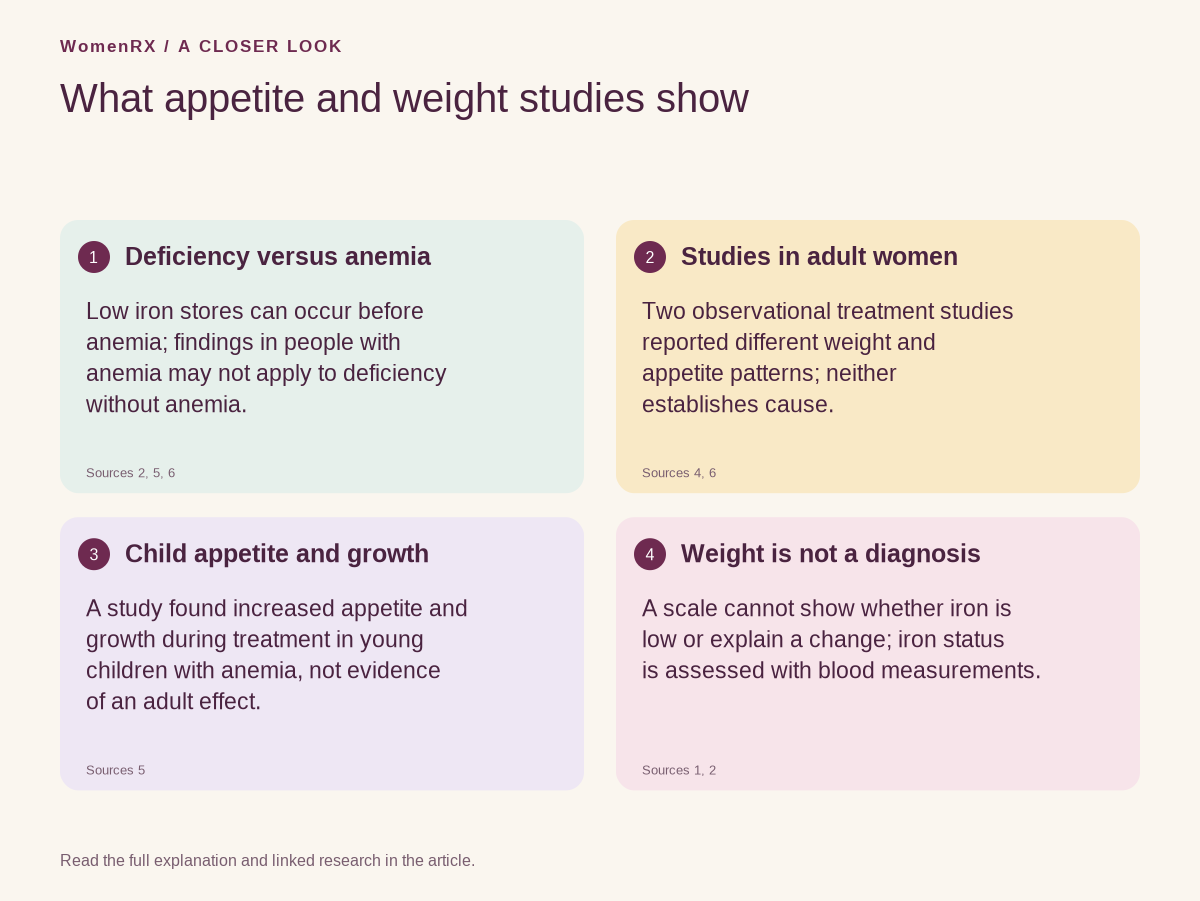
What appetite and weight studies show
Deficiency versus anemia: Low iron stores can occur before anemia; findings in people with anemia may not apply to deficiency without anemia.256
Studies in adult women: Two observational treatment studies reported different weight and appetite patterns; neither establishes cause.46
Child appetite and growth: A study found increased appetite and growth during treatment in young children with anemia, not evidence of an adult effect.5
Weight is not a diagnosis: A scale cannot show whether iron is low or explain a change; iron status is assessed with blood measurements.12
Read the figure as text
The findings differ by population and study. They suggest possible connections but don’t establish that iron deficiency or iron treatment causes a change in an adult woman’s weight.- Deficiency versus anemia: Low iron stores can occur before anemia; findings in people with anemia may not apply to deficiency without anemia.256
- Studies in adult women: Two observational treatment studies reported different weight and appetite patterns; neither establishes cause.46
- Child appetite and growth: A study found increased appetite and growth during treatment in young children with anemia, not evidence of an adult effect.5
- Weight is not a diagnosis: A scale cannot show whether iron is low or explain a change; iron status is assessed with blood measurements.12
More questions, answered
Can iron supplements cause weight gain?
The available studies in adult women don’t establish that iron supplements cause weight gain. One observational study reported weight increases in some treatment groups, while another found average weight decreases during treatment. Neither result proves iron caused the change. 4 6
Can a heavy period cause low iron?
Yes. Heavy menstrual bleeding increases the risk of iron deficiency because it increases iron loss. It may be relevant when considering low iron, but it doesn’t by itself explain a change in weight or appetite. 2 3
Sources you can check
- Body Weight: MedlinePlusAccessed 2026-09-25Return to first citation
- Iron - Health Professional Fact SheetAccessed 2026-09-25Return to first citation
- Iron: MedlinePlusAccessed 2026-09-25Return to first citation
- The effect of ferrous oral iron used in the treatment of iron deficiency on weight gain and appetite in adults: a prospective study.Alici Yilmaz C, Ayhan Baser D, Aksoy H, Tengilimoglu-Metin MM. · Primary health care research & development · 2025Return to first citation
- The effect of therapy on plasma ghrelin and leptin levels, and appetite in children with iron deficiency anemia.Kucuk N, Orbak Z, Karakelloglu C, Akcay F. · Journal of pediatric endocrinology & metabolism : JPEM · 2019Return to first citation
- The effect of oral ferrous sulfate use in different posology on laboratory values and clinical findings related to iron metabolism in anemia due to iron deficiency.Yüksel M, Aydoğan M, Doğan Ö, Yüksel MK. · Medicine · 2025Return to first citation