Iron Deficiency, Fertility, and Pregnancy: What to Know
Low iron doesn’t automatically prevent pregnancy, but confirming whether you’re deficient or anemic can guide care before conception and during pregnancy.
Iron deficiency can exist before anemia develops, so a normal hemoglobin result alone may not tell the whole story. Current evidence does not show that low iron always prevents conception. One fertility-clinic study found better outcomes after iron treatment, but its before-and-after design can’t establish that treatment caused the change. Testing and treatment depend on your results, possible causes, and whether you’re pregnant. 1 3
Low iron isn’t the same as anemia
Iron helps your body make hemoglobin, the protein in red blood cells that carries oxygen. Iron deficiency develops in stages: iron stores may fall first, while hemoglobin stays in the normal range. Anemia occurs later, when iron stores are more depleted and hemoglobin falls. That’s why hemoglobin alone may not capture early deficiency. 1
A clinician may consider hemoglobin or hematocrit measurements along with ferritin, which reflects stored iron. No single result always tells the whole story: ferritin can appear higher during inflammation, and iron status is often assessed using more than one measure. 1
Does low iron affect your chance of conceiving?
It’s understandable to wonder whether correcting low iron could help you get pregnant. The direct evidence is limited. A 2025 retrospective study followed 292 women with infertility and low ferritin at a fertility clinic in Finland. After intravenous iron treatment, more women conceived and had live births, and fewer had miscarriages than in the period before treatment. The study compared outcomes before and after treatment in the same clinic population; it can show an association, but it can’t prove that the infusion caused the differences or establish what would happen for women trying to conceive generally. 3
So, iron deficiency shouldn’t be treated as a universal explanation for difficulty conceiving, and an iron supplement isn’t an established fertility treatment. If you’re having fertility care and also have low iron, it’s reasonable to discuss both findings with your care team without assuming one caused the other. 3
Look for the reason, not just the number
For women who menstruate, blood loss can contribute to low iron. Heavy menstrual bleeding raises the risk of deficiency. Other possible contributors include not getting enough iron in food, digestive conditions that interfere with absorption, and blood loss from another source. 1 2
The cause can shape what happens next. For example, a low result alongside heavy periods raises different questions than low iron in someone with a condition that affects absorption. Ask what the results suggest about your iron stores and hemoglobin, and whether your history points to a likely cause that also needs attention.
Pregnancy changes the context
Iron needs rise during pregnancy as the body makes more red blood cells and supports the placenta and fetus. Iron deficiency during pregnancy is associated with risks including maternal anemia, premature birth, and low birthweight. Those associations make assessment and treatment worth discussing, but they don’t mean that an individual outcome is certain. 1
Guidance on routine screening and preventive supplements for pregnant people isn’t completely uniform. The NIH fact sheet summarizes guidance from ACOG to screen for anemia in pregnancy and treat iron-deficiency anemia, while the U.S. Preventive Services Task Force says evidence is insufficient to determine the balance of benefits and harms of routine screening and preventive supplementation for pregnant people without symptoms. That USPSTF statement doesn’t cover people with symptoms or certain higher-risk conditions. 1
If you’re already pregnant, mention a previous diagnosis of low iron, heavy bleeding before pregnancy, or a condition that could affect absorption. If you’re planning pregnancy, you can ask whether testing makes sense now, particularly if you’ve had iron deficiency before. Don’t assume you need a separate high-dose iron product: the right plan depends on whether deficiency is present, pregnancy status, and what you already take. Iron supplements can cause gastrointestinal side effects, and taking more than needed isn’t a substitute for finding out what’s going on. 1
Questions that make a results discussion useful
You might ask:
- Do my results suggest low iron stores, anemia, or both?
- Was ferritin measured as well as hemoglobin, and could inflammation affect how the result is interpreted?
- What might be contributing, such as heavy periods, diet, or an absorption problem?
- If I’m trying to conceive or pregnant, how does that change the plan?
- If treatment is recommended, what should I take, what side effects should I watch for, and how will we check whether it’s working?
The goal is to connect the lab results to your situation, not to assume low iron explains fertility problems or that everyone needs the same supplement plan.
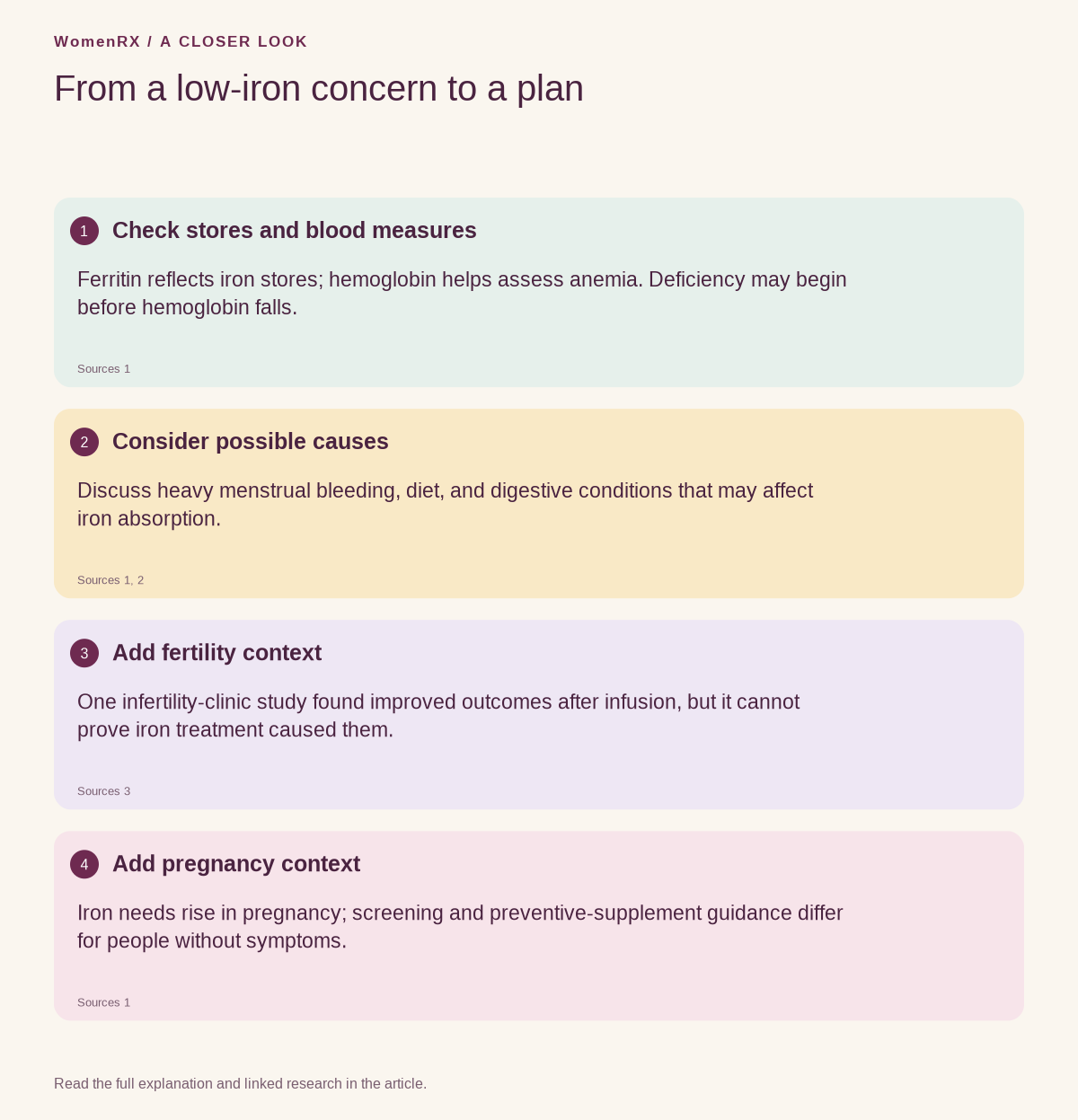
From a low-iron concern to a plan
Check stores and blood measures: Ferritin reflects iron stores; hemoglobin helps assess anemia. Deficiency may begin before hemoglobin falls.1
Consider possible causes: Discuss heavy menstrual bleeding, diet, and digestive conditions that may affect iron absorption.12
Add fertility context: One infertility-clinic study found improved outcomes after infusion, but it cannot prove iron treatment caused them.3
Add pregnancy context: Iron needs rise in pregnancy; screening and preventive-supplement guidance differ for people without symptoms.1
Read the figure as text
A useful discussion moves from confirming iron status to considering the cause, then adapting the treatment conversation to whether you’re trying to conceive or pregnant.- Check stores and blood measures: Ferritin reflects iron stores; hemoglobin helps assess anemia. Deficiency may begin before hemoglobin falls.1
- Consider possible causes: Discuss heavy menstrual bleeding, diet, and digestive conditions that may affect iron absorption.12
- Add fertility context: One infertility-clinic study found improved outcomes after infusion, but it cannot prove iron treatment caused them.3
- Add pregnancy context: Iron needs rise in pregnancy; screening and preventive-supplement guidance differ for people without symptoms.1
More questions, answered
Can you have iron deficiency without anemia?
Yes. Iron stores can become depleted before hemoglobin falls. Ferritin helps assess iron stores, while hemoglobin or hematocrit measurements help assess anemia; clinicians may consider multiple measures. 1
Does a fertility study prove iron treatment improves pregnancy chances?
No. One retrospective study in women with infertility found better conception and pregnancy outcomes after intravenous iron, but its before-and-after design can’t show that treatment caused the difference or that the result applies to everyone trying to conceive. 3
Sources you can check
- Iron - Health Professional Fact SheetAccessed 2026-09-25Return to first citation
- Iron: MedlinePlusAccessed 2026-09-25Return to first citation
- Association between iron deficiency and fertility.Tulenheimo-Silfvast A, Ruokolainen-Pursiainen L, Simberg N. · Acta obstetricia et gynecologica Scandinavica · 2025Return to first citation