Restless Legs: Causes, Iron Checks, and Pregnancy
Restless legs syndrome has a recognizable pattern, but iron status, pregnancy, family history, kidney disease, and some medicines may all be relevant.
Restless legs syndrome (RLS) is a strong urge to move the legs, often with uncomfortable sensations that start or worsen at rest, ease with movement, and are worse in the evening or at night. There isn’t one established cause for everyone. Iron status, pregnancy, family history, kidney disease, and certain medicines may be relevant, so an evaluation can include an iron blood test and a medication review. 16
The pattern matters
RLS is more than legs that feel restless after a long day. The typical pattern is an urge to move, often with sensations such as tingling, aching, itching, or crawling. Symptoms start or worsen while you’re sitting or lying still, ease while you move, and tend to be worse in the evening or at night. They can interrupt falling asleep or staying asleep. 16
That pattern helps distinguish RLS from other problems, but it doesn’t explain its cause. Leg cramps and peripheral neuropathy can produce symptoms that resemble RLS. A description of what you feel, when it happens, and whether movement helps can help a clinician consider the difference. RLS is diagnosed from the clinical history; a sleep study isn’t required to make the diagnosis. 16
What may contribute, and what remains uncertain
RLS is thought to involve iron and dopamine signaling in the brain, but a simple cause-and-effect explanation hasn’t been established. Some people have no clear cause. A family history is associated with a greater likelihood of RLS; kidney disease, pregnancy, and some medicines are also linked to it. These are possible contributors, not proof that any one factor caused your symptoms. 15
Some medicines may make symptoms worse. A review identifies serotonergic antidepressants, dopamine-blocking medicines, and centrally acting antihistamines such as diphenhydramine as examples. If symptoms began or changed around the time you started a medicine, bring that up during a medication review. Don’t stop a prescribed medicine on your own. 6
When iron is worth checking
Iron is relevant to RLS, but low iron isn’t the explanation for every case. Iron status is also worth considering for reasons unrelated to RLS: menstrual blood loss can increase iron loss, and iron requirements rise during pregnancy. Heavy periods, pregnancy, and breastfeeding are among the situations associated with greater risk of low iron. 23
A clinician may assess iron with blood tests such as ferritin, which reflects iron stores, and other measures, sometimes alongside hemoglobin. Hemoglobin alone can miss depleted iron stores, and ferritin can read higher during inflammation. So results need to be considered in context rather than interpreted as a stand-alone answer. 2
The threshold used to think about iron in RLS may not be the same as the threshold used to diagnose iron deficiency anemia. A recent RLS review describes treatment decisions based on ferritin at or below 100 ng/mL or transferrin saturation below 20%. Those are clinical decision points, not instructions to start a supplement yourself; the right interpretation and next step depend on your results and circumstances. 6
Iron supplements can cause side effects, and excess iron can be harmful. Checking whether iron is appropriate is especially useful before taking it for leg symptoms. If iron is recommended, ask what result supports that choice and how your status will be followed. 23
Pregnancy and after delivery
RLS can begin or worsen during pregnancy, often later in pregnancy, and symptoms commonly improve after delivery. Pregnancy-related changes in iron needs are one possible part of the picture, but the mechanisms are not fully understood. Research reviews discuss several hypotheses, including iron metabolism and hormonal changes, rather than establishing one cause. 145
Pregnancy and postpartum are also times when iron status can matter for reasons beyond RLS. Iron needs rise during pregnancy, and breastfeeding is another life stage associated with risk of low iron. If symptoms persist after delivery, or are affecting your sleep, raise both the leg symptoms and your iron status with your care team. 23
A useful next step
If the sensations fit the rest-at-night, eased-by-movement pattern and are disrupting sleep, ask whether your symptoms sound like RLS and whether iron tests or a medication review make sense. Mention pregnancy or recent delivery, heavy menstrual bleeding, kidney disease, and any recent medication changes if they apply. The goal is not to assume one cause, but to identify a contributor that can change what happens next. 126
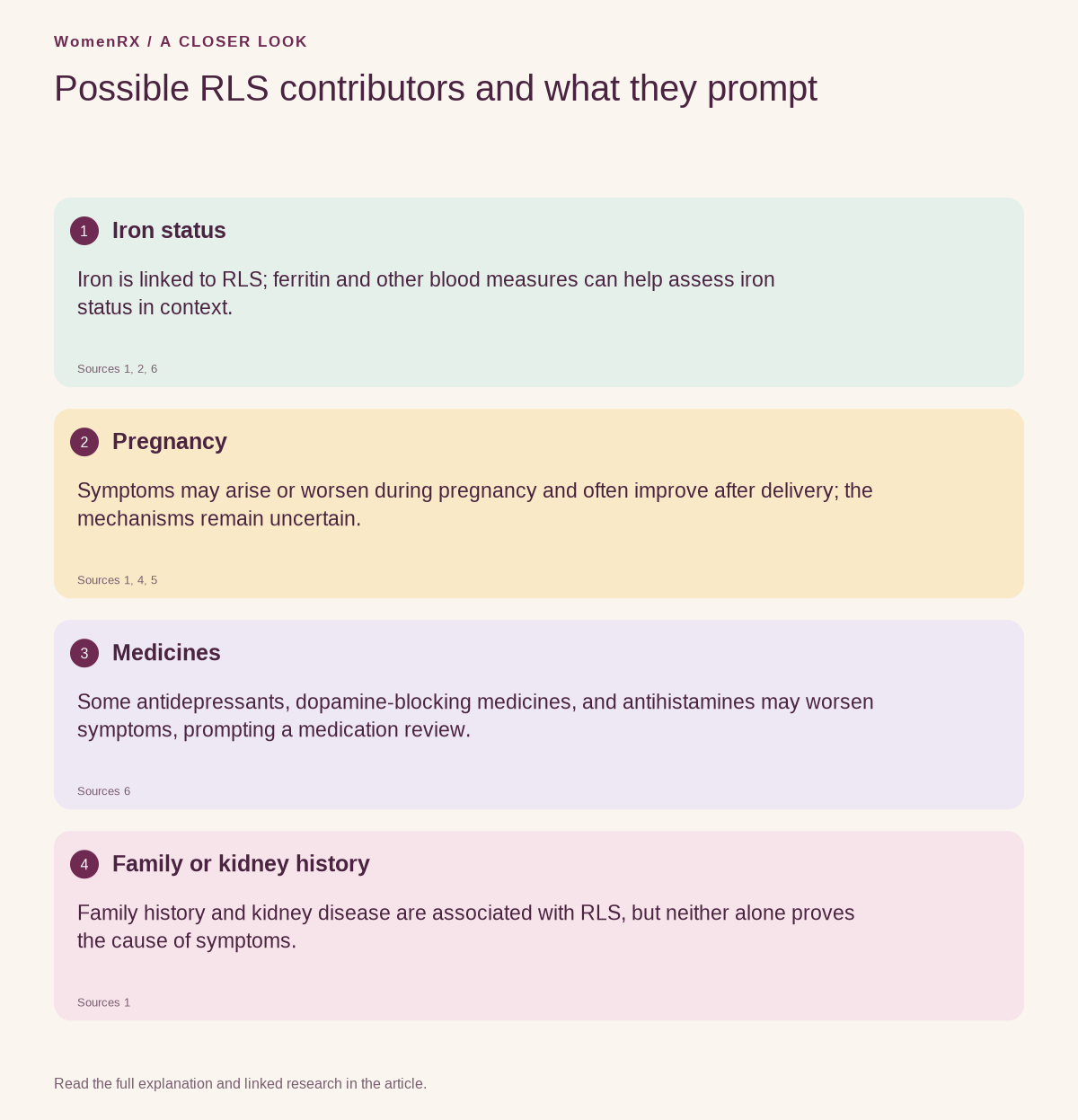
Possible RLS contributors and what they prompt
Iron status: Iron is linked to RLS; ferritin and other blood measures can help assess iron status in context.126
Pregnancy: Symptoms may arise or worsen during pregnancy and often improve after delivery; the mechanisms remain uncertain.145
Medicines: Some antidepressants, dopamine-blocking medicines, and antihistamines may worsen symptoms, prompting a medication review.6
Family or kidney history: Family history and kidney disease are associated with RLS, but neither alone proves the cause of symptoms.1
Read the figure as text
RLS has no single established cause. These links can help explain why evaluation may include symptom history, iron tests, and a medication review.- Iron status: Iron is linked to RLS; ferritin and other blood measures can help assess iron status in context.126
- Pregnancy: Symptoms may arise or worsen during pregnancy and often improve after delivery; the mechanisms remain uncertain.145
- Medicines: Some antidepressants, dopamine-blocking medicines, and antihistamines may worsen symptoms, prompting a medication review.6
- Family or kidney history: Family history and kidney disease are associated with RLS, but neither alone proves the cause of symptoms.1
More questions, answered
Does having RLS mean I have iron-deficiency anemia?
No. RLS can occur without a clear cause, and an iron-related RLS treatment threshold is not the same thing as a diagnosis of iron-deficiency anemia. Blood-test results need to be interpreted in context. 126
Should I try an iron supplement for restless legs?
It’s better to check whether iron is appropriate first. Iron supplements can cause side effects, and taking more iron than you need can be harmful. A clinician can interpret iron tests and consider your other health factors. 23
Sources you can check
- Restless legs syndrome - NHSAccessed 2026-09-25Return to first citation
- Iron - Health Professional Fact SheetAccessed 2026-09-25Return to first citation
- Iron: MedlinePlusAccessed 2026-09-25Return to first citation
- Update on Restless Legs Syndrome Management during Pregnancy.Jung KY. · Sleep medicine clinics · 2026Return to first citation
- Possible etiologies of restless legs syndrome in pregnancy: a narrative review.Mendes A, Silva V. · Sleep science (Sao Paulo, Brazil) · 2022Return to first citation
- Restless Legs Syndrome: A Review.Winkelman JW, Wipper B. · JAMA · 2026Return to first citation