Restless Legs at Night: Spot the Pattern, Discuss Relief
Restless legs syndrome has a recognizable rest-and-movement pattern, and checking iron status and medicines can help shape the next step.
RLS is more likely when an uncomfortable urge to move your legs starts or worsens while you’re still, eases while you move, and is strongest in the evening or at night. Leg cramps and peripheral neuropathy can feel similar, so the pattern matters. Before trying treatment, ask about iron testing, medicines that may worsen symptoms, and how pregnancy changes the options. 1 4
The clue is what happens when you rest
Restless legs syndrome (RLS) isn’t just legs that feel restless at bedtime. The characteristic pattern is an urge to move, often with unpleasant sensations such as aching or tingling. Symptoms are brought on or worsened by stillness, ease while you’re moving, and tend to be strongest in the evening or at night. They can make it hard to fall asleep or stay asleep. RLS can affect people of any sex. 1 4
A cramp or peripheral neuropathy can also cause uncomfortable leg sensations. If your symptoms don’t fit the rest, movement, and evening pattern, mention that: the name of the sensation alone doesn’t establish RLS. Diagnosis is usually based on your symptom history; a sleep study isn’t routinely needed to diagnose it. 1 4
Iron is worth checking, not guessing at
Iron is one factor linked with RLS, but it’s not the explanation for every case. A useful question is whether to check ferritin, which reflects iron stores, along with other iron measures such as transferrin saturation. A normal hemoglobin result doesn’t necessarily tell the whole story: iron stores can be low before anemia develops, and inflammation can make ferritin harder to interpret. 2 4
Iron deficiency is more likely during pregnancy and in people with heavy menstrual bleeding, because blood loss and pregnancy-related needs can affect iron status. That makes these useful details to share when discussing testing; it doesn’t prove that iron is causing your leg symptoms. Don’t start an iron supplement just because you have RLS. Too much supplemental iron can cause problems, and the right treatment depends on your results and circumstances. 2
Review medicines before adding one
Some medicines can worsen RLS symptoms. A recent clinical review names serotonergic antidepressants, dopamine-blocking medicines, and centrally acting antihistamines such as diphenhydramine among possible contributors. Ask your prescriber whether a medicine you take could be playing a role and whether there’s a suitable alternative. 4
If iron is low, ask whether treating that is a reasonable first step and what form of iron treatment fits your results. If symptoms remain disruptive, medication may be part of the discussion. For adults, a recent review describes gabapentinoids, including gabapentin, as first-line medication options; dopamine agonists are no longer recommended as first-line because they can cause treatment-related worsening of symptoms over time. These choices depend on your health and the cause of your symptoms. 4
Pregnancy changes the conversation
RLS symptoms may begin during pregnancy, often in the second or third trimester, and frequently ease after delivery. Pregnancy is one context for RLS, not the only one. A pregnancy-focused review describes non-drug measures and iron repletion as priorities, with medication generally reserved for severe symptoms that don’t respond to those approaches. Ask your prenatal care team how your iron results and pregnancy affect the choices; don’t assume a medicine used for RLS outside pregnancy is appropriate for you. 3
While you’re sorting out the cause, walking, stretching, massage, daytime exercise, or a warm bath may help some people manage symptoms. These steps can offer relief, but they don’t replace assessment if symptoms are repeatedly disrupting sleep. 1
A focused set of questions
You might ask: “Does my symptom pattern fit RLS, or could it be a cramp or nerve problem?” “Would ferritin and other iron tests help, even if I’m not anemic?” “Could one of my medicines be worsening this?” If you’re pregnant, add: “How does pregnancy change which treatments make sense for me?” These questions connect the symptom pattern to a decision, rather than assuming every nighttime leg sensation needs the same remedy.
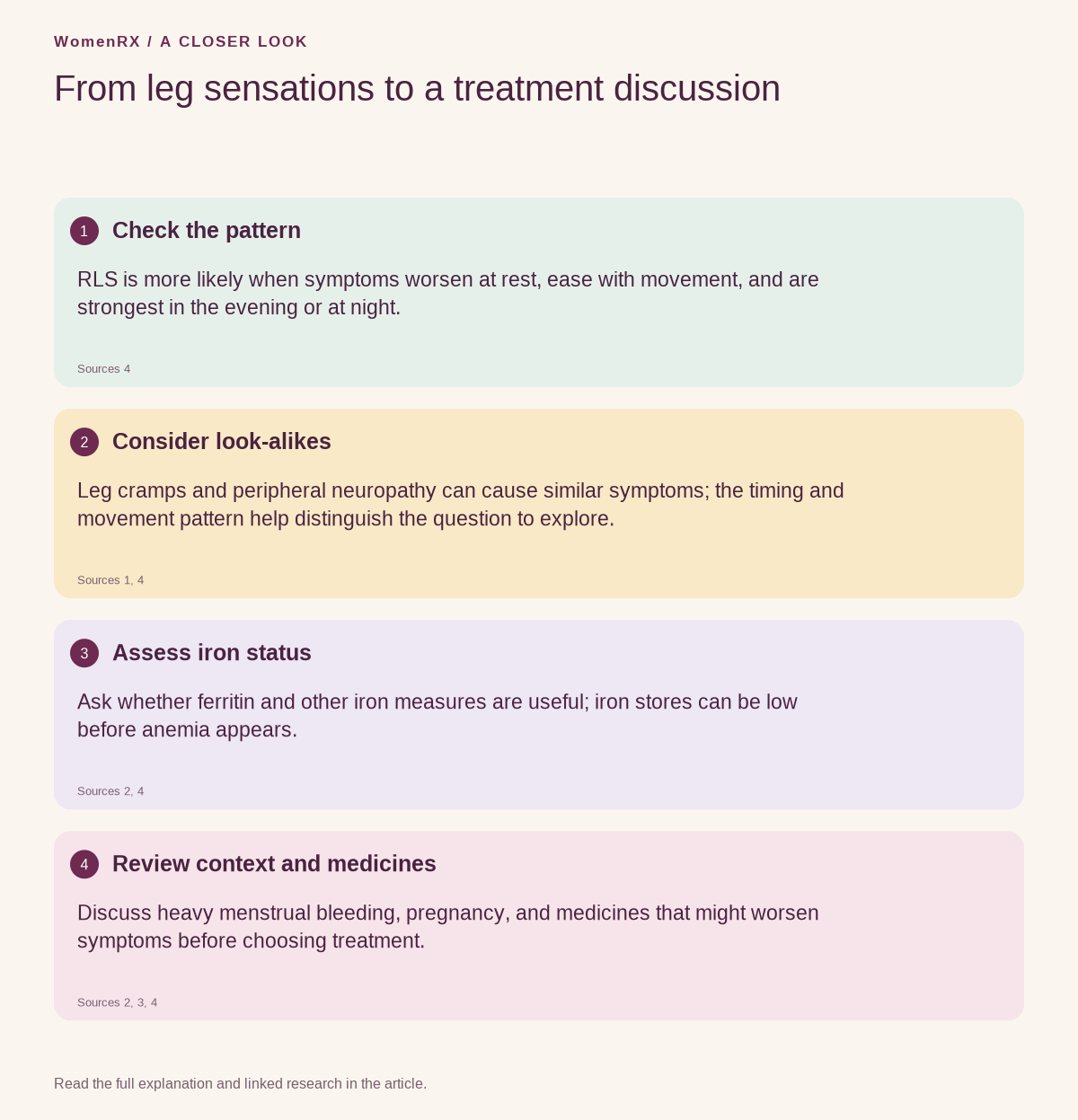
From leg sensations to a treatment discussion
Check the pattern: RLS is more likely when symptoms worsen at rest, ease with movement, and are strongest in the evening or at night.4
Consider look-alikes: Leg cramps and peripheral neuropathy can cause similar symptoms; the timing and movement pattern help distinguish the question to explore.14
Assess iron status: Ask whether ferritin and other iron measures are useful; iron stores can be low before anemia appears.24
Review context and medicines: Discuss heavy menstrual bleeding, pregnancy, and medicines that might worsen symptoms before choosing treatment.234
Read the figure as text
Use the symptom pattern to decide what to clarify next, rather than treating every nighttime leg sensation as RLS.- Check the pattern: RLS is more likely when symptoms worsen at rest, ease with movement, and are strongest in the evening or at night.4
- Consider look-alikes: Leg cramps and peripheral neuropathy can cause similar symptoms; the timing and movement pattern help distinguish the question to explore.14
- Assess iron status: Ask whether ferritin and other iron measures are useful; iron stores can be low before anemia appears.24
- Review context and medicines: Discuss heavy menstrual bleeding, pregnancy, and medicines that might worsen symptoms before choosing treatment.234
More questions, answered
Can iron stores be low even if I’m not anemic?
Yes. Iron stores may be depleted before hemoglobin falls, so ferritin can add useful information beyond an anemia screen. Ferritin can also be affected by inflammation, which is one reason more than one measure may be considered. 2
Sources you can check
- Restless legs syndrome - NHSAccessed 2026-09-25Return to first citation
- Iron - Health Professional Fact SheetAccessed 2026-09-25Return to first citation
- Update on Restless Legs Syndrome Management during Pregnancy.Jung KY. · Sleep medicine clinics · 2026Return to first citation
- Restless Legs Syndrome: A Review.Winkelman JW, Wipper B. · JAMA · 2026Return to first citation