Iron for Restless Legs: When Testing Matters
Restless legs can be linked to iron availability even when anemia isn’t present, so ferritin and transferrin saturation may matter alongside a blood count.
If you have a strong urge to move your legs when resting, especially at night, ask whether iron studies belong in the evaluation. Restless legs decisions may consider ferritin and transferrin saturation, not just whether a blood count shows anemia. Ferritin can be affected by inflammation, and pregnancy brings its own iron needs and anemia screening, so don’t start or increase iron based on symptoms alone. 1 2 4
Why iron tests can matter even without anemia
Restless legs syndrome (RLS) is usually recognized from the pattern of symptoms: a strong urge to move the legs, often when you’re resting at night. Iron status is one factor linked to RLS, but the symptoms don’t prove that your iron is low. Leg cramps and peripheral neuropathy can cause similar complaints, and medicines can worsen RLS symptoms. 1
A blood count and iron studies answer related but different questions. Hemoglobin is used to assess anemia. Ferritin reflects iron stores, and those stores can be depleted before hemoglobin falls. That means a normal blood count doesn’t necessarily rule out low iron stores. 2
For RLS, clinicians may consider ferritin together with transferrin saturation, a measure used to assess iron circulating in the blood. RLS treatment guidance has used iron measures in a way that doesn’t map neatly onto a general anemia diagnosis. So a ferritin result that isn’t flagged as low on a standard lab report may still be part of an RLS treatment discussion. There isn’t one universal number to apply to everyone: RLS guidance and research continue to examine how iron measures should guide treatment. 4 5 6
What tests may be part of the discussion
A clinician may consider a complete blood count, ferritin, and iron studies that include transferrin saturation. The blood count helps identify anemia; ferritin and transferrin saturation add information about iron stores and availability. Ferritin can rise with inflammation, which can make it harder to interpret on its own. 2 4
It’s also useful to discuss circumstances that could affect iron status, such as heavy menstrual bleeding, pregnancy, frequent blood donation, or a condition that affects iron absorption. These factors raise the possibility of low iron, but they don’t diagnose it. 2 3
Test methods can complicate comparisons. A 2025 laboratory study found that two ferritin assays produced different absolute results despite being highly correlated. That’s one reason not to treat a single cutoff as a stand-alone answer; clinicians may interpret ferritin alongside transferrin saturation and the rest of your situation. 4
Pregnancy needs a separate lens
Pregnancy increases iron needs, and routine prenatal anemia screening has its own schedule. The NIH Office of Dietary Supplements summarizes recommendations to screen for anemia in the first trimester and again at 24 to 28 weeks, with further evaluation when anemia is found. Recommendations about routine supplementation for pregnant people who have no symptoms vary among organizations. 2
Those pregnancy practices aren’t the same thing as an RLS-specific iron decision. If restless legs symptoms begin or worsen during pregnancy, mention them during prenatal care and ask how your iron results fit both the pregnancy assessment and the symptoms. Don’t add extra iron or change a prenatal supplement just to treat restless legs without discussing the results and your current supplements with your prenatal clinician. Iron supplements can cause stomach symptoms, and excess iron can be harmful. 2
Why not just try iron?
Iron may be part of treatment when low iron levels are contributing to RLS, but taking it without checking may expose you to side effects without addressing the cause of your symptoms. 1 Supplemental iron can cause nausea, constipation, and other stomach or bowel symptoms. Iron can also reduce levodopa absorption, and it can interfere with absorption of levothyroxine tablets when taken at the same time. If you take either medicine, include it in the conversation before starting iron. 2
A useful next step is to describe when the urge to move happens, what relieves it, and how it affects sleep, then ask whether a blood count, ferritin, and transferrin saturation would help clarify the picture. If the pattern doesn’t fit RLS, or symptoms continue to disrupt sleep, a clinician can consider other causes and treatment options. 1
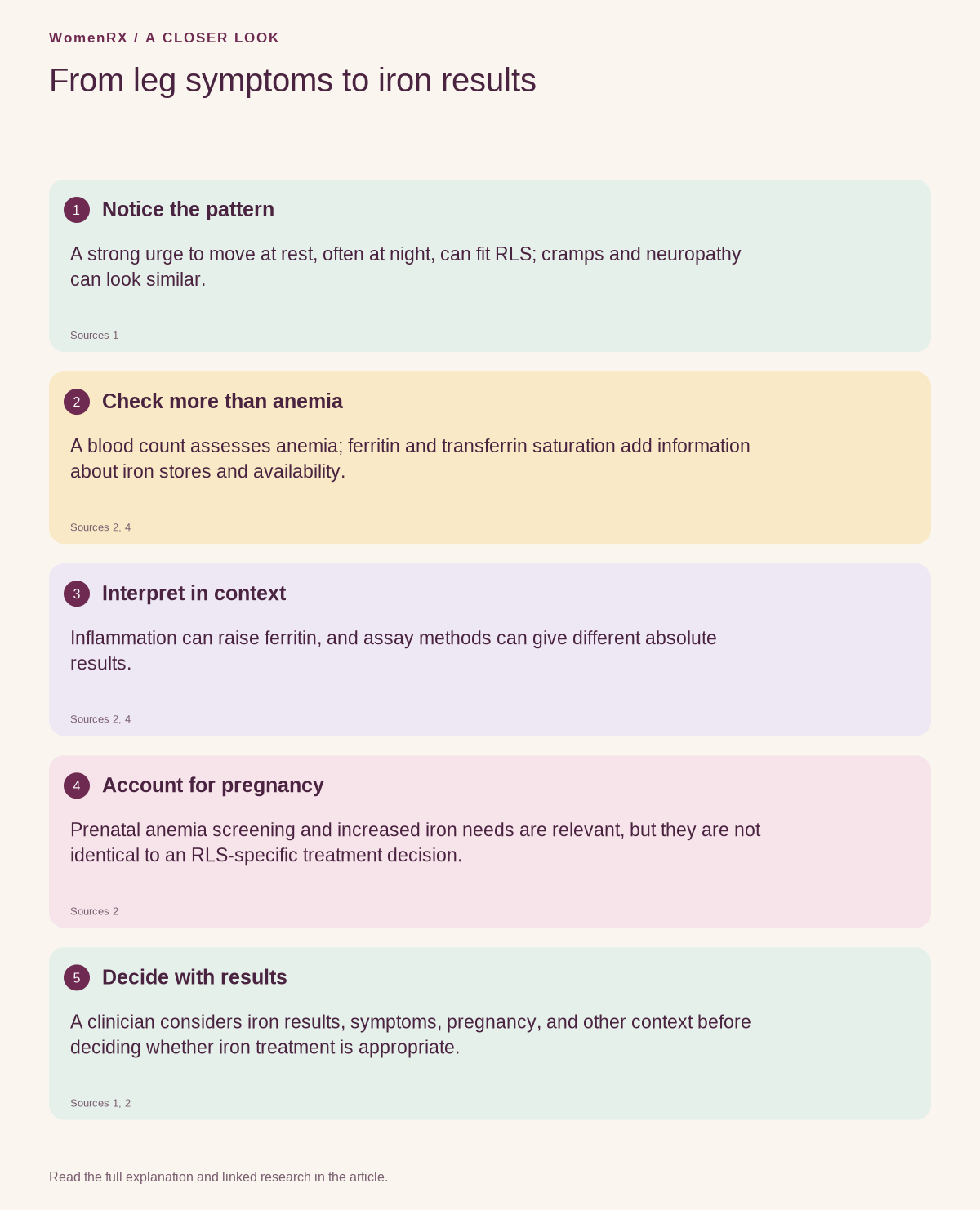
From leg symptoms to iron results
Notice the pattern: A strong urge to move at rest, often at night, can fit RLS; cramps and neuropathy can look similar.1
Check more than anemia: A blood count assesses anemia; ferritin and transferrin saturation add information about iron stores and availability.24
Interpret in context: Inflammation can raise ferritin, and assay methods can give different absolute results.24
Account for pregnancy: Prenatal anemia screening and increased iron needs are relevant, but they are not identical to an RLS-specific treatment decision.2
Decide with results: A clinician considers iron results, symptoms, pregnancy, and other context before deciding whether iron treatment is appropriate.12
Read the figure as text
This flow separates recognizing an RLS-like symptom pattern from checking iron and deciding whether treatment fits.- Notice the pattern: A strong urge to move at rest, often at night, can fit RLS; cramps and neuropathy can look similar.1
- Check more than anemia: A blood count assesses anemia; ferritin and transferrin saturation add information about iron stores and availability.24
- Interpret in context: Inflammation can raise ferritin, and assay methods can give different absolute results.24
- Account for pregnancy: Prenatal anemia screening and increased iron needs are relevant, but they are not identical to an RLS-specific treatment decision.2
- Decide with results: A clinician considers iron results, symptoms, pregnancy, and other context before deciding whether iron treatment is appropriate.12
More questions, answered
Can you have restless legs with normal hemoglobin?
Yes. Iron stores can be depleted before hemoglobin falls, so a normal blood count doesn’t rule out low iron stores. RLS assessment may also consider ferritin and transferrin saturation. 2 4
Does a low ferritin result prove that iron is causing my symptoms?
No. Ferritin helps assess iron stores, but RLS symptoms can have other causes, and ferritin can be affected by inflammation. Results need to be interpreted with the symptom pattern and other iron measures. 1 2
Sources you can check
- Restless legs syndrome - NHSAccessed 2026-09-25Return to first citation
- Iron - Health Professional Fact SheetAccessed 2026-09-25Return to first citation
- Iron: MedlinePlusAccessed 2026-09-25Return to first citation
- Serum ferritin measurements differ according to the assay used: implications for iron therapy in restless legs syndrome.Silber MH, Block DR, St Louis EK. · Journal of clinical sleep medicine : JCSM : official publication of the American Academy of Sleep Medicine · 2025Return to first citation
- Iron therapy & restless legs syndrome: a narrative review.Phan DM, Lam MY, Trang MN. · Sleep & breathing = Schlaf & Atmung · 2026Return to first citation
- Management of restless legs syndrome when gabapentinoids fail: intravenous iron and opioids.Berry LT, Winkelman JW. · Current opinion in pulmonary medicine · 2026Return to first citation