Do You Need an Iron Supplement? Start With Testing
Fatigue or heavy periods can raise the question, but your test results and the reason iron may be low should shape the next step.
Don’t start iron based on fatigue or menstruation alone. If you’re concerned, ask whether ferritin and hemoglobin tests would help: ferritin assesses iron stores, while hemoglobin helps show whether you have anemia. If iron is low, the next question is why. A supplement can replace iron, but it won’t stop ongoing blood loss. 3 4 6
What testing can tell you that symptoms can’t
Iron helps your body make hemoglobin, the protein in red blood cells that carries oxygen. Iron-deficiency anemia can cause fatigue, shortness of breath, and trouble concentrating. But fatigue alone can’t establish that low iron is the cause. 3 4
Ferritin and hemoglobin answer related but different questions. Ferritin is used to assess iron stores; hemoglobin helps identify anemia. Your iron stores can be low without a finding of anemia, and an anemia result doesn’t, by itself, establish iron deficiency. If you’ve been told your “iron is low,” ask which result was low and what it means alongside the other results. 4 6
One distinction may help if you’re looking at a lab report: a serum iron result isn’t interchangeable with ferritin. In an analysis of 1,484 non-pregnant U.S. women ages 18 to 44, serum iron varied across menstrual-cycle phases, while ferritin and hemoglobin did not change significantly across phases. The finding doesn’t create a rule for when to book a blood test, but it helps explain why the name of the test matters. 6
A low result needs a reason, not just a replacement
Heavy menstrual bleeding increases the risk of iron deficiency because it means more iron is lost with blood. If your bleeding has changed substantially, feels very heavy, or regularly lasts longer than eight days, bring up the bleeding itself rather than discussing only an iron supplement. 1 2
Blood loss isn’t the only possible explanation. Diet and difficulty absorbing iron can also contribute to low iron. For example, someone with heavy periods who eats mostly plant-based foods may have both greater losses and lower absorption of dietary iron. That combination is worth discussing, but it still doesn’t diagnose a deficiency without testing. 2 3
The cause matters because replacing iron and addressing blood loss do different jobs. A supplement may help restore iron, but it won’t explain or stop heavy bleeding. If your results improve and later fall again, revisiting the reason for the loss is part of making a lasting plan. 3 5
Pregnancy changes the conversation
Iron needs rise during pregnancy as blood volume and red blood cell production increase. Pregnancy care recommendations are not identical: the NIH Office of Dietary Supplements summarizes ACOG’s recommendations for anemia screening and iron supplementation, while the U.S. Preventive Services Task Force found insufficient evidence to judge routine screening and supplementation for pregnant people without symptoms. That finding does not apply to someone with symptoms or certain conditions that may increase iron needs. If you’re pregnant, discuss your results, symptoms, and prenatal vitamin with your obstetric care team rather than treating a general supplement label as your plan. 2
If treatment is recommended, make the plan specific
Iron supplements are commonly used to treat low iron and iron-deficiency anemia. Products differ in the amount of elemental iron they contain; that amount appears on the Supplement Facts label. More isn’t automatically better: supplemental iron can cause nausea or constipation, and too much iron can be harmful. 2 3
A useful treatment discussion connects three things: what your results show, what may be causing the low iron, and how you’ll check whether the plan is working. If a product bothers your stomach, say so rather than silently stopping it or adding another iron-containing supplement. If heavy periods are part of the picture, ask what can be done about the bleeding as well as the iron. 2 3 5
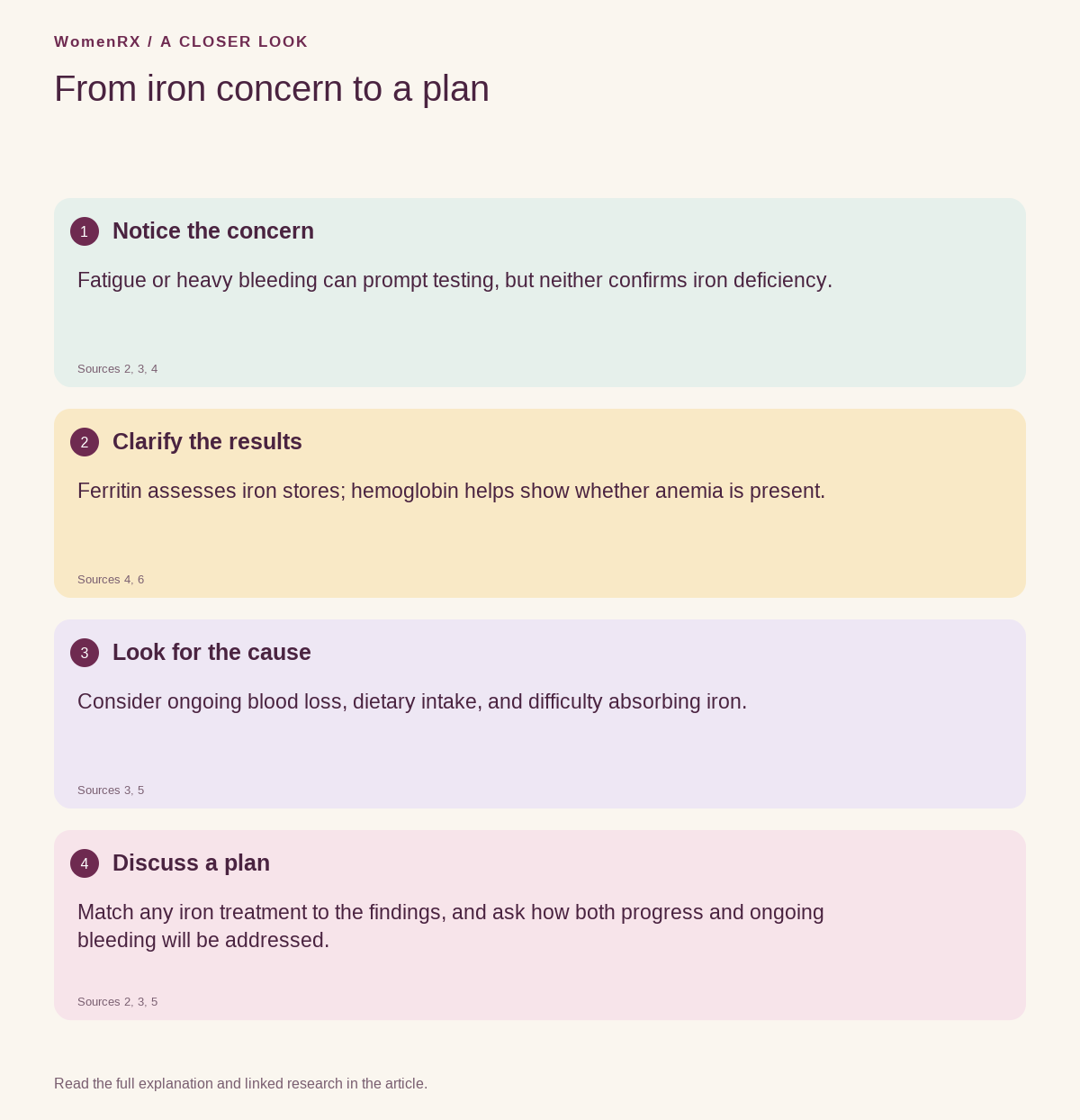
From iron concern to a plan
Notice the concern: Fatigue or heavy bleeding can prompt testing, but neither confirms iron deficiency.234
Clarify the results: Ferritin assesses iron stores; hemoglobin helps show whether anemia is present.46
Look for the cause: Consider ongoing blood loss, dietary intake, and difficulty absorbing iron.35
Discuss a plan: Match any iron treatment to the findings, and ask how both progress and ongoing bleeding will be addressed.235
Read the figure as text
The route from a symptom or risk factor to a treatment decision has a separate step for finding the cause.- Notice the concern: Fatigue or heavy bleeding can prompt testing, but neither confirms iron deficiency.234
- Clarify the results: Ferritin assesses iron stores; hemoglobin helps show whether anemia is present.46
- Look for the cause: Consider ongoing blood loss, dietary intake, and difficulty absorbing iron.35
- Discuss a plan: Match any iron treatment to the findings, and ask how both progress and ongoing bleeding will be addressed.235
Sources you can check
- Menstruation | Period | MedlinePlusAccessed 2026-09-25Return to first citation
- Iron - Health Professional Fact SheetAccessed 2026-09-25Return to first citation
- Iron: MedlinePlusAccessed 2026-09-25Return to first citation
- Screening for iron deficiency in young women: the predictive validity of a five-item screening instrument (IRON-5).Vinge F, Stubbendorff A, Bolmsjö BB, Jakobsson U, Milos Nymberg V, Wolff M. · Scandinavian journal of primary health care · 2026Return to first citation
- Disparities in Discussion of Heavy Menstrual Bleeding in Patients With Iron Deficiency.Patel NN, Samuelson Bannow B. · Journal of primary care & community health · 2026Return to first citation
- Cyclical fluctuations of iron biomarkers in women: Diagnostic implications for iron deficiency.Aguree S, Owora A, Silveyra P. · Practical laboratory medicine · 2025Return to first citation