Iron Supplements: What to Check Before You Choose
The right iron supplement depends on your test results, why iron may be low, and whether you can tolerate the treatment.
Before buying iron for fatigue, heavy periods, or a concerning test result, ask whether you have anemia, low iron stores, or both, and what might explain the result. A blood count and ferritin can answer different questions. If treatment is recommended, ask how much iron you need, which form is practical for you, and how your response will be checked. 1 5
Find out what needs treating
Iron helps your body make hemoglobin, the part of red blood cells that carries oxygen. Iron-deficiency anemia can cause fatigue, shortness of breath, and trouble concentrating. But fatigue alone can’t tell you whether you need iron. Blood loss, too little iron in your diet, and difficulty absorbing it are among the possible reasons iron runs low. 1
A useful distinction to ask about is anemia versus low iron stores. A blood count can show whether you have anemia; ferritin helps assess stored iron. You can have low stores before you have anemia. Ferritin also needs context because inflammation can affect its level, and anemia isn’t always caused by iron deficiency. 5 6
If your periods are heavy, say so when discussing the result. Blood loss may explain low iron, but a supplement alone won’t answer why the bleeding is happening. Likewise, an unexplained anemia deserves an explanation before you treat it as a product-selection problem. 1
Pregnancy and the weeks after birth need their own questions
Iron needs rise during pregnancy. That makes it worth asking what your blood count shows and whether checking iron stores would help in your situation. A normal hemoglobin result doesn’t necessarily mean stores are full: studies of pregnant participants have found low ferritin in some people who weren’t anemic. 6 7 8
An early test isn’t a forecast for the entire pregnancy, either. In a prospective study of initially nonanemic pregnant participants, first-trimester ferritin was a weak predictor of iron-deficiency anemia at 24 to 28 weeks. Ask what your result means now and whether it needs reassessment later, rather than assuming one test settles the question. 4
After birth, the amount of blood lost and any previous iron results are relevant to that conversation. Ferritin may also fluctuate around delivery, so the timing and context of a result matter. There isn’t one postpartum supplement plan that follows from having been pregnant. 1 5
Compare a treatment plan, not a “best” bottle
Ferrous sulfate is an established medicine for treating or preventing iron-deficiency anemia. It comes in tablets and drops, but that doesn’t make it the best form for everyone. If iron is recommended, ask what amount the plan calls for, how much iron your chosen product provides, and whether a prenatal vitamin or another supplement is already adding iron. The goal is a plan matched to your results, not the most iron you can find on a label. Too much iron can cause digestive symptoms and, at very high levels, serious harm. 1 2
How a product fits your day matters. Ferrous sulfate is generally absorbed best on an empty stomach, but taking it with or after food may help if it upsets your stomach. Tea, coffee, dairy products, and eggs can interfere with its absorption. If you take other medicines, ask a pharmacist how to fit iron into your routine. 2
Nausea, constipation, and diarrhea are possible side effects of ferrous sulfate. If those effects make the plan hard to follow, bring that up rather than assuming you have to put up with them. In pregnancy, there may also be a tradeoff between regimens: a review reports that daily supplementation may maintain iron status more effectively than alternate-day supplementation, while causing more side effects. The right choice depends on the clinical situation. 3 8
Before starting, settle three practical questions: What result are we treating? What might have caused it? And what will tell us whether the plan is working? Those answers make the choice of form and follow-up more useful than a generic ranking of supplements. 1 5
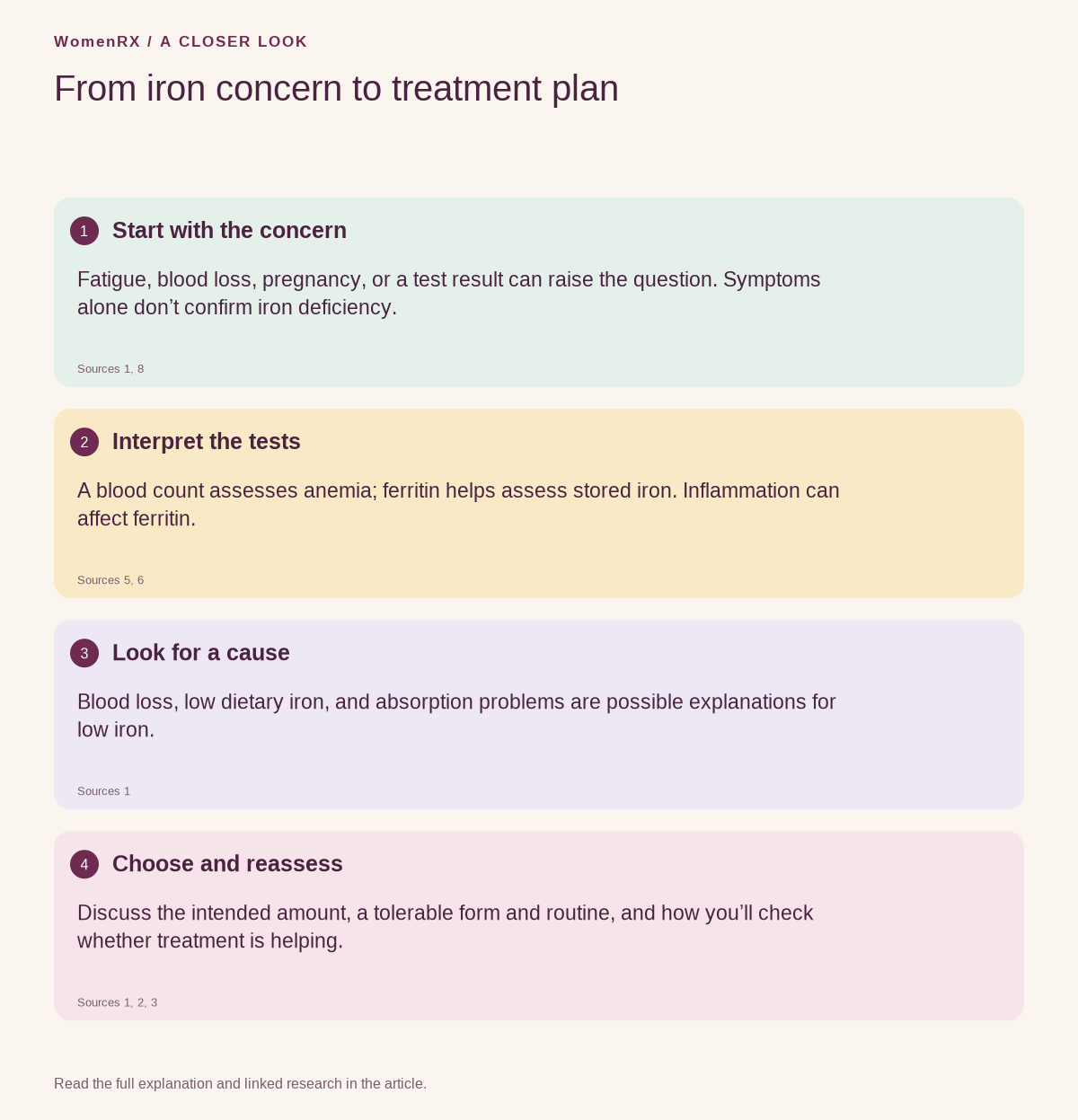
From iron concern to treatment plan
Start with the concern: Fatigue, blood loss, pregnancy, or a test result can raise the question. Symptoms alone don’t confirm iron deficiency.18
Interpret the tests: A blood count assesses anemia; ferritin helps assess stored iron. Inflammation can affect ferritin.56
Look for a cause: Blood loss, low dietary iron, and absorption problems are possible explanations for low iron.1
Choose and reassess: Discuss the intended amount, a tolerable form and routine, and how you’ll check whether treatment is helping.123
Read the figure as text
This flow separates the reason you’re concerned from the questions that make a supplement choice useful.- Start with the concern: Fatigue, blood loss, pregnancy, or a test result can raise the question. Symptoms alone don’t confirm iron deficiency.18
- Interpret the tests: A blood count assesses anemia; ferritin helps assess stored iron. Inflammation can affect ferritin.56
- Look for a cause: Blood loss, low dietary iron, and absorption problems are possible explanations for low iron.1
- Choose and reassess: Discuss the intended amount, a tolerable form and routine, and how you’ll check whether treatment is helping.123
Sources you can check
- Iron: MedlinePlusAccessed 2026-09-25Return to first citation
- About ferrous sulfate - NHSAccessed 2026-09-25Return to first citation
- Side effects of ferrous sulfate - NHSAccessed 2026-09-25Return to first citation
- Reticulocyte Hemoglobin Use for Prediction of Iron Deficiency Anemia in Pregnancy.Griffin MM, Avtushka V, Venkatesh P, Friedman S, Aquino J, Roman AS. · American journal of perinatology · 2026Return to first citation
- Ferritin as a diagnostic point-of-care marker in iron deficiency anemia: a narrative review and clinical implications.Dimen JN, Sunoqrot M, Hobbs C, Cherayil E, Sharma D, Ahmadzia HK. · Annals of translational medicine · 2026Return to first citation
- Association Between Serum Ferritin and Hemoglobin Levels in Pregnant Women: Implications for Early Iron Deficiency Screening.Ahmed D, Amin R, Raman V, Hashmi M, Hulo MG, Albousen B, Hameed A, Mani Tripathi K, Naureen N, Tariq L, Ibrahem Atoom G. · Cureus · 2026Return to first citation
- Non-Anemic Iron Deficiency in Pregnancy: A Cross-Sectional Study of Prevalence and Predictors.Detlefs S, Powers JM, Minard C, Patel C, Sukumar S. · Blood advances · 2026Return to first citation
- Iron deficiency during pregnancy and lactation.Wasserfallen L, Moretti D. · Current opinion in clinical nutrition and metabolic care · 2026Return to first citation