Iron Supplements: When They Help, and What They Change
Iron can improve blood tests when deficiency is present, but that doesn’t mean extra iron boosts energy or performance when your levels are adequate.
For women with confirmed iron deficiency, one study of 120 women with deficiency or anemia linked to chronic menstrual blood loss found improved blood measures and fewer reported symptoms after 90 days of iron treatment. The study compared two iron products and had no untreated group, so it offers limited evidence about the size of the benefit. Pregnancy prevention and blood-donation recovery are separate questions. 5 1
Iron has a clear job: it helps your body make hemoglobin, which carries oxygen in the blood. When iron stores are low, supplementation can address that shortage. The potential benefit depends on the situation, though. Correcting a deficiency is different from taking iron in hopes of feeling more energetic when your iron status is already adequate. 1 3
What changes when deficiency is treated
Iron deficiency develops in stages. Iron stores can fall before hemoglobin becomes low; later, if the shortage continues, iron-deficiency anemia can develop. That means a normal hemoglobin result alone may not rule out low iron. Ferritin is a measure of iron stores, and a low result can identify deficiency before anemia appears. Inflammation can raise ferritin, so results sometimes need to be interpreted alongside other tests and your health context. 1
When iron-deficiency anemia is present, low iron can contribute to fatigue, weakness, and difficulty concentrating. Iron is needed to make hemoglobin, but symptoms alone can’t show whether iron is the cause. 1 3
A study directly relevant to treatment enrolled 120 women with confirmed iron deficiency or iron-deficiency anemia linked to chronic menstrual blood loss. The women received one of two iron treatments for 90 days. The report described fewer symptoms and improvement in blood measures in both groups. But there was no untreated comparison group, and one treatment also included folate. So this study supports improvement during treatment, but it can’t show exactly how much improvement iron itself caused or whether one approach works better. 5
A separate trial measured recovery after blood donation, not treatment of women with confirmed deficiency. Among 215 adults who had recently donated blood, those given iron recovered their lost hemoglobin and iron in less than half the time taken by people who did not receive iron. At 24 weeks, two-thirds of the no-iron group had not recovered the iron they had lost. Women-specific results weren’t reported. 1
Periods raise risk; heavy bleeding deserves attention
Menstruation involves blood loss, so women who menstruate have higher iron losses than people who don’t. Heavy menstrual bleeding raises the risk of iron deficiency further. If testing confirms low iron, supplementation may replace some of what has been lost. But iron won’t identify or treat the reason bleeding is heavy, so the bleeding itself may need evaluation. 1 2
This distinction matters if low iron returns: replacing iron can address the shortage, while ongoing blood loss may keep causing it. Other possible contributors include low iron intake, trouble absorbing iron, or blood loss from another source. Finding the likely cause helps make the next step more useful than simply repeating a supplement. 1 3
Pregnancy is a separate context
During pregnancy, the body makes more red blood cells and supports the needs of the fetus and placenta, increasing iron needs. Trials summarized in a review found that daily iron supplementation during pregnancy reduced the risk of anemia at term by 70% and iron deficiency at term by 57%. In that review, low birthweight occurred in 8.4% of pregnancies with daily supplementation versus 10.2% without it, and average birthweight was 31 grams higher. These are findings from pregnancy studies, not proof that every woman needs iron for energy. 1
Guidance distinguishes routine prevention in someone without symptoms from treating a diagnosed problem. ACOG recommends low-dose iron supplementation during pregnancy to reduce anemia at delivery. The U.S. Preventive Services Task Force, by contrast, says evidence is insufficient to determine the balance of benefits and harms of routine screening and supplementation for asymptomatic pregnant women. That statement does not address treatment for someone with symptoms or diagnosed iron-deficiency anemia. 1
What the runner study can and can’t tell you
Iron is essential to oxygen transport, but that biological role alone doesn’t establish that extra iron improves performance when iron stores are adequate. A small randomized trial in 28 nonanemic female runners tested pea powders with vitamin C, not iron tablets. Changes in ferritin did not differ significantly between groups, and the groups also showed no differences in exercise performance. Because the study tested food-based products in a small group, it can’t establish whether iron tablets help iron-replete women. 4
The tradeoff: stomach effects and getting the cause right
Oral iron can cause nausea, constipation, abdominal discomfort, or other digestive symptoms. The NIH Office of Dietary Supplements notes that gastrointestinal effects can occur with high supplemental intakes; the amount and type of iron matter. 1
Testing can help distinguish low iron stores from anemia and from other causes of similar symptoms. Ferritin is useful, but it can be elevated by inflammation; clinicians may use more than one measure. If you have heavy periods, are pregnant, or have a condition that can affect absorption, that context matters when interpreting the results and deciding whether iron is appropriate. 1 2 3
The practical takeaway: iron can address confirmed deficiency, and pregnancy prevention evidence is a distinct question. Heavy menstrual bleeding can contribute to low iron but still needs its own explanation. The small runner study doesn’t show whether iron tablets improve performance in women whose iron stores are adequate.
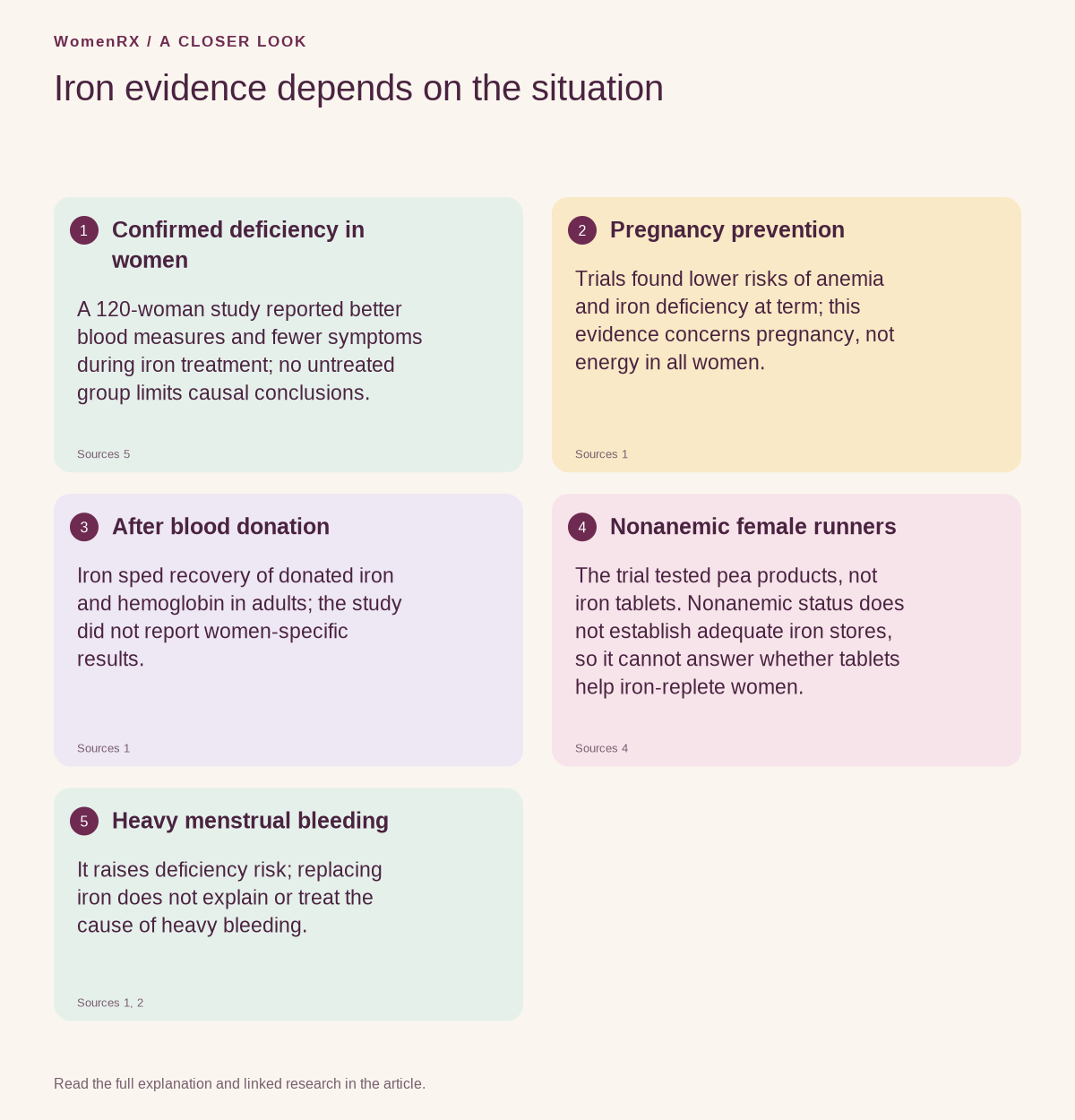
Iron evidence depends on the situation
Confirmed deficiency in women: A 120-woman study reported better blood measures and fewer symptoms during iron treatment; no untreated group limits causal conclusions.5
Pregnancy prevention: Trials found lower risks of anemia and iron deficiency at term; this evidence concerns pregnancy, not energy in all women.1
After blood donation: Iron sped recovery of donated iron and hemoglobin in adults; the study did not report women-specific results.1
Nonanemic female runners: The trial tested pea products, not iron tablets. Nonanemic status does not establish adequate iron stores, so it cannot answer whether tablets help iron-replete women.4
Heavy menstrual bleeding: It raises deficiency risk; replacing iron does not explain or treat the cause of heavy bleeding.12
Read the figure as text
Compare who was studied, whether deficiency was confirmed, what iron was used for, and which outcomes were measured.- Confirmed deficiency in women: A 120-woman study reported better blood measures and fewer symptoms during iron treatment; no untreated group limits causal conclusions.5
- Pregnancy prevention: Trials found lower risks of anemia and iron deficiency at term; this evidence concerns pregnancy, not energy in all women.1
- After blood donation: Iron sped recovery of donated iron and hemoglobin in adults; the study did not report women-specific results.1
- Nonanemic female runners: The trial tested pea products, not iron tablets. Nonanemic status does not establish adequate iron stores, so it cannot answer whether tablets help iron-replete women.4
- Heavy menstrual bleeding: It raises deficiency risk; replacing iron does not explain or treat the cause of heavy bleeding.12
More questions, answered
Can I tell from fatigue whether I need iron?
No. Iron deficiency can cause fatigue, but fatigue has many possible causes. Blood tests, including ferritin and measures of anemia, can help clarify whether low iron is involved. 1 3
Can iron supplements stop heavy periods?
No. Iron may replace iron lost through bleeding, but it doesn’t treat the reason the bleeding is heavy. A major change in your cycle or very heavy bleeding is worth discussing with a clinician. 1 2
Sources you can check
- Iron - Health Professional Fact SheetAccessed 2026-09-25Return to first citation
- Menstruation | Period | MedlinePlusAccessed 2026-09-25Return to first citation
- Iron: MedlinePlusAccessed 2026-09-25Return to first citation
- Low phytic acid pea supplementation as an approach to combating iron deficiency in female runners: A randomized control trial.Shaw KA, Chilibeck PD, Lindsay DL, Warkentin TD, Ko J, Zello GA. · Nutrition and health · 2025Return to first citation
- Experience of using modern oral iron formulations for the correction of iron deficiency conditions in women of reproductive age.Kondratiuk VK, Nikitina IM, Нorban NY, Kondratiuk KO, Dzis NP. · Wiadomosci lekarskie (Warsaw, Poland : 1960) · 2026Return to first citation