Iron Supplements, Food Sources, and What Tests Can Tell You
Iron-rich foods can contribute to your intake, but hemoglobin and ferritin answer different questions about whether you may need a supplement.
Iron-rich foods include meat and seafood, beans and lentils, nuts, vegetables, and iron-fortified grains. But fatigue or having periods alone doesn’t establish that you need a supplement. Hemoglobin can show anemia without identifying its cause; ferritin helps assess iron stores, which can be low even when hemoglobin isn’t. The results and the reason for any iron loss both matter. 2 3 5
Symptoms can raise the question, but they can’t answer it
Low iron may cause no symptoms at first. As iron deficiency progresses to anemia, fatigue, shortness of breath, and trouble with memory or concentration can occur. Those symptoms are a reason to consider testing, not proof that iron is the cause. 3
Iron is needed to make hemoglobin, the protein in red blood cells that carries oxygen. 3 A blood count, including hemoglobin, can show whether anemia is present. But hemoglobin alone doesn’t establish that iron is low: ferritin adds information about iron stores. Iron stores can be low before hemoglobin falls enough to indicate anemia, so a normal hemoglobin result doesn’t by itself rule out iron deficiency. Conversely, anemia doesn’t by itself show that iron deficiency is the cause. A study of adolescent girls attending a hospital in India measured iron deficiency both with and without anemia; a Dutch adult blood-donor study also assessed iron deficiency and anemia separately. Neither study supplies a universal diagnostic cutoff for all women. 5 6
There isn’t one number in this article that can diagnose you. The meaning of a result depends on the full clinical picture and the tests ordered. If you have results in front of you, ask whether they suggest low iron stores, anemia, both, or neither.
Food sources can help build iron into meals
Iron is found in both animal and plant foods. Meat and seafood provide heme iron, which is more readily absorbed. Beans, lentils, nuts, vegetables, and fortified grain products provide nonheme iron. For example, the NIH Office of Dietary Supplements lists oysters, white beans, lentils, spinach, and fortified breakfast cereal among iron-containing foods. Vitamin C can improve absorption of nonheme iron, while compounds in some grains and legumes can reduce it; these effects are generally less pronounced in a typical Western diet. 2
Food choices can contribute to iron intake, but they don’t show whether your iron stores are low or explain why. If tests show a deficiency or anemia, diet may be part of the discussion, while an iron supplement is commonly used as treatment. The appropriate plan depends on the results and their likely cause. 2 3
How life stage changes the context
If you have periods: Menstrual blood loss is one possible source of iron loss, and heavy menstrual bleeding raises the risk of iron deficiency. Tell the person ordering your tests if your bleeding is unusually heavy or has changed, and ask whether the bleeding itself needs evaluation. 1 2
A 2025 analysis of U.S. survey data from nonpregnant women aged 18-44 found that some iron markers varied across the menstrual cycle, while ferritin and hemoglobin were stable in that analysis. The study used older survey data and several different definitions of iron deficiency, so it doesn’t establish a rule about when everyone should test. It does help explain why an individual result should be interpreted in context rather than treated as a stand-alone verdict. 4
If you’re pregnant: Iron needs rise during pregnancy. Guidance summarized by the NIH Office of Dietary Supplements is not uniform: ACOG recommends screening for anemia during pregnancy and iron supplementation, while the U.S. Preventive Services Task Force says evidence is insufficient to assess routine screening and supplementation for pregnant people without symptoms. That difference concerns routine prevention in people without symptoms; it isn’t a reason to ignore symptoms or abnormal results. Ask your prenatal care team how your results and prenatal vitamin fit together. 2
If you’re postmenopausal: Menstrual bleeding no longer explains iron loss. Blood loss from another source, a problem absorbing iron, or low intake are among possible causes of low iron. A study of Dutch blood donors found lower iron deficiency in its postmenopausal than premenopausal donor group, but that selected donor sample can’t tell you whether an individual’s result needs investigation. If testing shows low iron, ask what might explain it in your situation. 3 6
The cause is part of the decision
Iron deficiency can be related to blood loss, not getting enough iron from food, or difficulty absorbing it. Heavy periods and frequent blood donation are recognized risk factors. Certain gastrointestinal conditions can also be associated with inadequate iron. Which possibility matters most depends on your history and test results. 2 3
That’s why “Should I take iron?” is only one part of the conversation. If a supplement is recommended, it may help restore iron, but it won’t explain or address ongoing blood loss or an absorption problem. Taking more iron than you need can also cause problems, including nausea, constipation, abdominal pain, and diarrhea. 2 3
A useful follow-up conversation
You could ask:
- Which results show whether I have anemia and whether my iron stores are low?
- Do the results point to iron deficiency, or could another cause explain them?
- Could my menstrual bleeding, pregnancy, diet, blood donation, or absorption be relevant?
- If you recommend iron, what is it intended to treat, and what follow-up testing should we plan?
- If my periods are heavy or have changed, should we evaluate the bleeding itself?
The goal isn’t to avoid iron when it’s needed. It’s to connect the test results to a likely cause and a plan to check whether that plan is working.
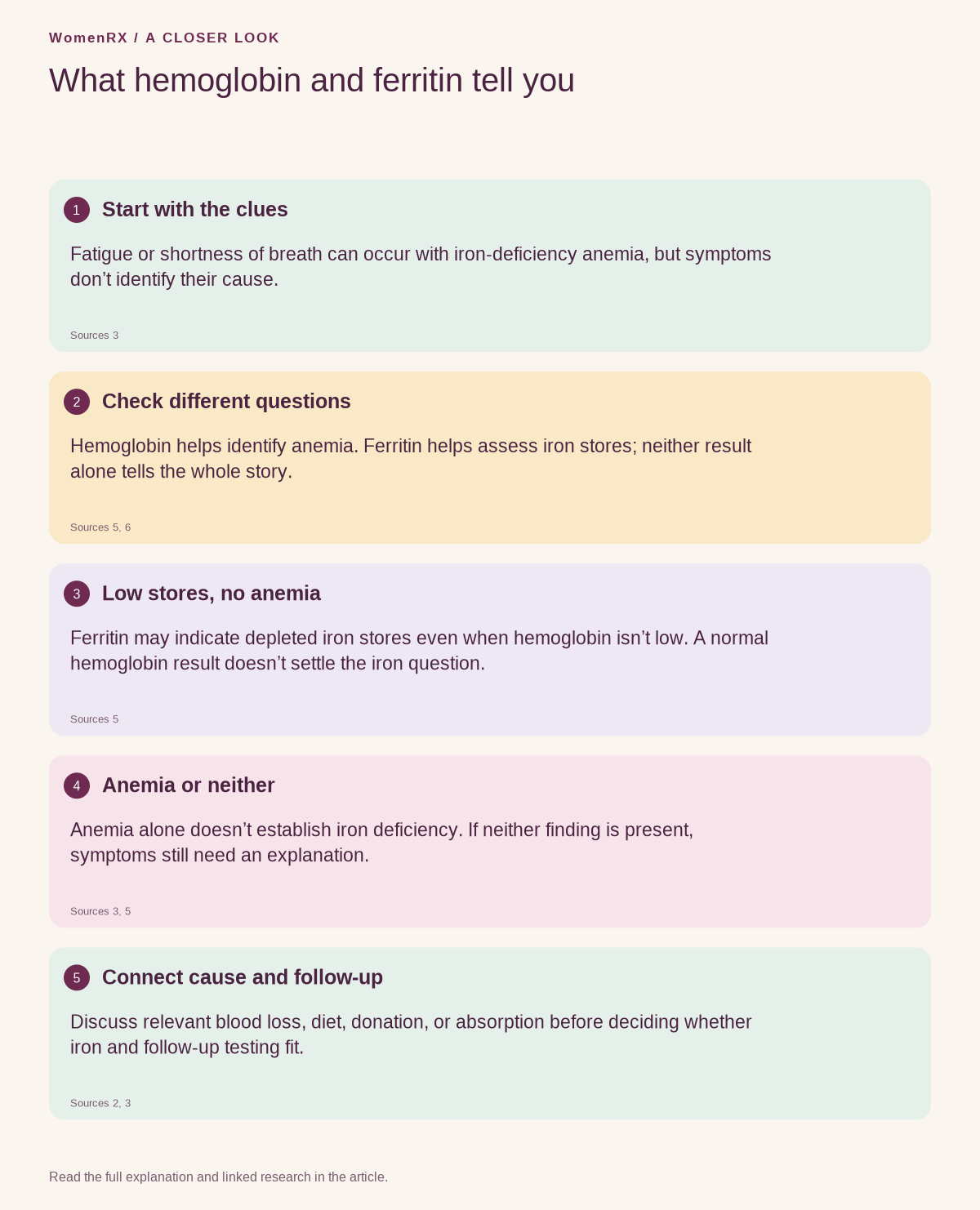
What hemoglobin and ferritin tell you
Start with the clues: Fatigue or shortness of breath can occur with iron-deficiency anemia, but symptoms don’t identify their cause.3
Check different questions: Hemoglobin helps identify anemia. Ferritin helps assess iron stores; neither result alone tells the whole story.56
Low stores, no anemia: Ferritin may indicate depleted iron stores even when hemoglobin isn’t low. A normal hemoglobin result doesn’t settle the iron question.5
Anemia or neither: Anemia alone doesn’t establish iron deficiency. If neither finding is present, symptoms still need an explanation.35
Connect cause and follow-up: Discuss relevant blood loss, diet, donation, or absorption before deciding whether iron and follow-up testing fit.23
Read the figure as text
Symptoms may prompt testing. The combination of results, not either number alone, helps frame the supplement and follow-up discussion.- Start with the clues: Fatigue or shortness of breath can occur with iron-deficiency anemia, but symptoms don’t identify their cause.3
- Check different questions: Hemoglobin helps identify anemia. Ferritin helps assess iron stores; neither result alone tells the whole story.56
- Low stores, no anemia: Ferritin may indicate depleted iron stores even when hemoglobin isn’t low. A normal hemoglobin result doesn’t settle the iron question.5
- Anemia or neither: Anemia alone doesn’t establish iron deficiency. If neither finding is present, symptoms still need an explanation.35
- Connect cause and follow-up: Discuss relevant blood loss, diet, donation, or absorption before deciding whether iron and follow-up testing fit.23
More questions, answered
Can I tell whether I need iron by how tired I feel?
No. Fatigue can occur with iron-deficiency anemia, but it doesn’t establish that iron is the cause. Hemoglobin helps identify anemia, while ferritin helps assess iron stores. Iron stores can be low even without anemia. 3 5
Which foods contain iron?
Meat and seafood provide heme iron; beans, lentils, nuts, vegetables, and fortified grains provide nonheme iron. Vitamin C can improve absorption of nonheme iron, though foods and meals differ in how much iron the body absorbs. 2
Does having periods mean I should take iron?
No. Menstrual blood loss, especially heavy bleeding, can raise the risk of iron deficiency, but periods alone don’t diagnose it or mean everyone who menstruates needs a supplement. 2
Sources you can check
- Menstruation | Period | MedlinePlusAccessed 2026-09-25Return to first citation
- Iron - Health Professional Fact SheetAccessed 2026-09-25Return to first citation
- Iron: MedlinePlusAccessed 2026-09-25Return to first citation
- Cyclical fluctuations of iron biomarkers in women: Diagnostic implications for iron deficiency.Aguree S, Owora A, Silveyra P. · Practical laboratory medicine · 2025Return to first citation
- Prevalence of Iron Deficiency and Iron Deficiency Anemia Among Adolescent Girls at a Tertiary Care Centre in Bihar: A Cross-Sectional Study.H H, Agrawal N, Kumar P, Ranjan A, Ahmad S, Kumar S, Chaudary N, Kumari S, Karthikeyan V. · Cureus · 2025Return to first citation
- Menstrual blood loss is an independent determinant of hemoglobin and ferritin levels in premenopausal blood donors.Ekroos S, Karregat J, Toffol E, Castrén J, Arvas M, van den Hurk K. · Acta obstetricia et gynecologica Scandinavica · 2024Return to first citation