Endometriosis Claims: What Symptoms and Tests Can Tell You
Endometriosis can look different from person to person, so symptoms can point toward it but can’t confirm or rule it out on their own.
Endometriosis is tissue similar to the womb lining growing elsewhere, often around the pelvis. Symptoms vary and can overlap with other conditions, so pain alone can’t diagnose it. Evaluation may involve several tests; laparoscopy can confirm endometriosis. Treatments can help manage symptoms, but there is currently no cure. 1 2
Claim: Endometriosis always causes the same symptoms
What the evidence says: False. Endometriosis is often found around the womb, ovaries, fallopian tubes, or pelvic lining, but it can also affect the bladder or bowel and, more rarely, areas beyond the pelvis. Symptoms may include pelvic pain, painful periods, or difficulty getting pregnant. Bowel and bladder can also be affected, but complaints involving those organs can have other explanations. Not everyone has the same combination of symptoms, and symptoms can be hard to distinguish from other conditions. 1 2
That variation matters across reproductive life stages, too. Endometriosis is commonly diagnosed in women and girls from when periods begin through menopause, but that isn’t an exclusive boundary: it can affect anyone who has or had a womb. Neither a person’s life stage nor a particular symptom proves the cause. 1
Claim: Severe period pain proves it’s endometriosis
What the evidence says: No. Painful periods can be part of endometriosis, but similar symptoms can have other causes. In interviews with 52 people in the United States who had endometriosis, researchers described how overlapping symptoms and being passed between different types of providers could contribute to a prolonged diagnostic experience. That qualitative study illustrates a challenge; it doesn’t tell us how often this happens to everyone. 1 2
The practical takeaway isn’t to dismiss pain or to label it yourself. It’s to treat a symptom as a reason to consider possibilities, not as a diagnosis. A useful description includes what the symptom is, where it happens, and whether it affects daily activities. For example, noting that pelvic pain and bowel symptoms tend to occur together is more informative than relying on a label such as “bad cramps.” This is a way to communicate clearly, not a diagnostic test.
Claim: A scan settles the diagnosis
What the evidence says: Not necessarily. Ultrasound and MRI are among the tests used to investigate suspected endometriosis, and some people need several different tests. Laparoscopy, a procedure using a camera passed through a small cut in the abdomen, can confirm endometriosis; areas may sometimes be removed during the procedure. The role of each test depends on the evaluation, so a scan by itself shouldn’t be treated as the whole story. 1
Symptoms also overlap with conditions such as adenomyosis, which can make it harder to identify the explanation from symptoms alone. A careful evaluation considers other possible causes as well as endometriosis. 1 2
Claim: Endometriosis has one known cause
What the evidence says: The cause isn’t known. The NHS describes the cause as unknown. That means a confident explanation presented as the established cause should be treated cautiously. A clear description of what endometriosis is doesn’t automatically settle how it begins. 1
Claim: Treatment cures endometriosis
What the evidence says: Treatment can help, but there’s currently no cure. Treatment may help manage symptoms such as pain. The right choice involves weighing possible benefits against risks and side effects. 1
A claim that a treatment is guaranteed to cure endometriosis goes beyond what this guidance supports. It’s more useful to ask what symptom or goal a treatment is intended to address and what tradeoffs come with it.
A clearer way to sort claims
Separate three things: what someone feels, what a test finds, and what treatment is expected to do. A symptom can be real and disruptive without identifying its cause. A test contributes information but may be one part of a longer evaluation. And treatment may help manage symptoms without curing the condition. Keeping those distinctions clear makes it easier to take symptoms seriously without treating every confident claim as fact. 1 2
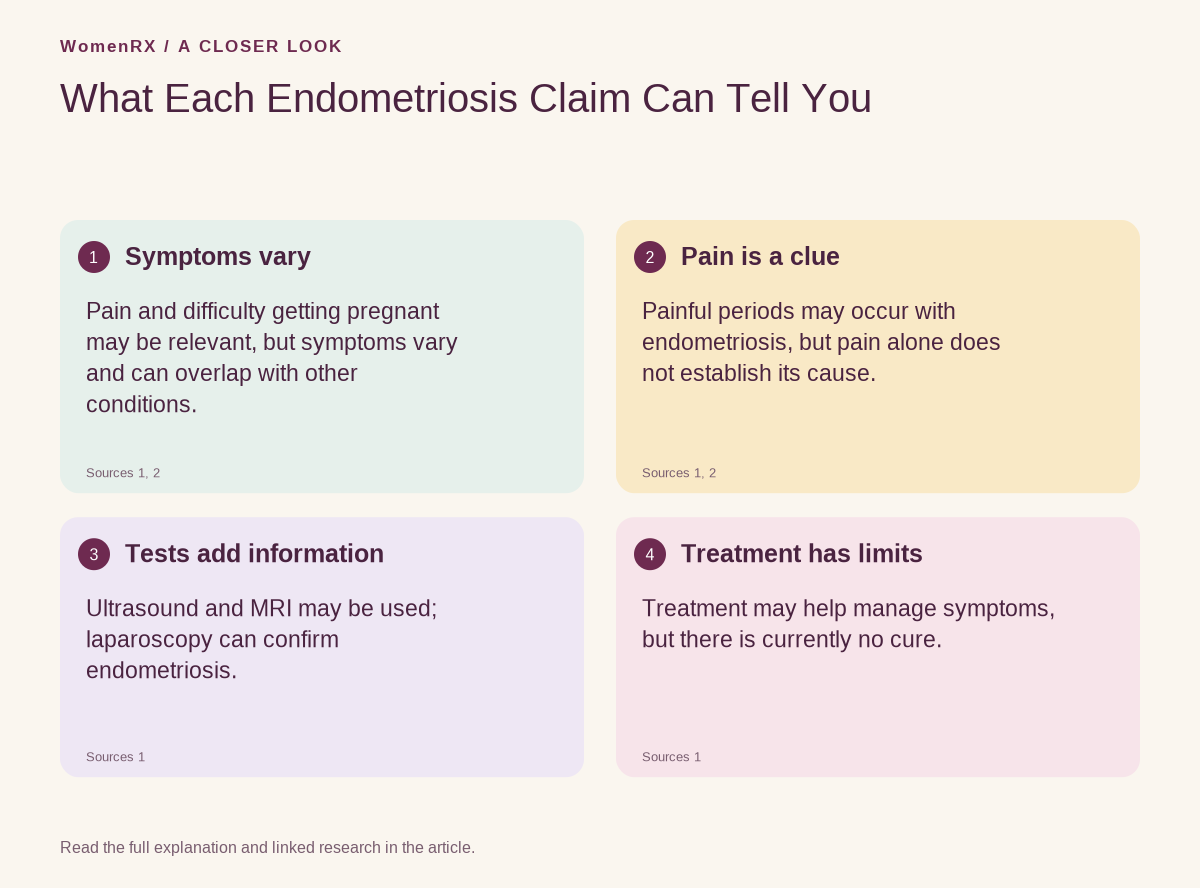
What Each Endometriosis Claim Can Tell You
Symptoms vary: Pain and difficulty getting pregnant may be relevant, but symptoms vary and can overlap with other conditions.12
Pain is a clue: Painful periods may occur with endometriosis, but pain alone does not establish its cause.12
Tests add information: Ultrasound and MRI may be used; laparoscopy can confirm endometriosis.1
Treatment has limits: Treatment may help manage symptoms, but there is currently no cure.1
Read the figure as text
These distinctions separate a symptom clue from a diagnosis and a treatment goal.- Symptoms vary: Pain and difficulty getting pregnant may be relevant, but symptoms vary and can overlap with other conditions.12
- Pain is a clue: Painful periods may occur with endometriosis, but pain alone does not establish its cause.12
- Tests add information: Ultrasound and MRI may be used; laparoscopy can confirm endometriosis.1
- Treatment has limits: Treatment may help manage symptoms, but there is currently no cure.1
More questions, answered
Can endometriosis affect the bowel or bladder?
Yes. Endometriosis can affect either organ, but bowel or urinary complaints can have other causes. Those complaints alone don’t identify endometriosis or show where it is located. 1 2
Does a long or difficult diagnostic process mean symptoms aren’t real?
No. Symptoms can be real even when their cause isn’t clear yet. A qualitative study of 52 people in the United States described diagnostic delays and experiences of being passed between providers; it offers insight into those experiences, not a measure of how common they are. 2
Sources you can check
- Endometriosis - NHSAccessed 2026-09-25Return to first citation
- Anything but Endo: Diagnostic Buck-Passing in Endometriosis Diagnosis.Dexter R, Kitts M, Welty H, Jeske M. · Sociology of health & illness · 2026Return to first citation