Endometriosis Supplements: What the Evidence Can Tell You
Some trials suggest pain relief, but reviews disagree, and evidence does not establish a reliable benefit for reducing lesions or improving fertility.
There isn’t a proven best supplement for endometriosis. A 2026 review of placebo-controlled trials found no significant overall benefit for pelvic pain, period pain, or pain during sex, while another review reported more favorable results for some supplements, including vitamins C and E. Neither finding establishes that supplements shrink lesions or improve fertility. 346 Check a product’s ingredients against your medicines, and get pregnancy-specific advice before using it. 2
Start with the outcome you want to change
A supplement claim is only useful if it addresses your actual goal. For endometriosis, that might be less period pain, less pain between periods, less pain during sex, improved daily functioning, or a change in fertility. Evidence for one outcome does not prove an effect on the others.
A recent rigorous review focused on pain and quality of life. It combined nine placebo-controlled trials with 545 participants. Compared with placebo, supplements did not significantly improve pelvic pain, period pain, or pain during sex; quality-of-life and pain-catastrophizing measures showed little to no improvement. The results varied substantially among trials, and only three met the review’s strictest trustworthiness criteria. 3
A separate review of 11 trials and 739 participants found a more encouraging pattern: all five trials of combined vitamins C and E reported reductions in pain-related outcomes. But the review also described limitations in study size and methods, and results for vitamin D were inconsistent. 4
These reviews do not neatly cancel each other out. They included different sets of trials and used different approaches to assess the evidence. One assessed placebo-controlled trials across several pain measures and reported no significant pooled benefit; the other summarized a broader group of randomized trials and highlighted positive findings in some interventions. Another review found that apparent pain benefits in some analyses were weakened by substantial differences between studies and by moderate or high risk of bias. 345
So a fair takeaway is not that supplements can never help, or that they reliably do. It’s that current trial results are mixed and don’t establish a dependable choice for endometriosis pain.
Pain relief isn’t the same as treating endometriosis
A change in a pain score, if a study finds one, does not show that a supplement reduces endometriosis lesions or improves the chance of pregnancy. The placebo-controlled review measured pain, pain-related thinking, and quality of life, not fertility benefit or disease modification. A critical review concluded that randomized-trial evidence does not support recommendations for supplements to treat endometriosis symptoms. It also reports that professional societies do not recommend supplements for endometriosis-related pain or infertility. 36
This distinction matters if a product is promoted as helping “endometriosis” broadly. Ask what was actually measured in people: a specific pain symptom, quality of life, lesion size, or a fertility outcome. A critical review describes preliminary reports of smaller lesions in animal and human studies, but those observations do not establish a reliable clinical benefit. Laboratory or animal findings about inflammation or lesions are not proof that a supplement changes those outcomes in women. 6
Endometriosis can cause pain and may be associated with difficulty getting pregnant. Treatments such as pain medicines and hormone medicines are used to manage symptoms; supplements have not been shown to replace those treatments. 16
Check the exact product, especially around medicines or pregnancy
Before trying a supplement, look at the full ingredient list, not just the main ingredient on the front. Write down the product name, each ingredient, and how you plan to use it. Then check it against your current medicines and other supplements with a pharmacist or prescriber. This is especially useful if you take a hormone treatment such as dienogest or use a pain medicine such as ibuprofen. The reviews do not establish specific interactions between those medicines and particular supplements, so don’t assume a product is compatible just because it is described as natural. 16
If you’re trying to conceive, pregnant, or could be pregnant, make that clear before starting a supplement. Some medicines, herbs, and supplements may be harmful in pregnancy, and MedlinePlus advises checking before taking them. Don’t stop a medicine you already use on your own; decisions about continuing or changing treatment during pregnancy should weigh the risks and benefits. 2
If you’re taking a prenatal vitamin or preparing for pregnancy, ask whether the product fits that plan rather than adding a separate supplement by default. MedlinePlus notes that prenatal vitamins are different from regular vitamins and highlights folic acid before and during pregnancy. 2
A practical way to weigh a claim
For any product, try these questions:
- Which symptom or outcome is the claim about? Pain relief is different from improving quality of life, shrinking lesions, or helping fertility.
- Was it tested against a placebo in people with endometriosis? A proposed mechanism or animal result cannot answer that by itself. 36
- Do the reviews agree? Reviews differ, and trial methods and results are inconsistent. That makes a confident product recommendation difficult. 345
- Have you checked the whole ingredient list against your medicines and pregnancy plans? Bring the actual label so the discussion is about the product you would use. 2
If your main goal is pain control, keep the supplement question separate from the larger treatment decision. Hormone medicines and pain medicines are among the established options used to manage endometriosis symptoms; a supplement should not delay care when pain is affecting daily life. 1
What supplement studies actually measure
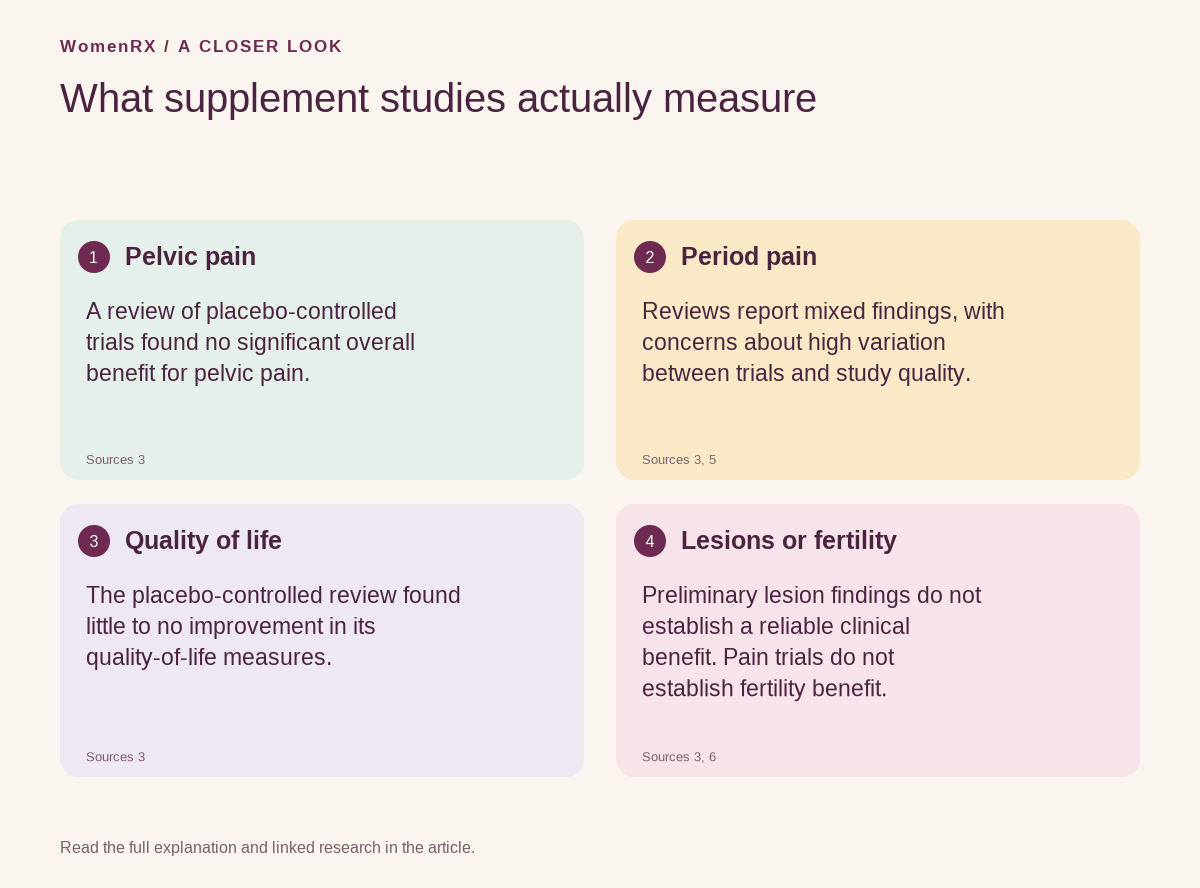
Pelvic pain: A review of placebo-controlled trials found no significant overall benefit for pelvic pain.3
Period pain: Reviews report mixed findings, with concerns about high variation between trials and study quality.35
Quality of life: The placebo-controlled review found little to no improvement in its quality-of-life measures.3
Lesions or fertility: Preliminary lesion findings do not establish a reliable clinical benefit. Pain trials do not establish fertility benefit.36
Read the figure as text
The evidence is more developed for pain than for broader claims about endometriosis. These distinctions help keep a product claim tied to the outcome studied.- Pelvic pain: A review of placebo-controlled trials found no significant overall benefit for pelvic pain.3
- Period pain: Reviews report mixed findings, with concerns about high variation between trials and study quality.35
- Quality of life: The placebo-controlled review found little to no improvement in its quality-of-life measures.3
- Lesions or fertility: Preliminary lesion findings do not establish a reliable clinical benefit. Pain trials do not establish fertility benefit.36
More questions, answered
Do supplements improve fertility in endometriosis?
Current research does not establish that supplements improve fertility. Pain studies cannot answer that question, and a critical review reports that professional societies do not recommend supplements for endometriosis-related infertility. 36
Can I take an endometriosis supplement with hormonal treatment?
The cited reviews do not establish specific interactions between individual supplements and medicines such as dienogest. Check the complete ingredient list against your treatment with a pharmacist or prescriber rather than assuming the combination is safe. If you’re pregnant or trying to conceive, mention that too. 26
Sources you can check
- Endometriosis - NHSAccessed 2026-09-25Return to first citation
- Pregnancy and Medicines | MedlinePlusAccessed 2026-09-25Return to first citation
- Dietary Supplements for Endometriosis-Associated Pain: A Systematic Review and Meta-Analysis of Randomized Placebo-Controlled Trials.Salmeri N, Ragusi A, Buffo C, Somigliana E, Viganò P, Vercellini P. · Gynecologic and obstetric investigation · 2026Return to first citation
- The Role of Dietary Supplements in the Management of Endometriosis-Related Symptoms: Current Evidence Based on a Systematic Review of Randomized Controlled Trials.Kırcalı-Haznedar N, Yıldız-Kopuz TN. · Gynecologic and obstetric investigation · 2026Return to first citation
- Effect of Dietary Interventions on Endometriosis: A Systematic Review and Meta-Analysis of Randomized Controlled Trials.Meneghetti JK, Pedrotti MT, Coimbra IM, da Cunha-Filho JSL. · Reproductive sciences (Thousand Oaks, Calif.) · 2024Return to first citation
- The Role of Dietary Supplements in the Treatment of Endometriosis: A Critical Review.Wójtowicz M, Małek P, Olszanecka-Glinianowicz M. · Nutrients · 2026Return to first citation