Iron Deficiency: What Symptoms and Blood Tests Can Tell You
Iron stores can run low before anemia appears, so symptoms or a normal blood count alone can’t settle the question.
Iron deficiency is usually assessed with blood tests, especially ferritin, which reflects stored iron, alongside a complete blood count that checks for anemia. A normal hemoglobin doesn’t rule out low iron stores, and symptoms such as fatigue aren’t specific enough to diagnose it. Ferritin needs context because inflammation can raise it; menstrual bleeding, pregnancy and possible causes of blood loss also matter. 1 2
Feeling unusually tired can make you wonder about iron, especially if your periods are heavy or you’re pregnant. But fatigue, shortness of breath and trouble concentrating can’t tell you on their own whether your iron is low. Diagnosis depends on blood tests interpreted together and in the context of your health and possible sources of iron loss. 1 2
Claim: “My symptoms prove I’m iron deficient”
What the tests can show: Symptoms can be a reason to get assessed, but they don’t establish the cause. Iron-deficiency anemia can cause fatigue, weakness, shortness of breath and difficulty concentrating, but these symptoms can have other explanations. Iron deficiency may also be present before anemia develops. 1 2
If symptoms are persistent, or you have a known risk such as heavy menstrual bleeding, ask about an assessment rather than trying to diagnose yourself from how you feel. Heavy periods increase the risk of iron deficiency because they involve blood loss. 1
Claim: “A normal blood count means my iron is fine”
What the tests can show: A complete blood count, including hemoglobin, can identify anemia, but it doesn’t measure iron stores directly. Iron depletion can happen in stages: stores may fall first, while hemoglobin remains in the usual range; anemia can develop later. 1
That’s why a normal hemoglobin result doesn’t necessarily rule out iron deficiency. Clinicians may check ferritin as well as the blood count, and may use additional measurements when the results or clinical context call for them. 1
Claim: “One ferritin cutoff works for everyone”
What the tests can show: Ferritin is a measure of stored iron. A low result can point to depleted stores, but the cutoff used to interpret it depends on the person and the clinical situation. The NIH Office of Dietary Supplements says a ferritin below 30 micrograms per liter suggests iron deficiency; that’s a useful reference point, not a stand-alone rule for every patient. 1
Inflammation can raise ferritin, which may make the result look less low than expected. If you have an inflammatory or chronic condition, a clinician may need to interpret ferritin alongside other findings rather than relying on one number. 1 3
Claim: “Iron deficiency and anemia are the same thing”
What the tests can show: They’re related, but not interchangeable. Iron deficiency means iron stores or supply are low. Iron-deficiency anemia means iron deficiency has also led to anemia, reflected in a low hemoglobin result. So it’s possible to have iron deficiency without anemia. 1
That distinction matters: a normal blood count may not answer whether iron stores are depleted, while a low hemoglobin result alone doesn’t establish that iron deficiency is the cause. Other conditions, including inflammation and deficiencies of other nutrients, can also contribute to anemia. 1
What menstrual bleeding and pregnancy change
Menstrual blood loss increases the amount of iron lost, and heavy periods are a recognized risk factor for iron deficiency. During pregnancy, iron needs rise as blood volume and red blood cell production expand. Pregnancy also changes how hemoglobin is interpreted, so results need to be considered in relation to the stage of pregnancy and the rest of the clinical picture. 1 3
If you’re pregnant, don’t use a general ferritin cutoff or a supplement label as a substitute for interpreting your results with your prenatal care team. Guidance and evidence about routine screening of pregnant people without symptoms have not been uniform; an individual’s symptoms and risk factors are a different situation from routine screening. 1 3
The cause matters as much as the result
If tests suggest iron deficiency, the next question is why. Menstrual blood loss is one possibility, but low intake, problems absorbing iron and blood loss from the digestive tract are others. Conditions such as celiac disease or inflammatory bowel disease can affect iron status, too. Identifying a likely cause helps shape what happens next. 1
Iron supplements can cause nausea, constipation and other digestive side effects, and excessive iron can be harmful. That’s one reason not to treat symptoms alone with iron: assessment can help establish whether iron is low and whether another issue needs attention. 1
A useful way to frame the conversation
If you seek assessment, share what symptoms you’ve noticed, whether your periods are heavy, whether you’re pregnant, and any relevant health conditions. Ask how your hemoglobin and ferritin fit together, whether inflammation could affect the ferritin result, and whether the results point toward a possible source of iron loss or poor absorption. Those details make the test results more useful than a single number on its own. 1 3
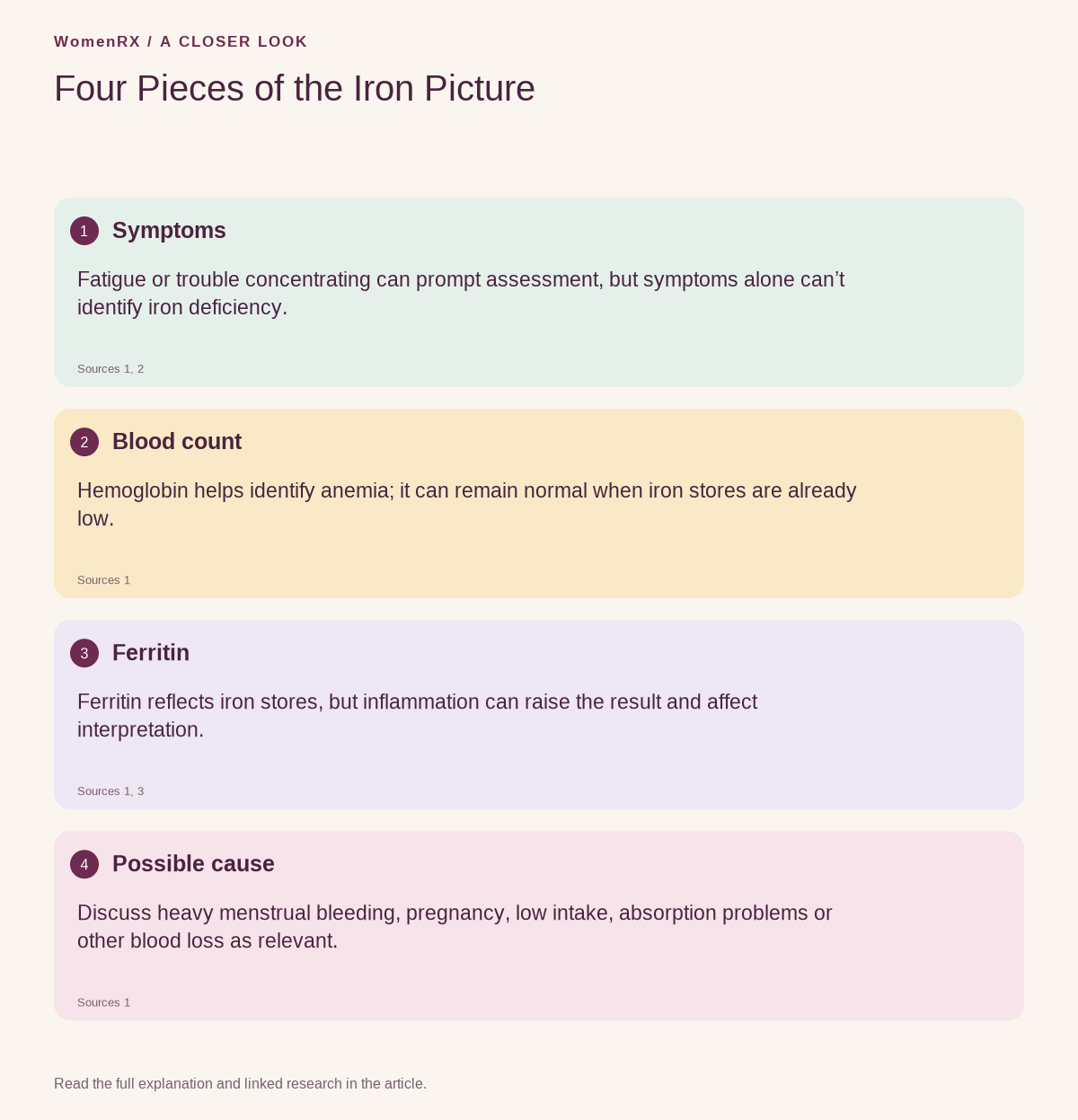
Four Pieces of the Iron Picture
Symptoms: Fatigue or trouble concentrating can prompt assessment, but symptoms alone can’t identify iron deficiency.12
Blood count: Hemoglobin helps identify anemia; it can remain normal when iron stores are already low.1
Ferritin: Ferritin reflects iron stores, but inflammation can raise the result and affect interpretation.13
Possible cause: Discuss heavy menstrual bleeding, pregnancy, low intake, absorption problems or other blood loss as relevant.1
Read the figure as text
Use these discussion points to connect symptoms and test results with possible reasons for low iron. They are not a self-diagnosis checklist.- Symptoms: Fatigue or trouble concentrating can prompt assessment, but symptoms alone can’t identify iron deficiency.12
- Blood count: Hemoglobin helps identify anemia; it can remain normal when iron stores are already low.1
- Ferritin: Ferritin reflects iron stores, but inflammation can raise the result and affect interpretation.13
- Possible cause: Discuss heavy menstrual bleeding, pregnancy, low intake, absorption problems or other blood loss as relevant.1
More questions, answered
Can ferritin be misleading?
It can be harder to interpret when inflammation or chronic illness is present because inflammation may raise ferritin. In that setting, ferritin may need to be considered alongside other test results and the clinical context. 1 3
Can you have iron deficiency without anemia?
Yes. Iron stores can be depleted before hemoglobin falls. That’s why a normal hemoglobin result alone doesn’t rule out iron deficiency. 1
Sources you can check
- Iron - Health Professional Fact SheetAccessed 2026-09-25Return to first citation
- Iron: MedlinePlusAccessed 2026-09-25Return to first citation
- Ferritin as a diagnostic point-of-care marker in iron deficiency anemia: a narrative review and clinical implications.Dimen JN, Sunoqrot M, Hobbs C, Cherayil E, Sharma D, Ahmadzia HK. · Annals of translational medicine · 2026Return to first citation