Iron Deficiency and Fertility: What the Evidence Says
Low iron deserves attention, especially with heavy periods or before pregnancy, but current research doesn’t show that iron supplements reliably improve fertility.
Iron deficiency is worth identifying and addressing for your health and pregnancy planning, but it isn’t established as a cause of infertility in every woman, and taking iron hasn’t been shown to reliably improve the chance of conception. Studies of pregnancy planners found inconsistent links between iron intake and time to pregnancy. One fertility-clinic study found better outcomes after iron treatment, but its before-and-after design can’t prove the treatment caused the change. 2 3
Iron and fertility are connected by a plausible question, but the evidence doesn’t yet give a simple answer. Low iron can be common during the menstruating years, and pregnancy raises iron needs. That makes it reasonable to ask about iron status when planning a pregnancy, especially if you have heavy periods. It doesn’t mean low iron is the explanation for fertility difficulties, or that iron supplements are a fertility treatment. 1
What fertility studies have found
A large prospective study followed pregnancy planners in Denmark and North America, tracking menstrual cycles until pregnancy or the end of follow-up. It found no consistent relationship between dietary iron and the chance of becoming pregnant in a given cycle. Iron-containing supplement use had a small positive association in the North American group, but not the Danish group. Stronger positive associations among people with heavy periods or short cycles appeared in the North American data, but not in the Danish data. These studies measured reported iron intake, not whether each participant had iron deficiency confirmed by blood tests. 3
A 2025 study offers a different, encouraging signal, but needs careful interpretation. It reviewed records for 292 women younger than 43 with infertility and low ferritin at one fertility clinic in Finland. All received an intravenous iron treatment. Comparing outcomes before and after treatment, the researchers found higher live-birth odds after treatment and lower miscarriage odds after treatment, even after statistical adjustment for some factors. Because this was a retrospective study without an untreated comparison group, it can’t establish that iron treatment caused the differences. It also doesn’t show that iron treatment improves fertility for women who aren’t iron deficient or who aren’t receiving fertility care. 2
Taken together, these studies support asking about iron when it may be relevant. They don’t establish that low iron routinely causes infertility, or that taking extra iron will help you conceive.
When testing may be worth discussing
Menstrual blood loss is one reason women can run low on iron. Heavy periods increase the risk of deficiency, and iron needs rise during pregnancy. If you’re trying to conceive and have heavy bleeding, a history of iron deficiency, or symptoms such as fatigue or weakness, those details can make iron testing a useful part of a conversation about your health. 1
Ask whether a complete blood count and ferritin are appropriate, rather than assuming a normal hemoglobin result rules out low iron. Hemoglobin is used to assess anemia, while ferritin gives information about iron stores and can fall before anemia develops. The NIH Office of Dietary Supplements says a ferritin below 30 micrograms per liter suggests iron deficiency; inflammation can raise ferritin, so a result may need to be interpreted alongside other information. 1
A practical question is: “Given my periods and pregnancy plans, would checking ferritin as well as a blood count make sense?” If a result does show deficiency, ask what might be causing it. Menstrual blood loss is one possibility; diet, problems absorbing iron, and other sources of blood loss can matter too. Finding the cause helps make the next step more useful than simply adding iron. 1
Deficiency matters for pregnancy, even apart from fertility
The reason to address iron deficiency before or during pregnancy isn’t a promise that it will improve conception. Iron supports red blood cell production, and iron needs increase during pregnancy as the mother’s blood volume and red-cell mass expand. Iron deficiency during pregnancy is associated with risks including premature birth and low birthweight. 1
Guidance about routine screening and preventive supplementation for pregnant people isn’t entirely uniform. The NIH fact sheet describes differing recommendations from professional and public-health groups, while also noting that iron deficiency anemia in pregnancy should be evaluated and treated. If you’re already pregnant, or planning to be soon, ask what testing or supplementation is appropriate for your circumstances. 1
Don’t treat a fertility question with iron alone
More iron isn’t automatically better. Iron supplements can cause stomach upset, nausea, or constipation, and taking iron without knowing whether you need it may not address the reason for fertility difficulties. If testing shows deficiency, discuss the cause and an appropriate treatment plan rather than choosing a high-dose supplement on your own. 1
The useful distinction is this: checking and treating confirmed iron deficiency can be part of caring for your health before pregnancy. Whether correcting low iron improves the odds of conception remains uncertain. If you’re having a fertility evaluation, bring up heavy periods, past low iron, and any recent blood-count or ferritin results, but don’t assume iron explains the whole picture.
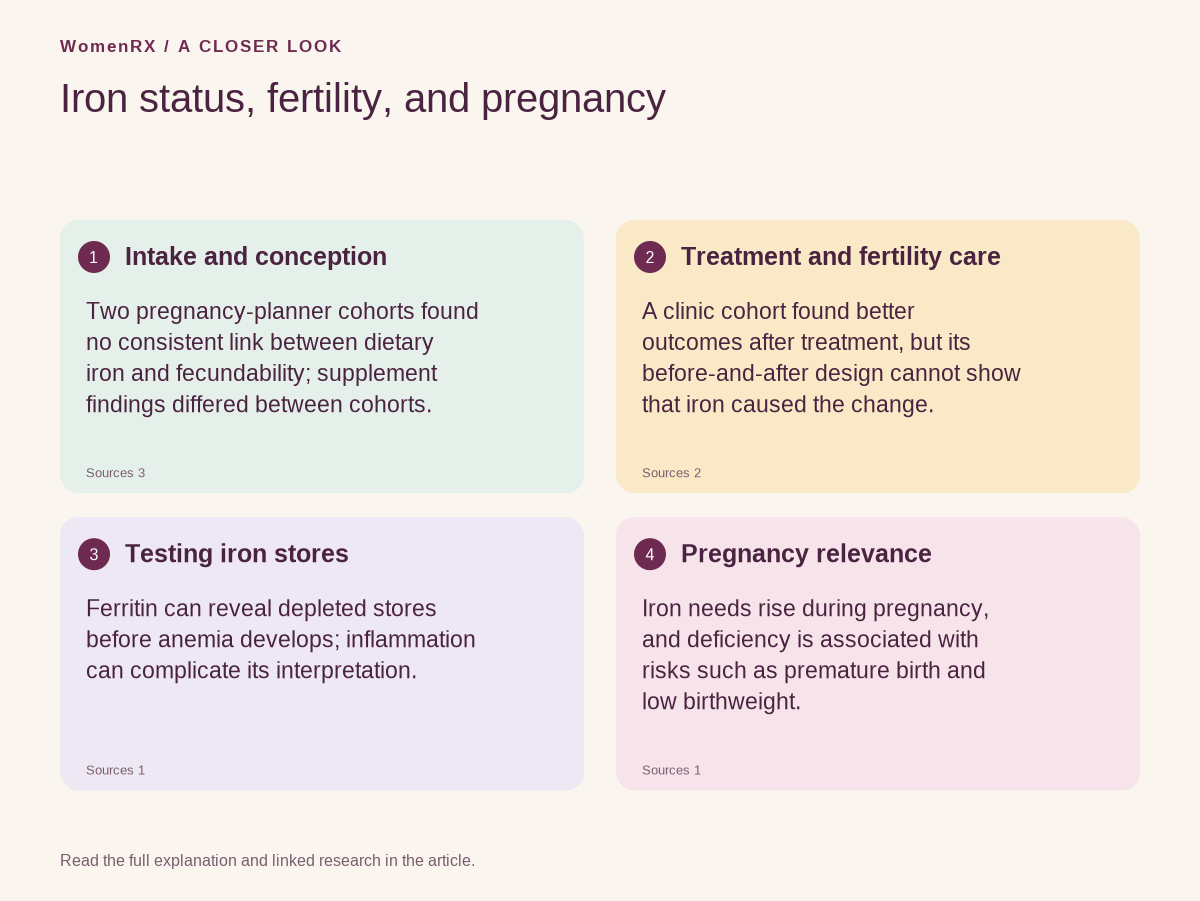
Iron status, fertility, and pregnancy
Intake and conception: Two pregnancy-planner cohorts found no consistent link between dietary iron and fecundability; supplement findings differed between cohorts.3
Treatment and fertility care: A clinic cohort found better outcomes after treatment, but its before-and-after design cannot show that iron caused the change.2
Testing iron stores: Ferritin can reveal depleted stores before anemia develops; inflammation can complicate its interpretation.1
Pregnancy relevance: Iron needs rise during pregnancy, and deficiency is associated with risks such as premature birth and low birthweight.1
Read the figure as text
These findings answer different questions: whether iron intake predicts conception, whether treatment was associated with outcomes in a selected fertility-clinic group, and why deficiency matters in pregnancy.- Intake and conception: Two pregnancy-planner cohorts found no consistent link between dietary iron and fecundability; supplement findings differed between cohorts.3
- Treatment and fertility care: A clinic cohort found better outcomes after treatment, but its before-and-after design cannot show that iron caused the change.2
- Testing iron stores: Ferritin can reveal depleted stores before anemia develops; inflammation can complicate its interpretation.1
- Pregnancy relevance: Iron needs rise during pregnancy, and deficiency is associated with risks such as premature birth and low birthweight.1
More questions, answered
Can I have low iron if my hemoglobin is normal?
Yes. Iron stores can be depleted before hemoglobin falls enough to indicate anemia. Ferritin helps assess iron stores, although inflammation can raise the result and affect interpretation. 1
Should I take iron to improve my chances of getting pregnant?
The evidence doesn’t support iron supplements as a reliable fertility treatment. If you may be deficient, ask about testing and the cause; treatment of confirmed deficiency is a separate question from whether it improves conception. 1 2 3
Sources you can check
- Iron - Health Professional Fact SheetAccessed 2026-09-25Return to first citation
- Association between iron deficiency and fertility.Tulenheimo-Silfvast A, Ruokolainen-Pursiainen L, Simberg N. · Acta obstetricia et gynecologica Scandinavica · 2025Return to first citation
- Iron Consumption Is Not Consistently Associated with Fecundability among North American and Danish Pregnancy Planners.Hahn KA, Wesselink AK, Wise LA, Mikkelsen EM, Cueto HT, Tucker KL, Vinceti M, Rothman KJ, Sorensen HT, Hatch EE. · The Journal of nutrition · 2019Return to first citation