Iron in Multivitamins: How to Check If You Need It
Compare the iron amount with your other supplements and life stage, but don’t use sex or age alone as proof that you need extra iron.
To compare iron-containing and iron-free multivitamins, find the iron amount per serving on each product’s Supplement Facts panel, then check how many pills make up a serving and whether other products you take also contain iron. Menstruation and pregnancy can affect iron needs, but neither confirms a deficiency. If you’re pregnant, have ongoing blood loss, or suspect deficiency, ask whether testing or a specific plan makes sense. 1 2 3
Start with what the label can tell you
Find “Iron” on the Supplement Facts panel and note the amount per serving. Check how many pills count as one serving, since the amount shown may not be for a single pill. Then look at the other vitamins or supplements you take, including a prenatal or a separate iron product. This label check helps you compare what you’d be taking; it can’t tell you whether your body needs more iron.
Iron is also found in foods, including meat, seafood, poultry, nuts, and some dried fruits, and is added to some fortified foods. Blood loss, diet, and trouble absorbing iron can all contribute to low iron. So the choice isn’t simply “women’s vitamin” versus “no iron.” Your overall diet, health history, and other products matter too. 1
Iron from overlapping supplements can add up. Too much iron can harm the body, and excess supplement use can cause symptoms such as constipation, nausea, vomiting, abdominal pain, or diarrhea. If two products both list iron, compare their amounts before adding them together. 1
Let life stage inform the question, not decide it
If you menstruate: Regular iron loss with menstruation can contribute to low iron, but having periods doesn’t mean you automatically need an iron-containing multivitamin. Diet and absorption also matter, and a label can’t diagnose deficiency. 1 3
If you’re pregnant: Iron demand rises during pregnancy. Check what’s in your prenatal rather than assuming another multivitamin is interchangeable. A randomized trial studied specific iron treatments in pregnant women already diagnosed with iron deficiency; it doesn’t show that every pregnant person needs the same product or that a routine multivitamin treats anemia. Ask your pregnancy care team what fits your situation. 2
If you’re postpartum: Blood loss is one possible reason iron stores may fall, but being postpartum alone doesn’t establish deficiency. If you had substantial blood loss or are concerned about possible low iron, ask whether testing would help guide your choice. 1
If you’re postmenopausal: Don’t assume that a product marketed to women is needed just because of your age or sex. Diet, blood loss, and absorption can still affect iron status. A history of bariatric surgery changes the context: surgery can affect absorption, and a study of people after gastric bypass found iron deficiency among premenopausal and postmenopausal women as well as men. That specific finding shouldn’t be generalized to everyone. 1 4
When a multivitamin isn’t a treatment plan
Iron deficiency may cause fatigue, shortness of breath, or trouble with memory and concentration, but those symptoms don’t confirm the cause. If you’re concerned, ask whether blood testing is appropriate before choosing an iron product. 1
If testing has found iron deficiency or anemia, don’t assume that an ordinary multivitamin will treat it. A multivitamin is a general supplement; treatment may call for a specific plan based on the finding and its cause. The pregnancy trial, for example, tested defined iron-containing regimens in women who already had iron deficiency, not routine multivitamins for everyone. 2
A quick label decision aid
- No known deficiency or specific reason for extra iron? Compare iron-containing and iron-free options, and consider your diet and other supplements.
- Already taking a prenatal, iron pill, or another product with iron? Check each serving amount to spot overlap before adding another product.
- Pregnant, experiencing ongoing blood loss, or concerned about symptoms? Ask whether testing or individualized guidance would help clarify the choice.
- Diagnosed with iron deficiency or anemia? Use a specific treatment plan rather than relying on a multivitamin label.
An iron-free option can help avoid adding iron when you don’t have a reason to do so. An iron-containing one may fit a particular need, but the label alone can’t establish that need. The useful first step is to know what’s in your routine, then decide whether you need more information before choosing.
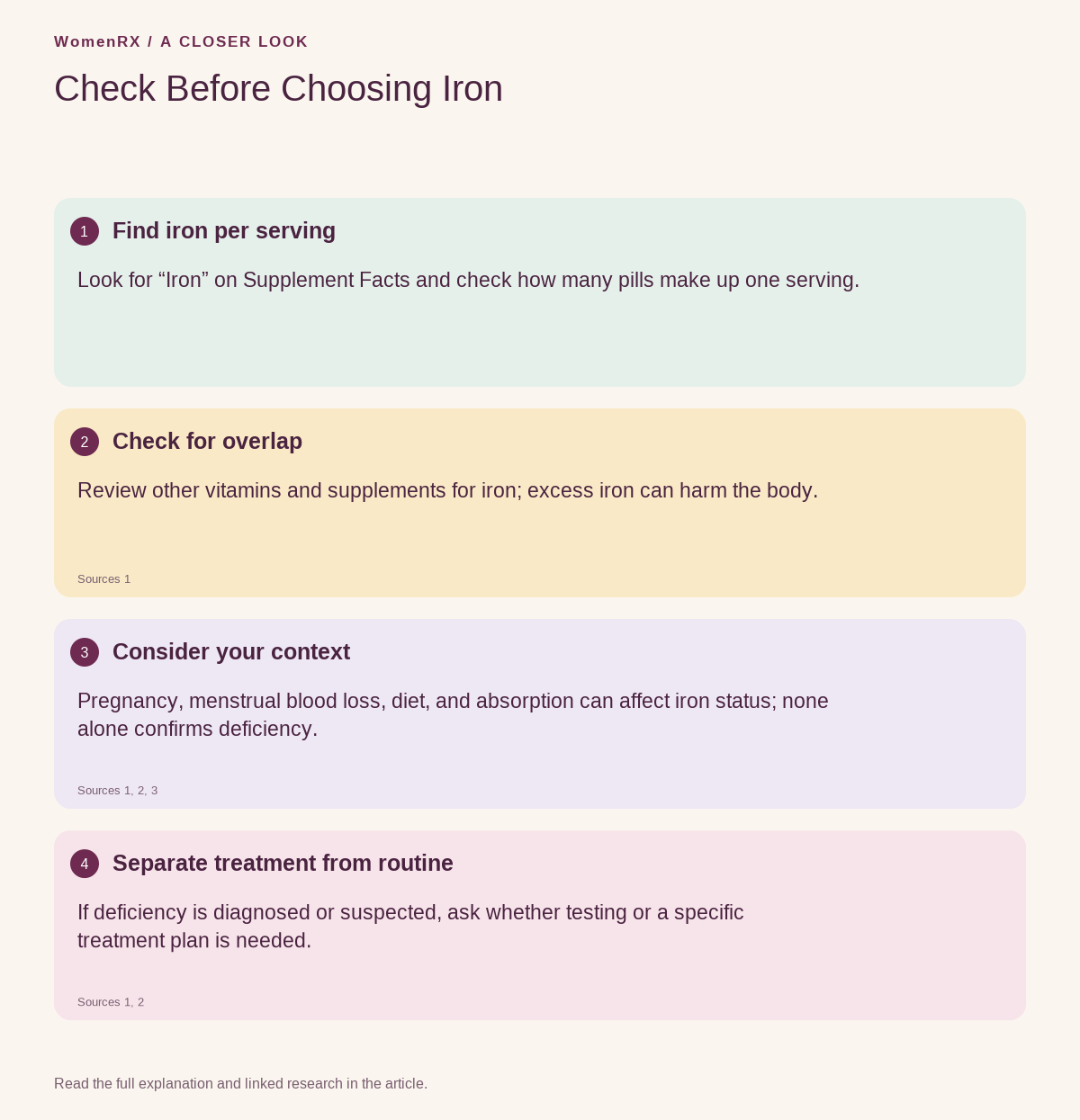
Check Before Choosing Iron
Find iron per serving: Look for “Iron” on Supplement Facts and check how many pills make up one serving.
Check for overlap: Review other vitamins and supplements for iron; excess iron can harm the body.1
Consider your context: Pregnancy, menstrual blood loss, diet, and absorption can affect iron status; none alone confirms deficiency.123
Separate treatment from routine: If deficiency is diagnosed or suspected, ask whether testing or a specific treatment plan is needed.12
Read the figure as text
Use these four checks to compare an iron-containing multivitamin with an iron-free option and spot when more than a label is needed.- Find iron per serving: Look for “Iron” on Supplement Facts and check how many pills make up one serving.
- Check for overlap: Review other vitamins and supplements for iron; excess iron can harm the body.1
- Consider your context: Pregnancy, menstrual blood loss, diet, and absorption can affect iron status; none alone confirms deficiency.123
- Separate treatment from routine: If deficiency is diagnosed or suspected, ask whether testing or a specific treatment plan is needed.12
More questions, answered
Can fatigue tell me I need an iron-containing multivitamin?
No. Fatigue can occur with iron deficiency, but it doesn’t identify the cause. If you’re concerned, ask whether testing would help before adding iron. 1
Does a standard multivitamin cover iron needs after bariatric surgery?
Not necessarily. Bariatric surgery can affect absorption, and a study of people after gastric bypass found iron deficiency in premenopausal and postmenopausal women and men. That population has specific needs, so don’t assume a standard multivitamin is enough. 4
Sources you can check
- Iron: MedlinePlusAccessed 2026-09-25Return to first citation
- Efficacy and Safety of Ferrous Bisglycinate and Folinic Acid in the Control of Iron Deficiency in Pregnant Women: A Randomized, Controlled Trial.Bumrungpert A, Pavadhgul P, Piromsawasdi T, Mozafari MR. · Nutrients · 2022Return to first citation
- Determinants of Serum Iron Profile in Non-Anemic Pregnant Women at Delivery: A Cross-Sectional Study at Baharloo Hospital (2022-2023) : Iron Deficiency Among Non-anemic Pregnant Women.Ghalandarpoor-Atta SN, Ghalandarpoor-Attar SM, Tayebi Tafreshi SMM, Ghorbani A. · Galen medical journal · 2025Return to first citation
- Iron Deficiency - Not Only a Premenopausal Topic After Bariatric Surgery?Kunst I, Krebs M, Dreschl B, Prager G, Meyer E, Kautzky-Willer A, Ranzenberger-Haider T. · Obesity surgery · 2021Return to first citation