Iron and Food: Finding a Routine You Can Tolerate
Iron may be absorbed better away from food, but taking it with a small meal can be a reasonable trade-off if an empty stomach makes you feel sick.
For ferrous sulfate, taking iron on an empty stomach may improve absorption. But if it causes nausea or stomach upset, its instructions allow taking it with or just after food. Follow your product’s directions and prescribed plan: ferrous sulfate guidance may not apply to every iron product, and timing with other medicines may need checking. 1 2 3
Start with the instructions for your iron product
For ferrous sulfate, the instructions described here favor an empty stomach, such as taking it before a meal or after some time has passed since eating. If it upsets your stomach, those same instructions allow taking it with or after food. This is product-specific guidance, so check the directions for your own iron product and follow any instructions from the person who prescribed it rather than changing the schedule on your own. 2
The reason for the trade-off is straightforward: food can change how much iron is absorbed, while taking iron without food can be harder on your stomach. Iron supplements can cause nausea, constipation, abdominal discomfort, and other digestive effects; taking iron with food may help minimize these problems. A routine you can manage may be more useful than repeatedly trying a fasting schedule that leaves you feeling unwell. If food seems necessary, ask whether that fits your prescribed plan. 1 3
What you take it with can matter
For ferrous sulfate, instructions advise avoiding tea, coffee, eggs, and dairy close to the dose because they can reduce how much iron gets into your system. The specific instructions give a two-hour gap for these foods and drinks. Check your own product directions rather than treating that timing as a rule for every iron product. Calcium supplements may also interfere with iron absorption, so NIH guidance suggests taking separate calcium and iron supplements at different times. 1 2
There’s direct evidence for one part of this: in a study of 34 iron-depleted women, researchers tested single iron doses under different conditions. Coffee reduced measured iron absorption compared with water, and coffee with breakfast reduced it even though the breakfast included vitamin C. In that study, vitamin C increased absorption compared with water, but a larger amount did not increase it further. These were short-term absorption results, not a test of long-term treatment success, and they don’t establish that everyone needs a vitamin C supplement. 4
Check medicine timing before you build a routine
Iron can affect some medicines, and some medicines can affect iron absorption. Iron taken at the same time as levothyroxine tablets can reduce levothyroxine absorption; product labeling cited by NIH advises against taking them within four hours of one another. Iron may also reduce absorption of levodopa. Ask a pharmacist or prescriber how to space your particular medicines rather than guessing at a gap. 1
Proton pump inhibitors, such as omeprazole, reduce stomach acidity and may reduce iron absorption. NIH notes that people with iron deficiency who take these medicines can have a suboptimal response to iron supplementation. Don’t stop a prescribed medicine to change iron absorption; ask whether the combination affects your plan. 1
A practical way to choose
If your product directions call for an empty stomach and you tolerate that routine, follow them. If it causes stomach upset, ask whether you can take it with a meal or snack, and check whether the meal includes something your product instructions say to separate from iron. If you take calcium, levothyroxine, levodopa, a proton pump inhibitor, or other regular medicines or supplements, ask a pharmacist to review the timing together. Keep the iron dose and schedule as prescribed while you clarify any changes. 1 2 3
Iron needs and the reason for treatment can change with life stage, but meal timing itself shouldn’t be assumed to differ by sex or menopause status. Menstrual blood loss can increase iron loss, and iron requirements rise during pregnancy. Menopause is another life-stage change, but the NIH reference values are age-based, not menopause-specific: they list 18 mg daily for women ages 19-50 and 8 mg for women 51 and older. These are intake reference values, not doses for treating iron deficiency. Your prescribed treatment plan is a separate matter. 1
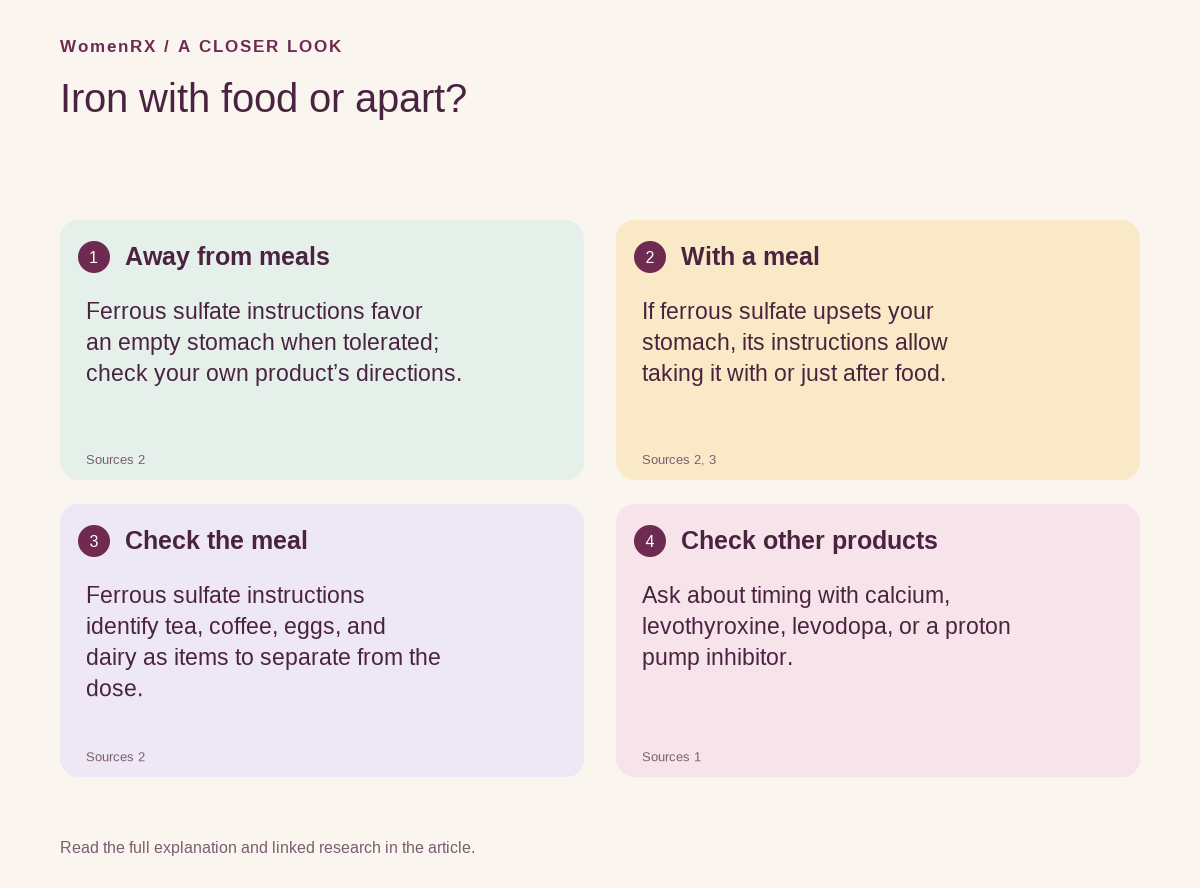
Iron with food or apart?
Away from meals: Ferrous sulfate instructions favor an empty stomach when tolerated; check your own product’s directions.2
With a meal: If ferrous sulfate upsets your stomach, its instructions allow taking it with or just after food.23
Check the meal: Ferrous sulfate instructions identify tea, coffee, eggs, and dairy as items to separate from the dose.2
Check other products: Ask about timing with calcium, levothyroxine, levodopa, or a proton pump inhibitor.1
Read the figure as text
Compare the ferrous sulfate food guidance with the practical questions of stomach tolerance and what else is in your routine.- Away from meals: Ferrous sulfate instructions favor an empty stomach when tolerated; check your own product’s directions.2
- With a meal: If ferrous sulfate upsets your stomach, its instructions allow taking it with or just after food.23
- Check the meal: Ferrous sulfate instructions identify tea, coffee, eggs, and dairy as items to separate from the dose.2
- Check other products: Ask about timing with calcium, levothyroxine, levodopa, or a proton pump inhibitor.1
More questions, answered
Does taking iron with food mean it won’t work?
No. Food can affect absorption, but ferrous sulfate instructions allow taking it with or after food if it upsets your stomach. Check the directions for your own product and follow your prescribed plan. 2
Should I take vitamin C with iron?
Vitamin C increased measured absorption in a single-dose study of iron-depleted women, but the study did not establish that a vitamin C supplement is needed for everyone or improves long-term treatment outcomes. Ask whether it belongs in your routine. 4
Sources you can check
- Iron - Health Professional Fact SheetAccessed 2026-09-25Return to first citation
- How and when to take ferrous sulfate - NHSAccessed 2026-09-25Return to first citation
- Side effects of ferrous sulfate - NHSAccessed 2026-09-25Return to first citation
- Effect of dietary factors and time of day on iron absorption from oral iron supplements in iron deficient women.von Siebenthal HK, Moretti D, Zimmermann MB, Stoffel NU. · American journal of hematology · 2023Return to first citation