When to Take Iron for Better Absorption and Comfort
Food can affect iron absorption, while taking a supplement with food may make stomach side effects easier to manage.
There isn’t one best time of day for everyone. What you eat can affect iron absorption, but the guidance here doesn’t set a general rule to take iron apart from meals. Taking it with food may help limit stomach side effects. Space iron from calcium supplements, and keep it at least four hours from levothyroxine tablets. If you’re pregnant or take levodopa, get advice for your specific schedule. 1
Choose the tradeoff you can live with
Food can affect how much iron is absorbed, depending on what you eat. Vitamin C and meat, poultry, or seafood can improve absorption of nonheme iron, while calcium and some compounds in grains and beans can interfere. These effects vary, and a typical mixed diet can soften their impact. Taking iron with food may help minimize gastrointestinal side effects. 1
So the practical choice is not “perfect absorption or no benefit.” Follow the directions for your specific product or prescription, and consider taking it with food if that makes it more tolerable. If you’re unsure whether a food or supplement needs to be kept apart from your dose, ask a pharmacist about that specific product rather than assuming every food has the same effect.
Space iron from a few specific medicines and supplements
Calcium supplements are best taken at a different time from iron supplements because calcium may interfere with absorption. The extent of that effect isn’t firmly established, and the NIH fact sheet doesn’t specify a required number of hours, so don’t treat a particular gap as a universal rule. 1
For levothyroxine tablets, the spacing is clearer: taking iron at the same time can reduce absorption of the thyroid medicine. Product labels advise against taking levothyroxine within four hours of an iron supplement. 1
Iron can also reduce absorption of levodopa, a medicine used for Parkinson’s disease and sometimes restless legs. The guidance doesn’t give a specific spacing interval for this interaction, so have a pharmacist or prescriber set a schedule that fits your medicine. Proton pump inhibitors, such as omeprazole, lower stomach acidity and may reduce iron absorption. If you take one and your iron status isn’t improving as expected, mention it when reviewing your treatment rather than stopping it on your own. 1
A sample spacing map
For example, if you take a levothyroxine tablet in the morning, put iron at least four hours away. Take a calcium supplement at another time of day. If iron is hard on your stomach, taking it with food may help; if you take levodopa or a proton pump inhibitor, have a pharmacist check the schedule and whether the medicine could affect your iron treatment. These are spacing principles, not a prescription for a particular clock time. 1
Pregnancy needs its own dosing context
Pregnancy changes the picture. Hepcidin generally falls as pregnancy progresses, and the needs and interpretation of iron tests also change. In a randomized trial of 135 nonanemic pregnant participants, iron-status markers changed during pregnancy across daily, alternate-day, and three-times-weekly regimens. The study doesn’t establish a single best timing plan for every pregnant person. Follow your prenatal or treatment plan rather than applying a nonpregnant dosing idea on your own. 2
Your iron needs change with life stage
The recommended daily intake is 18 mg for women ages 19 to 50, 27 mg during pregnancy, 9 mg during lactation for ages 19 to 50, and 8 mg from age 51 onward. These are total intake recommendations from food and supplements, not a dose to start taking as a pill. Heavy menstrual bleeding raises the risk of iron deficiency, but having periods by itself doesn’t establish that you need a supplement. 1
During pregnancy, recommendations about routine screening and supplementation for people without symptoms differ among organizations. Your prenatal clinician can tell you how your test results and pregnancy plan apply to you. The recommended intake of 8 mg per day applies from age 51 onward; it’s an age-based recommendation, not a menopause-specific rule. That doesn’t rule out deficiency. Iron tests can help identify low stores, and ferritin, a measure of stored iron, can be affected by inflammation. 1
The useful next step is to clarify whether you need iron and what schedule fits your medicines, rather than trying to solve an unconfirmed deficiency by changing the time of day you take a supplement.
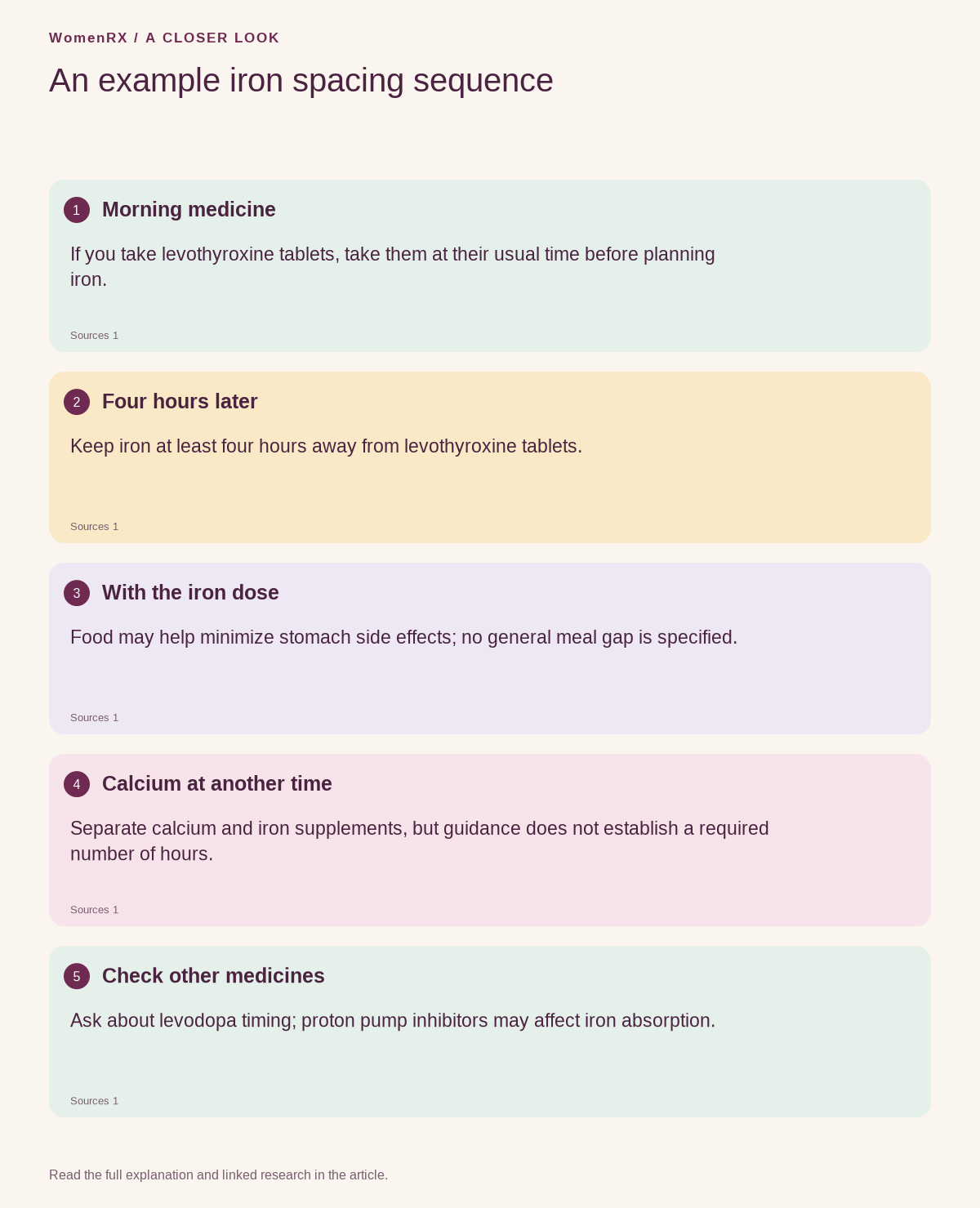
An example iron spacing sequence
Morning medicine: If you take levothyroxine tablets, take them at their usual time before planning iron.1
Four hours later: Keep iron at least four hours away from levothyroxine tablets.1
With the iron dose: Food may help minimize stomach side effects; no general meal gap is specified.1
Calcium at another time: Separate calcium and iron supplements, but guidance does not establish a required number of hours.1
Check other medicines: Ask about levodopa timing; proton pump inhibitors may affect iron absorption.1
Read the figure as text
This is an illustrative sequence, not a required clock-time plan: keep iron at least four hours from levothyroxine tablets, take calcium at another time without assuming a specific gap, and use food if it helps with stomach comfort.- Morning medicine: If you take levothyroxine tablets, take them at their usual time before planning iron.1
- Four hours later: Keep iron at least four hours away from levothyroxine tablets.1
- With the iron dose: Food may help minimize stomach side effects; no general meal gap is specified.1
- Calcium at another time: Separate calcium and iron supplements, but guidance does not establish a required number of hours.1
- Check other medicines: Ask about levodopa timing; proton pump inhibitors may affect iron absorption.1
More questions, answered
Can I take iron with a vitamin C supplement?
Vitamin C can improve absorption of nonheme iron, but the NIH guidance describes this as an effect on absorption, not a requirement to take a separate vitamin C pill with iron. 1
Does taking iron at night improve absorption?
The NIH fact sheet does not specify a preferred time of day. Choose a time that lets you follow your medicine-spacing instructions and tolerate the dose. 1
Sources you can check
- Iron - Health Professional Fact SheetAccessed 2026-09-25Return to first citation
- Impact of oral iron dosing regimens on iron biomarkers during pregnancy: insights from the PANDA trial.Haynes S, Armitage AE, Roy NBA, Morovat A, Drakesmith H, Churchill D, Stanworth SJ. · Blood advances · 2026Return to first citation